Categories
Breaking News

Giant Penguin Might Have Been Around With the Dinosaurs

history of the flightless seabirds. Situated in New Zealand’s Canterbury region, the fossil sites along the Waipara River have long been a vital resource to scientists for the abundance of avian fossils which became embedded in the sand just four million years after the dinosaurs went extinct. “Among the finds from these sites, the skeletons of Waimanu, the oldest known penguin to date, are of particular importance,” explained Dr. Gerald Mayr of the Senckenberg Research Institute in Frankfurt. Hugely significant is the fact the bones of the recently discovered giant penguin differ markedly from those of others from the same time period, suggesting there was much greater diversity among Paleocene penguins than previously assumed. In their study published in the Springer Journal Science of Nature, the team postulate that the newly discovered giant penguin fossil could point to the evolution of the birds having started much earlier than previously thought, perhaps even during the age of the dinosaurs. “What sets this fossil apart are the obvious differences compared to the previously known penguin remains from this period of geological history,” explained Mayr, an ornithologist from Frankfurt. “The leg bones we examined show that during its lifetime, the newly described penguin was significantly larger than its already described relatives. Moreover, it belongs to a species that is more closely related to penguins from later time periods.” Although impressive with its 1.5 metre length, the newly described giant penguin was still not as big as Anthropornis nordenskjoeld, the largest penguin fossil ever discovered, which lived on the Antarctic coast between 45 and 33 million years ago. Evidence has been found suggesting A.nordenskjoeld could reach heights of up to two metres from beak to toe. According to Mayr, it’s highly significant that the newly discovered penguin is much older than A.nordenskjoeld. “This shows that penguins reached an enormous size quite early in their evolutionary history, around 60 million years ago”. The team believe that the newly discovered species would have already adopted the unique, waddling gait which characterises modern penguins. This is something which would have distinguished it from other, more primitive species in the genus Waimanu – a genus of early penguin which lived during the Early Paleocene. “The discoveries show that penguin diversity in the early Paleocene was clearly higher than we previously assumed,” concluded Mayr, adding, “In turn, this diversity indicates that the first representatives of penguins already arose during the age of dinosaurs, more than 65 million years ago.” Image courtesy of Senckenberg Gesellschaft für Naturforschung (Senckenberg Nature Research Society) The newly published study is available from Sprnger Nature ]]>

Categories
Breaking News

Penguin Brains Were Unaffected By Loss of Flight

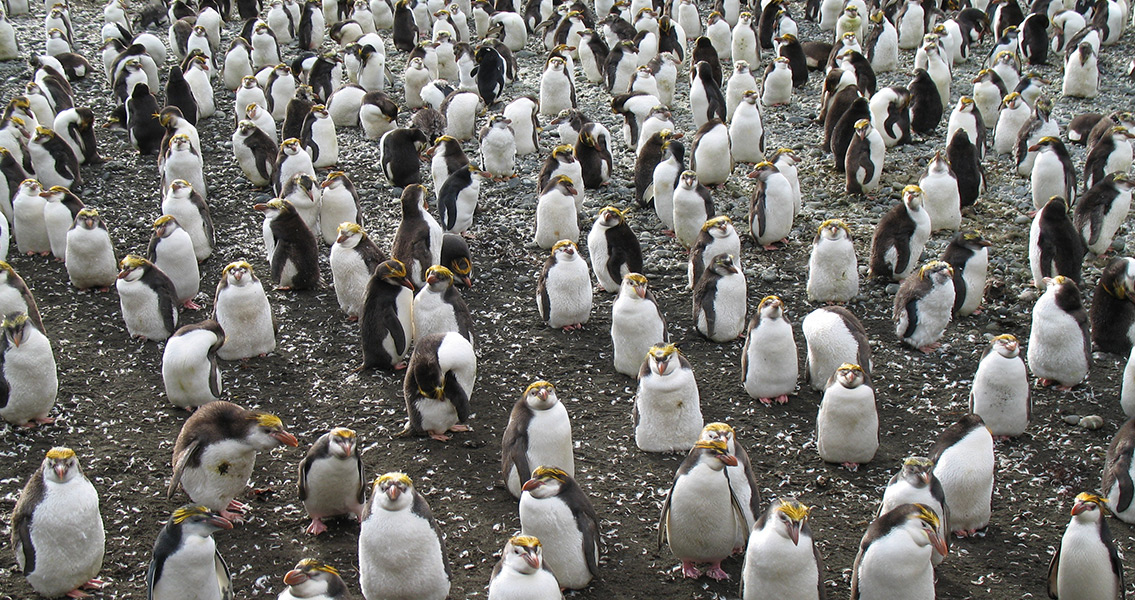
Journal of Anatomy. Researchers from the University of Texas at Austin argue that although the loss of flight was responsible for modern penguins’ unique way of walking, it didn’t cause any major changes in the animals’ brain structure. The conclusions have been reached following examination of the skull of the world’s oldest known penguin fossil, from the mid to late Paleocene era in New Zealand. “What this seems to indicate is that becoming larger, losing flight and becoming a wing-propelled diver does not necessarily change the [brain] anatomy quickly,” said James Proffitt, a graduate student at University of Texas’ Jackson School of Geosciences and the leader of the research, in a press release from the University of Texas. Despite modern penguins exhibiting a unique brain, one remarkably different from those of their ancestors, these changes didn’t take place until long after the birds had evolved away from flying. “The way the modern penguin brain looks doesn’t show up until millions and millions of years later.” Proffitt explained. The 60 million year old penguin whose remains were used in the study was likely to have lived a life very similar to modern penguins. Its age, and its position in the line of penguin evolution meant it provided invaluable insights for the study. “It’s the oldest [penguin] following pretty closely after the loss of flight and the evolution of flightless wing-propelled diving that we know of”, Proffitt said. Exactly why penguins evolved to not fly is a mystery that plagued scientists for centuries. It seems massively impractical, Emperor penguins for example, have to walk distances of up to 60km from their rookeries to the sea, a journey which takes several days but could be achieved in a matter of days if the birds flew. Similarly, many penguins are the target of predators such as leopard seals at the point they enter the ocean – a problem which could be avoided if they were able to fly. A 2013 study by scientists from the University of Aberdeen used comparisons with Guillemots to conclude that there is no way for a bird to develop wings which are good for both flying and swimming. According to the scientists, as penguin wings evolved to make them better swimmers, the amount of energy they needed for flying became too great. Proffitt and his partners on the latest study, Julia Clarke; a professor in the Jackson School’s Department of Geological Sciences, and Paul Scofield; the senior curator of Natural History at the Canterbury Museum in Christchurch, New Zealand, assumed that the loss of flight would have impacted brain structure, making the brains of ancient and modern penguins similar in certain regions. Due to the fact the shape of a bird’s skull is influenced by the structure of its brain, the team were able to use X-ray CT scanning to capture digitally the minute details of the penguin skull’s anatomy before applying computer modelling software to form a digital mold of the brain, called an endocast. Their results showed that in reality the ancient penguin’s brain anatomy had more in common with petrels and loons than modern penguins. If the peculiarities of penguin brain structure were a consequence of its initial loss of flight, the changes would have been apparent in the Paleocene skull. Similarities between the ancient penguin and modern diving birds suggest that the actual act of diving could be responsible for the differences in brain structure. “The question now is do the old fossil penguins’ brains look that way because that’s the way their ancestors looked, or does it have something maybe to do with diving?” Proffitt said, in the press release. For more information: www.wileyonlinelibrary.com]]>

Categories
Breaking News

Prehistoric Penguins Found That Were as Large as Humans

Categories
Breaking News

The Great Auk Bone Excavated

Bone from the Extinct Great Auk Unearthed at the Scottish Seabird Center An upper arm bone of the extinct Great Auk, also known as Scotland’s Dodo, was unearthed in an archeological dig at the Scottish Seabird Center at a location called the Kirk Ness site. Archaeologists were excavating the grounds of the Scottish Seabird Center when they uncovered this invaluable piece of bone fragment of the Great Auk, also known as Scotland’s Dodo. The archaeological dig, led by Addyman Archeology and supported by Historic Scotland, uncovered a number of invaluable animal bones belonging to the mid-18th century, in addition to the bone of the Great Auk. This bone fragment was, reportedly, unearthed near the entrance area of an old building. The Great Auk, also called as Scotland’s Dodo, was a flightless, Penguin-like bird. The meter-tall bird, while extant, had a range that extended from north-eastern United States all the way across the Atlantic, and covered the British Isles and Northern parts of Spain and France. As the bird could not fly, it was an easy target for hunting. Moreover, it was a staple food of people in the Middle Ages, both because of its inability to fly and its availability in abundance. However, the Great Auk started experiencing a severe decline in its population because of massive hunting, until it finally became completely extinct by the middle of the 19th century. The bird was last seen on St. Kilda British Waters in 1840. The Great Auks largely bred on the rocky and remote islands present in the Atlantic Ocean region. Since these islands provided great access to food, these birds flourished. The birds were also found on the coasts of Iceland, Greenland and Canada, and as far as the British and Norwegian coastlines. Mr. Tom Brock, Chief Executive of the Scottish Seabird Center said, “The discovery of the Great Auk bone on site at the Scottish Seabird Centre is fascinating but also very sad.We are so fortunate in Scotland to have a rich variety of seabirds and we must use the extinction of the Great Auk as a warning to future generations to look after our wonderful wildlife and the marine environment as an absolute priority.” Mr. Brock also said, “There are both behavioral and environmental lessons that must be taken from this internationally-important finding, and as an educational and conservation charity we will remain dedicated to inspiring people to enjoy, protect and learn about wildlife and the natural environment.” Although this excavation sheds light on the Great Auk and endangered wildlife, it is also believed be able to provide better insights into human society during the Middle Ages. Remains of various domestic buildings, in addition to the remnants of daily life at North Berwick, manage to provide us with a limited but encouraging glimpse of the way in which people and wildlife of East Lothian had been at that time. It will also help us gain a sounder understanding of extinction as a phenomenon, and help us make better decisions regarding our present-day environmental scenarios. Mr. Todd Addyman, of Addyman Archeology, said, “The discovery of the Great Auk bone at Kirk Ness is an illuminating find, as we seek to understand and document the importance of the area in the history of wildlife and human habitation in the Middle Ages. We hope that its discovery helps historians and conservation experts, such as the Scottish Seabird Centre, to educate future generations about the precious nature of our natural resources.” Senior Archeology manager of Historic Scotland, Mr. Rod McCullagh, said, “In the last two decades, there has been a renaissance in our understanding of the archaeology and history of early Medieval Scotland. The discovery of the remains of domestic buildings and the associated detritus of daily life at Kirk Ness gives us a glimpse of what ordinary life was like in East Lothian at this time. That ‘daily life’ involved the killing of such valuable birds as the Great Auk is no surprise but the discovery of this single bone perhaps attests to a time when hunting did not overwhelm such a vulnerable species.” ]]>