Categories
Breaking News

Easter Island's society: far more collaborative than we thought

Credit: Wikimedia Commons[/caption]

The Easter Island heads: secrets spilled

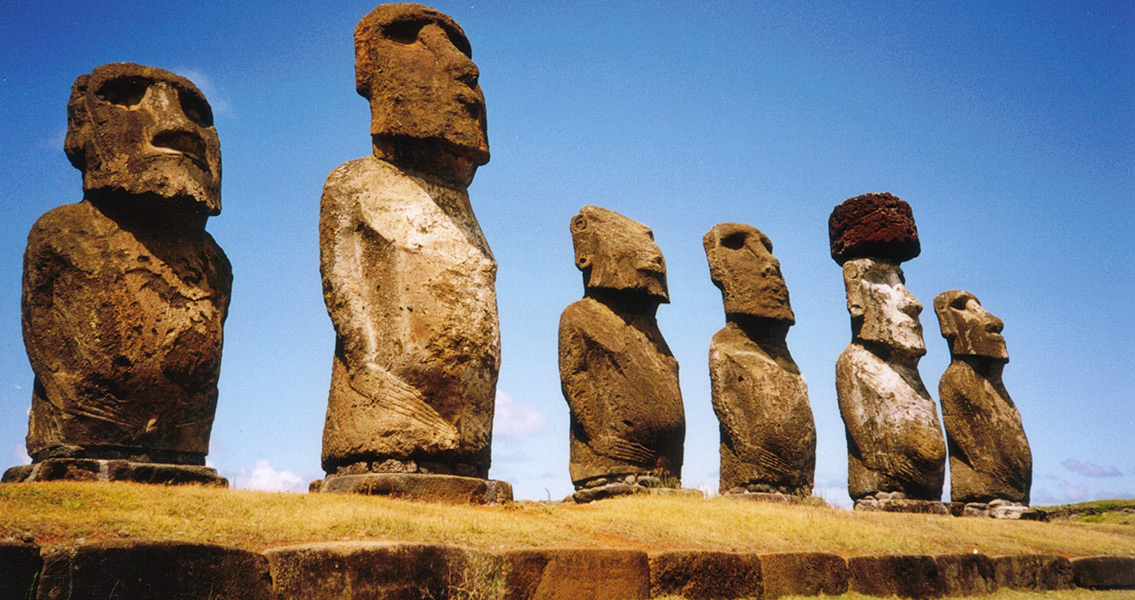
Field Museum scientist Laure Dussubieux was one of the study’s authors. “For a long time, people wondered about the culture behind these very important statues,” she says. “This study shows how people were interacting, it’s helping to revise the theory.” Lead author Dale Simpson Jr., an archaeologist from the University of Queensland adds: “The idea of competition and collapse on Easter Island might be overstated… To me, the stone carving industry is solid evidence that there was cooperation among families and craft groups.” [caption id="attachment_8696" align="aligncenter" width="800"] Credit: Bjørn Christian Tørrissen via Wikimedia Commons[/caption]

The history of Easter Island

People first arrived on Easter Island around 900 years ago. The society was later scourged by colonists and slavers, but the Rapa Nui culture has persisted. According to oral tradition, the founding population was two canoes led by the island’s first chief. Over the years, the population rose to reach a number of many thousands, making up the complex society that carved the famous Easter Island statues, or moai. Easter_Island_c1880

Sociopolitical organisation

Although the moai are colloquially known as ‘the Easter Island heads,’ they are actually full-body figures that have been part-buried over time. There are nearly a thousand of the statues, with the largest standing at 70 ft tall. “Ancient Rapa Nui had chiefs, priests, and guilds of workers who fished, farmed, and made the moai. There was a certain level of sociopolitical organisation that was needed to carve almost a thousand statues,” says Simpson.

Rapa Nui excavation

Recent excavations of four statues were conducted by Jo Anne Van Tilburg of Cotsen Institute of Archaeology, UCLA and director of the Easter Island Statue Project, along with her Rapa Nui excavation team. Van Tilburg worked with Simpson and Dussubieux to analyse 21 of roughly 1,600 stone tools discovered in the excavations. Around half were fragments that suggested how they were used, giving us a better understanding of the society that erected the statues. Easter Island Maori

The Easter Island production industry

For Van Tilburg, the goal of the project was to gain a better understanding of how tool makers and statue carvers may have interacted, thus gaining insight into how the statue production industry functioned. Dussubieux explains: “We wanted to figure out where the raw materials used to manufacture the artefacts came from… We wanted to know if people were taking material from close to where they lived.” The results pointed to a society that involved consistent collaboration. “The majority of the [tools] came from one quarry complex–once the people found the quarry they liked, they stayed with it,” says Simpson. “For everyone to be using one type of stone, I believe they had to collaborate. That’s why they were so successful–they were working together.” Easter Island
An interactive society from day one

This level of large-scale cooperation flies in the face of the popular narrative that Easter Island’s inhabitants warred themselves into extinction after running out of resources. Van Tilburg urges caution in interpreting the study’s results. “The near exclusive use of one quarry to produce these seventeen tools supports a view of craft specialization based on information exchange, but we can’t know at this stage if the interaction was collaborative. It may also have been coercive in some way. Human behaviour is complex. This study encourages further mapping and stone sourcing, and our excavations continue to shed new light on moai carving.” Simpson says: “There’s so much mystery around Easter Island because it’s so isolated, but on the island, people were, and still are, interacting in huge amounts.”]]>

Categories
Breaking News Editorial

What is Taira rock art, and what does it tell us about ancient desert culture in Chile?

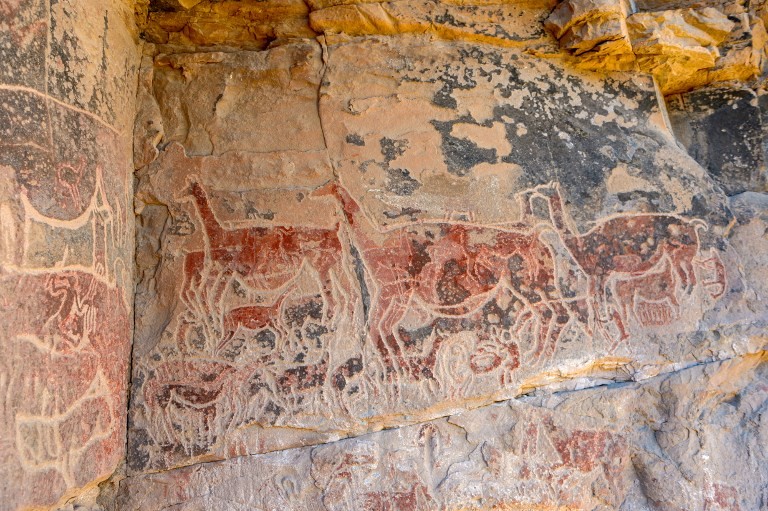
What does the Taira rock art depict? Roughly 90% of the artworks focus on llamas. Some are pregnant, others are suckling their young; and all represent life. The other 10% of the engravings depict the diversity of the desert, with foxes, snakes, ostriches, partridges and dogs featuring in scenes. Human figures are few and far between, and always drawn small. Archaeologists have posited that it is as if painting them small represents just how important desert animals were to their culture and economy. [caption id="attachment_8867" align="aligncenter" width="500"]
View of drawings at the Taira Cave in Chile, located at a height of 3,150 meters, on July 21, 2018. The paintings left by shepherds almost three millennia ago on the walls of the rocks that flank the course of the Loa River. Credit: AFP Martin Bernetti.[/caption]

The role of llamas in ancient desert culture

Archaeologist and curator at Santiago’s Museum of Pre-Colombian Art, Jose Bereguer, says that Taira art is ‘a celebration of life’. First rediscovered by Swedish archaeologist Stif Ryden in 1944, the gallery has been dated to c.400-800 BCE. 16 paintings remain, sitting 3,000 metres above sea level on the banks of the Loa River that traverses the desert. [caption id="attachment_8866" align="aligncenter" width="670"] Archaeologist Jose Bereguer, above, curator at Santiago’s Museum of Pre-Columbian Art, describes the site as “the most complex in South America” because of its astronomical importance as well as the significance to local shepherds. Credit: AFP Martin Bernetti[/caption] Previous studies tell us that the rock art was created by shepherds, who were pleading with the ‘deities that governed the skies and the earth’ to allow their llama flocks to flourish. The Alero Taira drawings, which were created in a natural shelter 30 metres away from the Loa River, give us deeper insight into the role of llamas in ancient desert culture. More than just the lead source of wealth for people inhabiting the desert, the llama was a symbolic creature used in ritual ceremonies throughout the Andes for thousands of years. The ‘Wilancha’, for instance, sees llamas given as sacrifice to ‘Pacha Mama’ (Mother Earth). Volcanoes, like springs, were considered deities by the Atacama natives, while llamas were thought to have been born of springs. Berenguer says: “No one can understand the things done 18,000 years ago because the cultures that did them have disappeared. Here, it’s possible to delve into the meaning because we have ethnography and because there are still people living in practically the same way as in the past.”

Lasting significance for indigenous peoples

The Rumualda Galleguillos is one of roughly 15 indigenous peoples that still raises llamas in the Atacama Desert. Just like their forefathers, it’s a matter of tradition and a way of life. To the Rumualda Galleguillos, these pictures are a ‘testament’ to their ancestors who did not read or write.

UNESCO plans

Now, conservationists want UNESCO to officially recognise the Taira Valley rock art as a heritage site, which will allow them to develop sustainable tourism for the region – similar to Spain’s Cave of Altamira of France’s Lascaux caves.]]>

Categories
Editorial

Why Are So Many Flags Red, White and Blue? (Part Two)

first part of this article looked at the history of the flags of the Netherlands, the UK and France; but the prevalence of red, white and blue flags goes way beyond western Europe. On 14th June, 1777, the US flag was born in a resolution by the Marine Committee of the Second Continental Congress. “Resolved, that the flag of the United States be thirteen stripes, alternate red and white; that the union be thirteen stars, white in a blue field representing a new constellation.” The basis of the stars and stripes was born, although additional stars would be added as the USA expanded. An explanation for the decision to make the flag red, white and blue can be found in events a year earlier. The country’s great seal, also coloured red, white and blue, had been designed to reflect the beliefs of the Founding Fathers. It is therefore unsurprising that those same colours found themselves in the flag of the USA. Charles Thomson, Secretary of the Continental Congress, explained the meaning of the colours when he presented the seal to Congress. “White signifies purity and innocence. Red, hardiness & valour, and Blue… signifies vigilance, perseverance & justice.” Significantly, some historians have suggested that the colours were chosen because of their presence in the British flag. Despite having just won the war of independence, the US flag still reflected the heritage of many of the Founding Fathers. On the other side of the world these same colours had also started to be used in Russia, and then elsewhere in Eastern Europe. Again, the process was a combination of specific regional histories, external influences and coincidences. The origins of the Russian flag of horizontal white, blue and red stripes dates back to the seventeenth century. Tsar Peter the Great chose the design for Russia’s merchant ships, inspired by the Dutch design after a visit to the Netherlands. The flag became a poignant symbol for the Russian people, the colours taking on symbolic meanings, and by the late nineteenth century it was the flag of the country despite attempts by the Tsars to impose a black, orange and white tricolor as Russia’s symbol. The 1848 Pan Slavic Congress saw these colours spread throughout Eastern Europe. The meeting, held in Prague between representatives from all Slavic populations, was carried out as an act of defiance against growing German and Hungarian nationalism. Among the meeting’s outcomes was the declaration of red, white and blue as the colours of the Slavic peoples. Some historians say that this decision was inspired by the French flag, the members of the Congress drawing a link between their cause and the French Revolution. Others argue the colours were chosen in reference to the Russian flag, reflecting the belief that Russia could protect and foster Slavic nationalist movements. Whatever the case, following the Congress different nationalist groups such as Slovenians, Slovakians and Croatians started to use the colours on their flags, and they have stayed prominent into the twenty first century. Countless other examples of red, white and blue flags exist, in Chile for instance, or Thailand. Sometimes this can be explained by specific local circumstances – in Chile the blue stands for the sky, the white for the snow capped Andes and the red for the blood of the citizens who fell in the struggle for Independence. In other instances global events were at play – the blue in the Thai flag was added deliberately in 1917 to reflect the flags of its allies in World War One: Britain, France, Russia and the USA. Each of the examples mentioned, from the Netherlands to Chile, have their own story behind the use of red, white and blue in their national flags. Although there are of course some connections between the decisions, there are also examples which can only be explained by chance and circumstance. What is perhaps most striking however, is the multitude of meanings the three colours have come to hold, as history has seen red, white and blue weaved into countless different narratives of cultural identity and association. ]]>

Categories
Breaking News

Hair Analysis of Chile Mummy Reveals Low-Stress Life

Categories
Breaking News

Evidence of the First Americans Found in Chile

Categories
News

CIA Nemesis Allende Elected In Chile

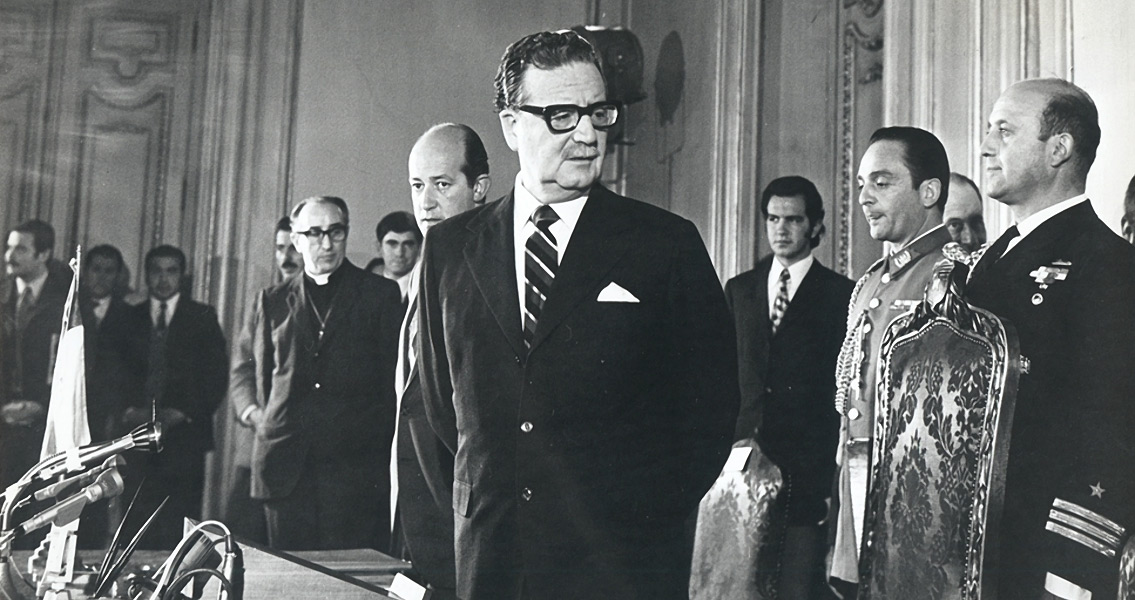
involved in South American politics. To this day, documents are still classified about what actions the White House sanctioned in Chile as a means to remove Allende. Although not actively leading the coup which removed Allende, it is increasingly apparent that the CIA did everything within its power to support resistance to Allende, and destabilise his government. Born into a middle class family in 1908 in Valparaíso, Chile, Allende studied medicine at university, where he also started to campaign as a marxist activist. In 1933 he helped found Chile’s Socialist Party, and four years later was elected to the country’s Chamber of Deputies for the first time. Over the next few years Allende’s political career flourished. From 1939 until 1942 he served as Chile’s health minister, while in 1945 he was elected to the Chilean senate for the first time. Prior to his 1970 election, Allende had run for the country’s presidency three times. His first attempt, in 1952, was blighted by his temporary expulsion from the Socialist Party, and he eventually came in fourth place in the contest. A second attempt, in 1958, was much more successful. Supported by both Chile’s Socialist and Communist parties, Allende finished a close second to the eventual winner, the Liberal-Conservative Jorge Alessandri. Allende’s third campaign, in the 1964 presidential election, marked the start of a major CIA initiative to prevent Socialism gaining power in Chile. The US intelligence agency underwrote more than half of the campaign of Allende’s main opponents, the Christian Democratic Party. Alongside funding the opposition, the CIA launched a propaganda campaign, using the press, radio, posters and films to denounce Socialism, and warn Chileans that a victory for Allende would lead to Soviet Union style brutality and dictatorship taking hold in Chile. Unsurprisingly, Allende’s opponent Eduardo Frei won the election comfortably. In 1970 the CIA again launched a massive campaign to aid Allende’s opponents and prevent him coming to power. This time the initiative proved less successful and Allende won 36% of the vote, placing him first out of the four candidates, although lacking a clear majority. Inaugurated on 3rd November, 1970, Allende soon set about reforming Chile’s society and economy along socialist lines. The Chilean government expropriated US owned copper mines in the country without offering any compensation. Nationalisation also extended to the country’s banks and other industries, while wages were increased by 40%, with businesses prohibited from increasing their prices. Over three years, these aggressive policies caused mounting controversy. Hyperinflation struck Chile, while accusations were made that Allende was circumventing the Chilean Congress, turning the country into the kind of autocracy seen in Cuba, or the Eastern Bloc of Europe. Considering Allende a dangerous force in South America, one accused of supporting more extremist political groups around the continent, the United States began to make attempts to destabilise his government. In 1970, President Richard Nixon had told his foreign secretary Henry Kissinger to facilitate a coup against Allende, a fact backed up by a CIA documented released several years later which claimed “It is firm and continuing policy that Allende be overthrown by a coup”. The United States attempted to set the conditions for an insurrection against Allende’s government in two ways, firstly by destabilising the country’s economy by cutting aid agreements, and secondly by actively looking for military leaders who could be persuaded to launch a coup. On 11th September, 1973, the US plan finally came to fruition. With the Chilean economy in crisis, a fact triggered by both internal and external factors, General Augusto Pinochet finally completed his coup, and Allende committed suicide to avoid capture. Although documents released since have revealed substantial US involvement in affairs in Chile in the early 1970s, the organisation was cleared of directly sponsoring Pinochet’s coup. Rather, the Church Committee investigation of 1975 concluded that they had created the conditions where Pinochet felt a coup could be successful. Democratically elected, Allende’s government was targeted by the United State’s for its socialist policies. Its successor, the dictatorship of Pinochet, was much more conservative, and allowed US investment back into Chile. It was also notorious for its brutal human rights violations. ]]>

Categories
Editorial

The USA and Latin America: A History of Meddling?

Argentina that the US is continuing to meddle in their countries’ affairs. On the one hand, the US President is claiming that the USA’s interference in Latin American is over, while on the other the leaders of two countries in the region have both accused the US of meddling in their affairs within the last month. This continued controversy reveals the at times bitter history of the relationship between the United States and Latin America. European Conquest of the Americas The background of any analysis of the history of US intervention in Latin America has to be the conquest of the Americas by the European Powers in the fifteenth and sixteenth centuries. Eduardo Galeano argued in his book ‘Open Veins of Latin America’ that the conquest of South America by the Portuguese and Spanish Empires set in place a pattern of domination that has continued into the present, with the only change being which ‘imperial’ power received the benefit of this domination. On this basis, the United States has taken control of the benefits of the economic exploitation of Latin America started by the Spanish Conquistadors. Galeano’s description of political economy and exploitation in his book, first published in the 1970s, is of course controversial, but even if one disagrees with the arguments about exploitation, the connections it draws between the Old European Powers and the United States in terms of relationships with South America can provide a useful framework for studying the history of the continent. Within a hundred years of Columbus’ first discovering America, most of the New World was under the control of the Spanish and Portuguese Empires. Whole civilisations had been wiped out, and the resources of the Americas were being expolited to form the basis of Spanish and Portuguese imperial success. Years later, other European powers, and in particular Great Britain, France and Holland, began to try to take advantage of the riches offered in the New World. Acts of piracy, as well as attacks on Spanish colonies, took place in an attempt to secure control of the riches offered in South America and the Caribbean. The key fact is that from the moment of discovery, the Americas were often treated as an economic resource to fight over. The Monroe Doctrine On 2nd December, 1823, President James Monroe announced in his annual message to Congress that “The American continents … are henceforth not to be considered as subjects for future colonization by any European powers.” The declaration, issued in response to a territory dispute with Russia, came to be known as the Monroe Doctrine and has become a defining moment in the development of US Foreign Policy. A bigger concern behind the doctrine was the decline of Spanish authoirity in South America. As revolution against Spanish rule spread throughout the South American colonies, the United States wished to prevent France, Spain, and other European powers attempting to re-exert their influence in the region. The Monroe Doctrine was a means to guarantee mercantile freedom for the United States in Latin America and the Caribbean, bringing to an end the threat of a return of the strict trade laws associated with the Spanish Empire. The Roosevelt Corrollary An extension to the Monroe Doctrine, Roosevelt’s Corollary declared that European Powers would no longer be able to use force to extract debts from Latin American countries. For many historians however, the Corrollary was a justification for direct US involvement in Latin American affairs. The Corollary coincided with the beginnings of increased US activity in the Caribbean and South America. The Spanish-American War of 1898 had officially been fought to liberate Cuba from Spanish rule. In the Platt Amendment to the Cuban-American Treaty of 1903 however, restrictions were placed on Cuban economic and political freedom which lasted until the Castro revolution of 1959. Over the course of the first decades of the twentieth century, the United States increasingly used military force to ensure stability in Latin America, but also to secure the success of governments sympathetic to it. US Navy vessels were used to obstruct Colombian military vessels attempting to suppress the Panamanian Revolution in 1903. The success of the Panamanian Revolution saw the country achieve independence, and guaranteed US control of the vital trade route of the Panama Canal. By 1934, the Dominican Republic, Nicaragua, Cuba and Haiti had all been partially occupied by US forces at some point. Latin America and the War on Communism US intervention in South America continued following the Second World War, and was often linked with broader Cold War foreign policy aims of restricting the spread of Communism. In Cuba, the Bay of Pigs incident of 1961 was a well documented diplomatic catastrophe that saw the United States provide CIA training and financial support to a group of Cuban exiles attempting to reverse the Cuban Revolution and overthrow the recently formed government of Fidel Castro. In Chile, the United States played a key role in the coup led by General Augusto Pinochet which overthrew the democratically elected left-wing governent of Salvador Allende. Exact details of how much aid the USA gave Pinochet are unclear. The withdrawal of economic support, and a banking embargo during Allende’s government however, were a clear attempt to destabilise Chile. Tellingly, economic aid was restored once Pinochet’s government had secured power. The Iran-Contra scandal, where the administration of Ronald Reagan attempted to covertly and illegally fund the Contra rebels against the Sandanista government in Nicaragua, was another clear example of the United States attempting to remove a left-wing anti-American government in South America. There are countless other example of US ‘meddling’ in the Cold War period, many of which are still shrouded in ambiguity. The consistent theme however, was an attempt to prevent left-wing governments, particularly those who attempted to nationalise their countries’ industry, from securing power in the region. Significantly, the late Venezuelan President Hugo Chavez frequently claimed the CIA plotted against him. These accusations were never confirmed, but reveal that the image of the USA meddling in Latin American affairs is well entrenched. Today As mentioned above, South American leaders still accuse the United States of meddling in the affairs of their countries. Galeano’s argument that the United States’ (and previously Europe) are directly responsible for the comparatively weaker economies of the Latin American countries is of course a highly subjective one which has been widely debated, but it is useful for highlighting the connection between the United States and Latin America. Since the Monroe Doctrine there has been a clear connection of interests between the United States and Latin America. Arguing the morality and benefits of this connection is of course a deeply controversial and perilous task, but it is clear that the image of the United States meddling in Latin American affairs is one that is well entrenched and likely difficult to shift. Image courtesy of Wikimedia Commons user: TownDown]]>