Categories
Breaking News

Easter Island's society: far more collaborative than we thought

Credit: Wikimedia Commons[/caption]

The Easter Island heads: secrets spilled

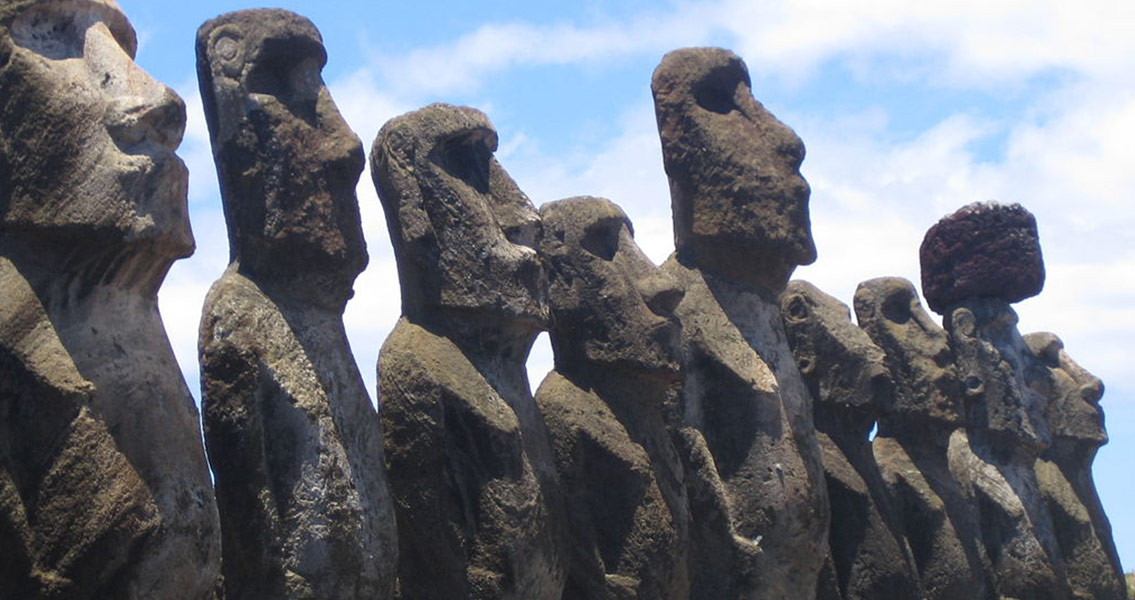
Field Museum scientist Laure Dussubieux was one of the study’s authors. “For a long time, people wondered about the culture behind these very important statues,” she says. “This study shows how people were interacting, it’s helping to revise the theory.” Lead author Dale Simpson Jr., an archaeologist from the University of Queensland adds: “The idea of competition and collapse on Easter Island might be overstated… To me, the stone carving industry is solid evidence that there was cooperation among families and craft groups.” [caption id="attachment_8696" align="aligncenter" width="800"] Credit: Bjørn Christian Tørrissen via Wikimedia Commons[/caption]

The history of Easter Island

People first arrived on Easter Island around 900 years ago. The society was later scourged by colonists and slavers, but the Rapa Nui culture has persisted. According to oral tradition, the founding population was two canoes led by the island’s first chief. Over the years, the population rose to reach a number of many thousands, making up the complex society that carved the famous Easter Island statues, or moai. Easter_Island_c1880

Sociopolitical organisation

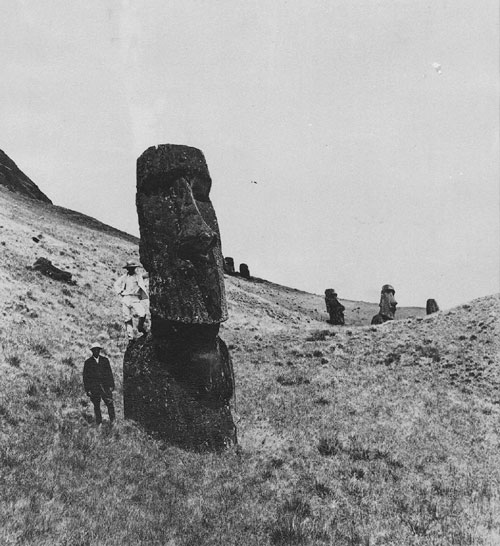
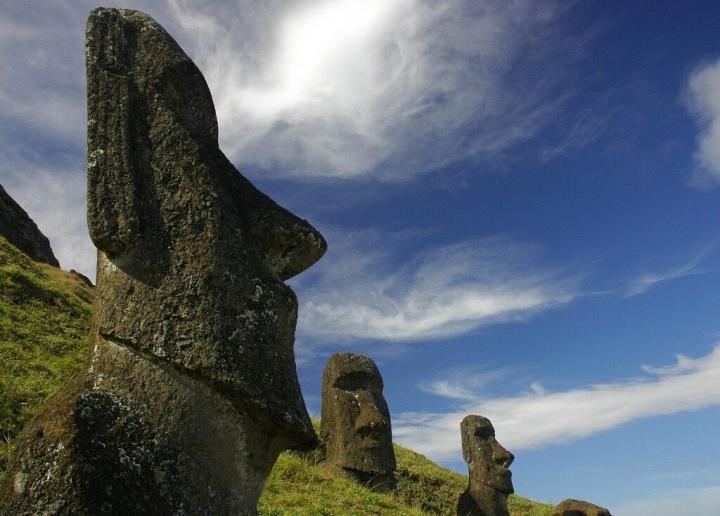
Although the moai are colloquially known as ‘the Easter Island heads,’ they are actually full-body figures that have been part-buried over time. There are nearly a thousand of the statues, with the largest standing at 70 ft tall. “Ancient Rapa Nui had chiefs, priests, and guilds of workers who fished, farmed, and made the moai. There was a certain level of sociopolitical organisation that was needed to carve almost a thousand statues,” says Simpson.

Rapa Nui excavation

Recent excavations of four statues were conducted by Jo Anne Van Tilburg of Cotsen Institute of Archaeology, UCLA and director of the Easter Island Statue Project, along with her Rapa Nui excavation team. Van Tilburg worked with Simpson and Dussubieux to analyse 21 of roughly 1,600 stone tools discovered in the excavations. Around half were fragments that suggested how they were used, giving us a better understanding of the society that erected the statues. Easter Island Maori

The Easter Island production industry

For Van Tilburg, the goal of the project was to gain a better understanding of how tool makers and statue carvers may have interacted, thus gaining insight into how the statue production industry functioned. Dussubieux explains: “We wanted to figure out where the raw materials used to manufacture the artefacts came from… We wanted to know if people were taking material from close to where they lived.” The results pointed to a society that involved consistent collaboration. “The majority of the [tools] came from one quarry complex–once the people found the quarry they liked, they stayed with it,” says Simpson. “For everyone to be using one type of stone, I believe they had to collaborate. That’s why they were so successful–they were working together.” Easter Island

An interactive society from day one

This level of large-scale cooperation flies in the face of the popular narrative that Easter Island’s inhabitants warred themselves into extinction after running out of resources. Van Tilburg urges caution in interpreting the study’s results. “The near exclusive use of one quarry to produce these seventeen tools supports a view of craft specialization based on information exchange, but we can’t know at this stage if the interaction was collaborative. It may also have been coercive in some way. Human behaviour is complex. This study encourages further mapping and stone sourcing, and our excavations continue to shed new light on moai carving.” Simpson says: “There’s so much mystery around Easter Island because it’s so isolated, but on the island, people were, and still are, interacting in huge amounts.”]]>

Categories
Breaking News

History News of The Week – Ancient Amazonians, Rapa Nui and Medieval Jewellery

Amazonians Domesticated Wild Rice 4,000 Years Ago Amazonian farmers were manipulating wild rice to boost food production more than 4,000 years ago, long before Europeans arrived in South America, according to new research. A team of scientists from the UK and Brazil have discovered the first evidence that ancient South American farmers had domesticated wild rice to grow bigger crops with larger grains. The researchers speculate that this knowledge may have been lost with the arrival of Europeans and the decimation of the indigenous population in 1492. Different species of rice were first grown around 11,000 years ago near the Yangtze River in China, and around 2,000 years ago in West Africa. Led by the University of Exeter, the latest study has unearthed evidence of successful rice farming on the vast wetlands of Guaporé River in Rondônia state, Brazil The study highlights the importance of the huge wetlands of lowland South America in providing food for the ancient settlers of the continent. Ancient inhabitants also managed to domesticate cassava, peanut and chilli pepper crops for food. By analysing 16 samples of microscopic plant remains from ten different time periods, which were excavated by a team from the University of São Paulo in South West Amazonia, it was determined that more phytoliths – hard, microscopic pieces of silica made by plant cells, were found at higher ground level. This suggests that rice began to play a bigger role in the diet of the people who lived in the area over time, leading to increasing amounts being farmed. It was also revealed that the Amazon residents likely became more efficient farmers over time. Changes in the ratio of husk, stem and leaves at different ground levels suggest they brought more grain and fewer leaves to the site. Professor Jose Iriarte, from the University of Exeter, who led the research, said: “This is the first study to identify when wild rice first began to be grown for food in South America. We have found people were growing crops with larger and larger seeds. Even though they were also eating wild and domesticated plants including maize, palm fruits, soursop and squash, wild rice was an important food, and people began to grow it at lake or river edges.” The results of the study have been published in the journal Nature Ecology and Evolution. New Light Shed on the Mysteries of Rapa Nui The history of Rapa Nui, popularly known as Easter Island, has long been shrouded in mystery. As well as the obvious fascination with the monolithic stone heads that dominate the island, the history of the Rapa Nui people prior to the arrival of Europeans is far from clear. New palaeogenomic research carried out by a team of scientists led by University College Santa Cruz has shed some new light on Rapa Nui’s ancient history. The study has ruled out any intermixing between the inhabitants of the incredibly remote island and other South Americans prior to the arrival of Europeans in 1772. The international team of scientists, led by Lars Fehren-Schmitz, associate professor of anthropology at UC Santa Cruz, analysed bone fragments from the remains of five individuals excavated in the 1980s. Three of the individuals lived on the island prior to contact with Europeans, and two after. “We found no evidence of gene flow between the inhabitants of Easter Island and South America,” said Fehren-Schmitz. “We were really surprised we didn’t find anything. There’s a lot of evidence that seems plausible, so we were convinced we would find direct evidence of pre-European contact with South America, but it wasn’t there.” Previous research found genetic traces of early inhabitants of the Americas in present-day indigenous residents of Easter Island. It was suggested that this was likely the result of intermixing that occurred sometime between 1280 and 1425. Fehren-Schmitz is the first to use paleaogenomic analysis to test that hypothesis, and the results suggest that the contact must have happened after 1722. “The most likely scenario is that there wasn’t a single episode,” said Fehren-Schmitz. Acknowledging that his results answer one question but leave many others unanswered, he said, “The story is simply more complicated than we expected.” The findings don’t solve one of the most enduring mysteries of Rapa Nui, which is how a landmass 1,300 miles from the nearest inhabited island and 2,200 miles from central Chile on the nearest continent of South America came to be populated. Some archaeologists have suggested that sea travel between Polynesia and the Americas was plausible, leading to the intermingling of those populations and perhaps even the peopling of the Americas. Fehren-Schmitz pointed out in a statement that plausibility isn’t proof. “We want to do more work to determine more precisely when this gene flow between Native Americans and the people of Rapa Nui occurred, and where in the Americas it originated,” he said. “The population dynamics of these regions are fascinating. We need to study the ancient populations of other islands–if remains exist.” New technological advances mean such insights could eventually be gained, yielding new clues from materials long kept in museum collections. “Our methodologies have evolved so much in the last five years that we might need to re-study samples we gave up on in the past to see if we can get DNA out of them,” Fehren-Schmitz concluded. Secrets of Medieval Jewellery Manufacture Revealed Scientists have gained startling insights into the techniques used to make gold jewellery in the Medieval period. The techniques used by artisans to manufacture the gold-coated silver threads found in textiles from the Middle Ages have long perplexed historians, despite the wealth of examples in the form of artefacts available to study. Four decades of intensive research have yielded limited insights, comprehensive investigation of the materials restricted by their small size. A single metal thread is sometimes no thicker than a human hair, while its gold coating is only a hundredth of that. Scientists from the American Chemical Society set out to fill in the knowledge gap. Tamás G. Weiszburg, Katalin Gherdán and colleagues examined medieval gilded silver threads, and silver and gold strips produced during and after the Middle Ages, from a variety of European cultures. Using high-resolution scanning electron microscopy, electron back-scattered diffraction with energy-dispersive electron probe microanalysis and other analytical methods, the scientists were able to gather remarkable new insights. Their results suggest that the threads were gilded exclusively by using an ancient method that survived for a millennium. The goldsmiths simply heated and hammered the silver sheets and the gold foil together, and then cut them into strips. The results show that this process was used in the thirteenth century, and was still widely practiced well into the seventeenth century. These new insights, which are revealed in a study published in the journal Analytical Chemistry, could help scientists restore, preserve and date medieval artefacts. Featured image courtesy of University of Exeter]]>

Categories
Breaking News

History News of the Week – St. Francis of Assisi Myth, Neanderthal Children, and the Rapa Nui

Saint Francis of Assisi Myth Proven true? For more than seven centuries the Friary of Folloni near Montella in Italy has gone to great lengths to protect some small fragments of textile. This is because of a myth claiming the fragments originate from a sack of bread that appeared on the doorstep of the friary in the winter of 1224, a sack allegedly sent from Francis of Assisi and carried to the friary by an angel. Now, an international team of scientists has determined that at least part of this myth is true. C-14 analysis has confirmed that the textile can be dated to between 1220-1295, while there is also evidence that bread had been kept in the sack. “Our studies show that there was probably bread in the sack. We don’t know when, but it seems unlikely that it was after 1732, where the sack fragments were inmured in order to protect them. It is more likely that bread was in contact with the textile in the 300 years before 1732; a period, where the textile was used as altar cloth — or maybe it was indeed on the cold winter’s night in 1224 — it is possible,” said research leader Kaare Lund Rasmussen, a specialist in archaeo-chemical analysis from the University of Southern Denmark, and the leader of the research team. Unfortunately, the researchers have not been able to address the question of how the bread sack ended up at the friary. “This is maybe more a question of belief than science,” said Rasmussen, in a statement. The results of the study have been published in the journal Radiocarbon. New Insights Into How Neanderthals Grew Pioneering research has shed light on how Neanderthals, the closest extinct evolutionary cousins to modern humans, grew. A study led by Antonio Rosas, researcher at the Spanish National Research Council (CSIC), looked at the fossilised remains of an eight-year-old Neanderthal child’s skeleton to establish whether there are any differences in the growth of Neanderthals and Homo sapiens. Published in the journal Science, the study determined that both species do indeed regulate their growth differently. Neanderthals had a greater cranial capacity than modern humans, an intracranial volume of 1,520 cubic centimetres for a Neanderthal adult compared to 1,195 cubic centimetres for a modern human. Tellingly, the intercranial volume of the Neanderthal child had already reached 1,330 cubic centimetres at the time of his death. In other words, it had reached 87.5% of the total by around eight years of age. For a modern human child, the full development of cranial capacity would already have been reached by that age. “Developing a large brain involves significant energy expenditure and, consequently, this hinders the growth of other parts of the body. In sapiens, the development of the brain during childhood has a high energetic cost and, as a result, the development of the rest of the body slows down,” Rosas explained. According to the research, the skeleton and dentition of the young Neanderthal present a physiology which is similar to that of a sapiens of the same age, except for the thorax area, which corresponds to a child between five and six years, in that it is less developed. “The growth of our Neanderthal child was not complete, probably due to energy saving”, explains CSIC researcher Antonio Rosas. It was also determined by the study that the maturation of the Neanderthal child’s vertebral column occurred around two years later than it would in an anatomically modern human. In all hominids, the cartilaginous joints of the middle thoracic vertebrae and the atlas are the last to fuse, but in this Neanderthal, fusion occurred about two years later than in modern humans. “The delay of this fusion in the vertebral column may indicate that Neanderthals had a decoupling of certain aspects in the transition from infancy to the juvenile phase. Although the implications are unknown, this feature could be related to the characteristic enlarged shape of the Neanderthal torso, or slower brain growth”, says Rosas. New Insight into the Size of Rapa Nui’s Population When Europeans first arrived on Rapa Nui (aka Easter Island), they estimated the population to be between 1,500 and 3,000, numbers which seemed strikingly low considering the nine hundred giant stone statues located around the island. Now, a new study hopes to give a new estimation of the population of Rapa Nui, based on the island’s farming potential, and hopefully provide some explanation as to how the spectacular statues could have been built. “Despite its almost complete isolation, the inhabitants of Easter Island created a complicated social structure and these amazing works of art before a dramatic change occurred,” said Dr. Cedric Puleston, lead author of the study, from the Department of Anthropology, University of California, Davis, USA. “We’ve tried to solve one piece of the puzzle – to figure out the maximum population size before it fell. It appears the island could have supported 17,500 people at its peak, which represents the upper end of the range of previous estimates.” He added: “If the population fell from 17,500 to the small number that missionaries counted many years after European contact, it presents a very different picture from the maximum population of 3,000 or less that some have suggested.” Rapa Nui’s history has long been a source of controversy. Much archaeological evidence has suggested that the population had been much higher than the small number encountered by the first Europeans to arrive at the island. What caused this massive population drop-off however, has remained shrouded in mystery, with theories ranging from war to the island’s resources being exhausted through over use. Puleston and colleagues examined the agricultural potential of the island, to calculate how many people the island could have sustained. “We examined detailed maps, took soil samples around the Island, placed weather stations, used population models and estimated sweet potato production. When we had doubts about one of these factors we looked at the range of its potential values to work out different scenarios,” Puleston explained. “The result is a wide range of possible maximum population sizes, but to get the smallest values you have to assume the worst of everything. If we compare our agriculture estimates with other Polynesian Islands, a population of 17,500 people on this size of island is entirely reasonable.” ]]>
Categories
Breaking News

History News of the Week – New Insights on the fate of the Rapa Nui

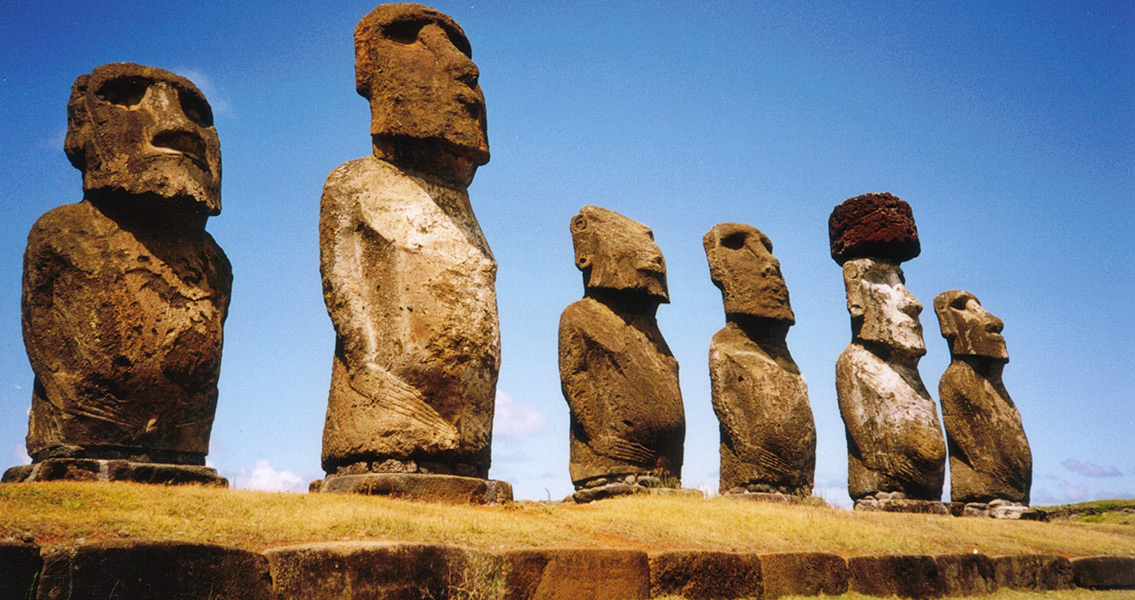
Easter Island mystery – ‘Ecocide’ didn’t lead to the Rapa Nui’s demise New scientific research is challenging the popular belief that the ancient inhabitants of Rapa Nui, aka Easter Island, were wiped out due to over exploitation of natural resources. It is often proposed that the Rapa Nui islanders cut down giant forests of palm trees on Easter Island, leaving them without wood to build canoes for fishing. The theory states that the absence of fish forced them to eat chickens, rats and agricultural crops. The island’s climate and infertile soil meant crop productivity started to decrease as the island’s inhabitants ate more and more. Conflict erupted as competition arose over the dwindling resources, and the population essentially wiped itself out through having destroyed the island’s ecosystem, a theory of their fate dubbed ‘ecocide’. New research from scientists at the University of Bristol, published in the American Journal of Physical Anthropology, is throwing the ecocide theory into question, showing through isotopic analysis of bones, soils and plant remains from Rapa Nui that the population had a diet of equal parts seafood and terrestrial food. Catrine Jarman, lead author of the study and PhD student at the University of Bristol’s Department of Anthropology and Archaeology, said: “We also discovered that agricultural crops consumed must have been planted in soils that were deliberately managed and manipulated to provide better yields. “Previous work has shown that plants of Rapa Nui were grown in rock mulch gardens and planting enclosures known as manavai. These had been carefully constructed and deliberately managed, and our study showed that the islanders may have added fertilisers.” Put simply, the new results suggest the Rapa Nui islanders adapted to the island’s harsh environmental conditions by managing their gardens and manipulating soils for better crops. Contrary to the idea of this ancient people recklessly wiping out the environment that had sustained them, it shows they demonstrated astute environmental awareness and stewardship to overcome nutrient poor soils. Jarman concluded: “This research highlights the unique and varied environmental adaptations that Pacific Islanders have shown through time. “Polynesians developed sustainable economies in ways that we are now better understanding through interdisciplinary research. Lessons from the past and from traditional island societies have value and relevance today.” Ancient Greek theatre had a wooden stage thousands of years ago An investigation by a Japanese architectural researcher suggests a high possibility that a wooden stage existed in the theater of the ancient Greek City of Messene during the Greek Classical period (ca. 369 BCE). During the Messene theatre’s 2007 excavation, a large storage room and three stone rows were discovered beside the stage by a group from the History of Western Architecture Laboratory of Kumamoto University. Similar features had also been discovered in Ancient Greek theatres at Megalopolis and Sparta. After studying the three sites in depth, a Kumamoto University researcher determined the stone rows remaining in the Megalopolis theater would have been used to set up wooden background picture panels, and the stage storage room would have likely been the custodian of such panels. In Hellenistic theatre, a one-story construction known as a proskenion was installed on the stage as background, behind which was another two story construction known as a skene that served as both a dressing room for actors and additional stage background. Traditionally, it’s been assumed that the skene and proskenion were wheeled around the stage as a single, large construction. The new research however, suggests they might have been moved separately. “A large force would have been required to move stage equipment as large as the proskenion and skene,” said Associate Professor Ryuichi Yoshitake who led the research project. “In previous studies, there was a theory that the proskenion and skene were simultaneously moved along just three stone rows, but I think it is more logical that the proskenion and skene each had their own set of two stone rows to move along. I came to this conclusion due to the positions of three stone rows and the fact that it would have been quite difficult to move the heavy proskenion and skene together using a single axle with three wooden wheels.” The findings have been published in the German language science journal Archäologischer Anzeiger. A new method to chart humans’ domestication of seeds Scientists from University College London have used synchrotron light to document for the first time the rate of evolution of seed coat thinning, a major mark of crop domestication, from archaeological remains. It marks the first-time scientists have been able to measure coat thickness throughout an entire seed. Published in the journal Science Reports, the authors present evidence for seed coat thinning between 2,000 BCE and 1,200 BCE in the legume horsegram (Macrotyloma uniflorum), a bean commonly eaten in southern India. “Seed coat thickness is a great indicator of domestication, as thinner coats will mean faster germination of a seed when it is watered,” explained Dorian Fuller, co-author on the paper. “But conventional methods of looking at the seed coat require breaking and destroying archaeological specimens.” “Being able to look at the seed coat thickness without breaking the sample is possible by other methods, but you can only look at a spot on the seed,” added Charlene Murphy, co-author on the paper. “The beamline at Diamond has allowed us to look at the entire seed, and has shown considerable variation within individual specimen’s seed coat thickness.” The team’s results suggest that domestication of horsegram took place during the second millennium BCE, with seed coats fairly fixed in thickness by the early centuries CE. The findings also suggest that the high-resolution X-ray computed tomography method could be used to study a variety of domesticated grains and pulses. Featured image: New isotopic analyses of bones, soils and plant remains from Rapa Nui, Chile (Easter Island) provide evidence contrary to the widely-held belief that the ancient civilization recklessly destroyed its environment. Courtesy of Terry Hunt ]]>

Categories
News

New Insights into What Happened on Easter Island

Frontiers in Ecology and Evolution, has attempted to provide an answer to the question of the fate of the Rapa Nui people by taking a holistic approach to new evidence discovered over the last decade. According to records, when Captain Cook first set foot on Easter Island in 1774, only 700 Rapa Nui remained. What caused the island’s population to sink so low is a mystery, but there are a number of popular hypotheses. The prevailing view of the island’s history is that it is a microcosmic example of human selfishness leading to a population’s extinction. This narrative claims that the island was first settled by people from east Polynesia sometime between 800 and 1200 CE. As the island’s population expanded, the people started to over-exploit its resources, triggering an ecological catastrophe which in turn led to a social one. Scientific evidence supports this hypothesis by revealing a period of dramatic deforestation between 1200 CE and 1400 CE. Thousands of obsidian points discovered on Easter Island’s south coast are considered by some archaeologists to be weapons, pointing to a massive war among the island’s population as they started to compete for the dwindling resources. Earlier this year however, that interpretation of the evidence was called into question by a study suggesting the points weren’t in fact weapons. Other explanations suggest that the deforestation was caused by a plague of rats who ate the island’s palm fruit, or that in fact the cultural extinction was a result of Europeans arriving on the island, wiping out the population through slave trading and the unintentional spread of diseases the islanders had no immunity to. The main argument made by the latest study is that the truth of the Rapa Nui’s’ fate can not be explained by a single factor. “These different interpretations may be complementary, rather than incompatible,” said Dr. Valenti Rull, a senior researcher of the Spanish National Research Council in Barcelona, Spain, and the lead author of the study. “In the last decade, there’s been a burst in new studies, including additional research sites and novel techniques, which demand that we reconsider the climatic, ecological and cultural developments that occurred.” Taking advantage of the latest analytical methods, Rull and his team are beginning to shed light on many of the uncertainties in the history of Easter Island. In particular, complete sedimentary samples for the last 3000 years have revealed how drought and wet seasons may have influenced the island’s population. Periods of adverse weather could have affected sea travel to and from the island, leading to periods of isolation. Times of drought could have triggered the deforestation shown in the pollen record. Other evidence, such as radio carbon dating and DNA analysis of artefacts and human remains, has provided insights into Easter Island’s inhabitants. It is now possible to see where the islanders lived, what they farmed and ate, and how other cultures influenced them. By combining all of this newly available evidence, the complexity of the Rapa Nui’s story is being revealed. “These findings challenge classical collapse theories and the new picture shows a long and gradual process due to both ecological and cultural changes. In particular, the evidence suggests that there was not an island-wide abrupt ecological and cultural collapse before the European arrival in 1722,” said Rull, in a press release. The causes of the extinction of the people of Easter Island remains a mystery, but the work of Rull and his colleagues shows that to truly trace the story of the Rapa Nui, a combined approach studying climate, ecology, and culture is necessary. For more information, the study is available here]]>

Categories
Breaking News

New Study Looks at the Politics of Human Sacrifice

Categories
Breaking News

Easter Island Inhabitants Weren't Wiped Out By War

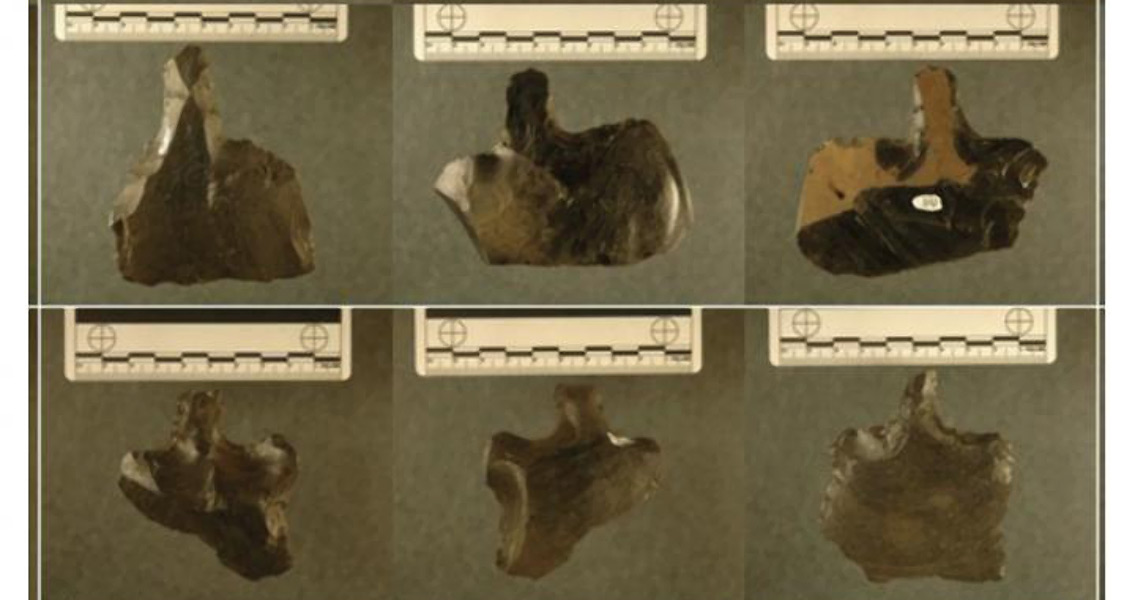
Antiquity. Famed for its impressive yet mysterious stone head statues, Easter Island, and the fate of the inhabitants who constructed the monolithic Mo’ai heads, has long captured the imagination. Multiple interpretations exist for the disappearance of the Rapa Nui, the small Polynesian civilisation that inhabited the isolated island off the coast of Chile. A popular hypothesis is that they were victims of their own expansion. Believing that the first inhabitants reached the island by canoe around 800 CE, the explanation goes that the small initial settlement rapidly grew into a population of several thousand. When Captain Cook first set foot on the 63 square mile island in 1774, only 700 Rapa Nui remained The hypothesis claims that the Rapa Nui’s slash and burn form of agriculture saw them permanently alter the once densely forested island, essentially driving themselves extinct. As the Rapa Nui population expanded, the forests of the island were wiped out. Deforestation meant the inhabitants had no wood to build boats, leaving them unable to launch deep sea fishing missions for food. Perhaps more terrifyingly, it also left them with no way to escape the isolated island. Leading on from this, the hypothesis claims that war broke out between the islanders as competition for resources became deadly. A key piece of evidence to support this theory is thousands of obsidian triangles found on the island’s coast, known as mata’a. The abundance of the objects, and their sharpness, has lead many archaeologists to conclude that they were weapons of war, evidence of the Rapa Nui’s violent demise. The new study has dramatically brought this interpretation into question, however. Led by Carl Lipo, anthropology professor at Binghamton University, a team of researchers have concluded that the triangular objects were not weapons, but general purpose tools instead. “We found that when you look at the shape of these things, they just don’t look like weapons at all,” said Lipo in a press release from Binghamton University. “When you can compare them to European weapons or weapons found anywhere around the world when there are actually objects used for warfare, they’re very systematic in their shape. They have to do their job really well. Not doing well is risking death.” Lipo’s team used morphometrics to analyse the shape variability of a photo set of some 400 mata’a collected from the island, allowing them to study the shapes in a quantitative manner. Both the variability in the shapes, and their differences from other weapons, led Lipo’s team to conclude the obsidian objects were unlikely to have been used for warfare. “You can always use something as a spear. Anything that you have can be a weapon. But under the conditions of warfare, weapons are going to have performance characteristics. And they’re going to be very carefully fashioned for that purpose because it matters…You would cut somebody {with a mata’a], but they certainly wouldn’t be lethal in any way.” Lipo said. The traditional interpretation of the Rapa Nui is that it was a failed society, one which brought about it’s own demise. The new findings however, pull this theory into doubt, and raise a host of new questions about the fate of the people who built the remarkable Easter Island Heads. Lipo and his team believe that the collapsed civilisation narrative is just a later European reading of the record, rather than an actual archaeological event. “What people traditionally think about the island being this island of catastrophe and collapse just isn’t true in a pre-historic sense. Populations were successful and lived sustainably on the island up until European contact.” For more information: www.journals.cambridge.org Image courtesy of Carl Lipo, Binghamton University]]>

Categories
Breaking News

Clues to Easter Island Diet Found in Teeth