Answered: Who First Domesticated Horses?
A new study claims that horses were first domesticated by descendants of hunter-gatherer groups in Kazakhstan.
Exactly when, where and who first domesticated horses is shrouded in mystery. A popular theory is that it was the Yamnaya culture (3300 BC–2600 BCE), yet the new research is dispelling this idea.
“The successful spread of the Indo-European languages across Eurasia has puzzled researchers for a century. It was thought that speakers of this language family played a key role in the domestication of the horse, and that this, in combination with the development of wheeled vehicles, allowed them to spread across Eurasia from the Yamnaya culture,” explained Dr. Guus Kroonen, historical linguist at University of Copenhagen, in a press release.
In the new study, published in the journal Science, it is shown that in fact horses were already being used by the Botai people 5,500 years ago, and much further east in Central Asia, completely independent of the Yamnaya pastoralists.
An inter-disciplinary team analysed ancient and modern DNA samples from humans and compared the results – the 74 ancient whole-genome sequences studied by the group were up to 11,000 years old and were from Inner Asia and Turkey. The results found no genetic link between the Yamnaya and Botai.
Intriguingly, the Botai were eventually pushed out of the central steppe region by migrations from the west. The Botai horses were also replaced, suggesting domestication of horses had already occurred elsewhere.
“We now know that the people who first domesticated the horse in Central Asia were the descendants of ice age hunters, who went on to become the earliest pastoralists in the region,” stated Professor Alan Outram from the Department of Archaeology at the University of Exeter
“Despite their local innovations, these peoples were overrun and replaced by European steppe pastoralists in the middle and later Bronze Age, and their horses were replaced too.”
[caption id="attachment_8613" align="alignnone" width="1440"] Skeletal remains showing evidence of leprosy from the Odense St. Jørgen cemetery in Denmark, which was established in 1270 and existed until 1560.
Credit:
Dorthe Dangvard Pedersen[/caption]
Did Leprosy Originate in Europe?
Leprosy may have originated in Europe, innovative new research is claiming.
The study by the Max Planck Institute for the Science of Human History, the University of Tübingen, EPFL Lausanne and the University of Zurich sequenced 10 new ancient genomes from the leprosy causing bacterium Mycobacterium leprae. This included the oldest leprosy genome sequenced to date, from around 400CE in the UK.
The results have shown there was much more diversity in Medieval European strains of leprosy than previously thought.
90 sets of remains with skeletal deformations characteristic of leprosy from across Europe were studied, dating from 400CE to 1400CE. Previous research on the bacterium suggested that it clusters into several strains, only two of which had been present in Medieval Europe.
However, the scientists found strains from Medieval Europe that are traditionally associated with locations such as Africa, Asia and the Americas. At the same time, multiple strains were also often detected in a single cemetery, giving an insight into the diversity of the disease.
“We found much more genetic diversity in ancient Europe than expected,” explains Johannes Krause, senior author of the study and a director at the Max Planck Institute for the Science of Human History.
“Additionally, we found that all known strains of leprosy are present in Medieval Europe, suggesting that leprosy may already have been widespread throughout Asia and Europe in antiquity or that it might have originated western Eurasia.”
Interestingly, the results add growing support to the idea that the squirrel fur trade played a role in the spread of leprosy. The oldest leprosy genome sequenced in the study, from Great Chesterford, England, is the same strain found in modern day red squirrels.
“The dynamics of M. leprae transmission throughout human history are not fully resolved. Characterisation and geographic association of the most ancestral strains are crucial for deciphering leprosy’s exact origin” states lead author Verena Schuenemann of the University of Zurich. “While we have some written records of leprosy cases that predate the Common Era, none of these have yet been confirmed on a molecular level.”
The research has been published in the journal PLOS Pathogens.
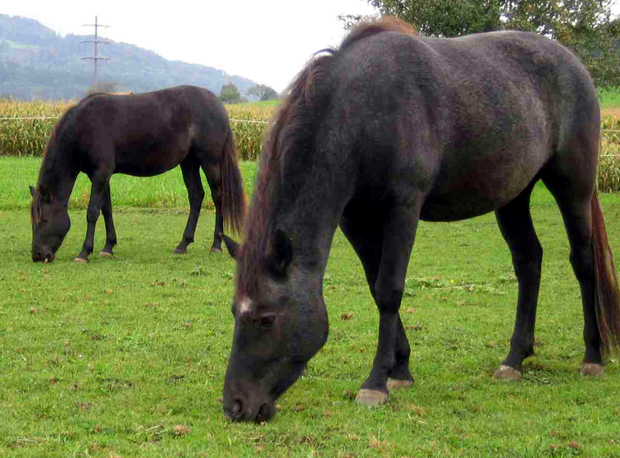
Image credit: Pottok [GFDL (http://www.gnu.org/copyleft/fdl.html) or CC-BY-SA-3.0 (http://creativecommons.org/licenses/by-sa/3.0/)], via Wikimedia Commons
]]>
 Horse Evolution Mystery Solved?
The genetic ancestors of the modern horse were animals with five toes. Generally, it is believed that horses evolved to have fewer digits, but new research is challenging that theory and arguing that remnants of the five toes are still present in modern hooves.
Humans and horses actually evolved from the same common ancestor, a creature with five digits. As a consequence of living on open grassland, horses adapted to move across these plains. Scientist’s widely believe that this adaption saw horses evolve to have fewer digits. The first horse only had four digits, its later descendant had three, while modern horses have just a central digit, known as the metacarpal.
In research published in a recent issue of Royal Society Open Science, a team of scientists are proposing that rather than horses simply losing four digits, all five merged to form the compacted forelimbs with hooves seen today.
Currently, scientists accept that splints, small bones found along the outer sides of the metacarpal in modern horses, are partially formed remnants of second and fourth digits. Tapering mid-way down the metacarpal, these fragments were inherited from an earlier ancestor, but ceased to develop into fully formed digits in modern horses. The authors of the new paper claim that this theory is incomplete, failing to account for the animals’ first and fifth digits.
“With a distinct surface from the metacarpal, we know the splints on today’s horses to be the remnants of the second and fourth digits,” said Nikos Solounias, a paleontologist from New York Institute of Technology (NYITCOM) and an author on the study. “However, these partially formed digits also appear to contain their own elevated surfaces which hold additional evolutionary clues. We find these ridges, located on the posterior of each splint, to be the partially formed remains of the first and fifth digits, which were once connected to the cartilages of the hoof.”
Key to the research are the famous Laetoil footrprints in Tanzania, which show that the famous, eight-million-year-old horse known as Hipparion primigenium walked alongside early humans and had three digits. According to a NYITCOM statement, Solounias analysed the footprints and came to the conclusion that Hipparion actually had five compacted toes, the forelimb divided into five sections – suggesting the small toes had binded together.
“Interestingly, we not only find hints of the missing digits on the modern horse, but also its ancestors, such as Hipparion and Mesohippus, two species believed to have three toes,” said Solounias.
Neurovascular evidence has provided further support to the NYITCOM researchers’ theory, with dissections of modern equine foetus forelimbs revealing a greater number of arteries and nerves than would be expected in a single digit.
“If today’s horse does indeed have one digit per forelimb, we would expect each forelimb to have a total of two veins, two arteries, and two nerve bundles,” said Melinda Danowitz, a recent NYITCOM graduate who worked with Solounias on the study. “However, our dissections found between five and seven neurovascular bundles per forelimb, suggesting that additional toes begin to develop, but do not become fully differentiated.”
King Ramses Statue Moved to New Home
A colossal, 83 tonne, 3,200 year old statue of the Ancient Egyptian King Ramses II has been moved to a new home, according to Reuters. The complex operation, which saw the statue moved 400m to Cairo’s new Grand Egyptian Museum, required army engineers and specialist contractors.
Reuters reports that the statue was put inside a cage, mounted on a truck and suspended from a steel beam to help reduce the impact of any jolts during the journey. Road surfaces on the route were treated with special materials to ensure they could adequately take the massive weight of the statue.
The entire operation cost 13.6 million Egyptian pounds ($770,000).
The statue was first discovered at the Mit Rahina archaeological site in 1820. Brought to Ramses Square in Cairo in 1955, it was moved again in 2006 due to pollution and congestion, according to Reuters. It was placed in a storage area away from public view, until now.
It will be the first site visitors to the Grand Egyptian Museum will see. The museum is set to partially open this year, before its full launch in 2022.
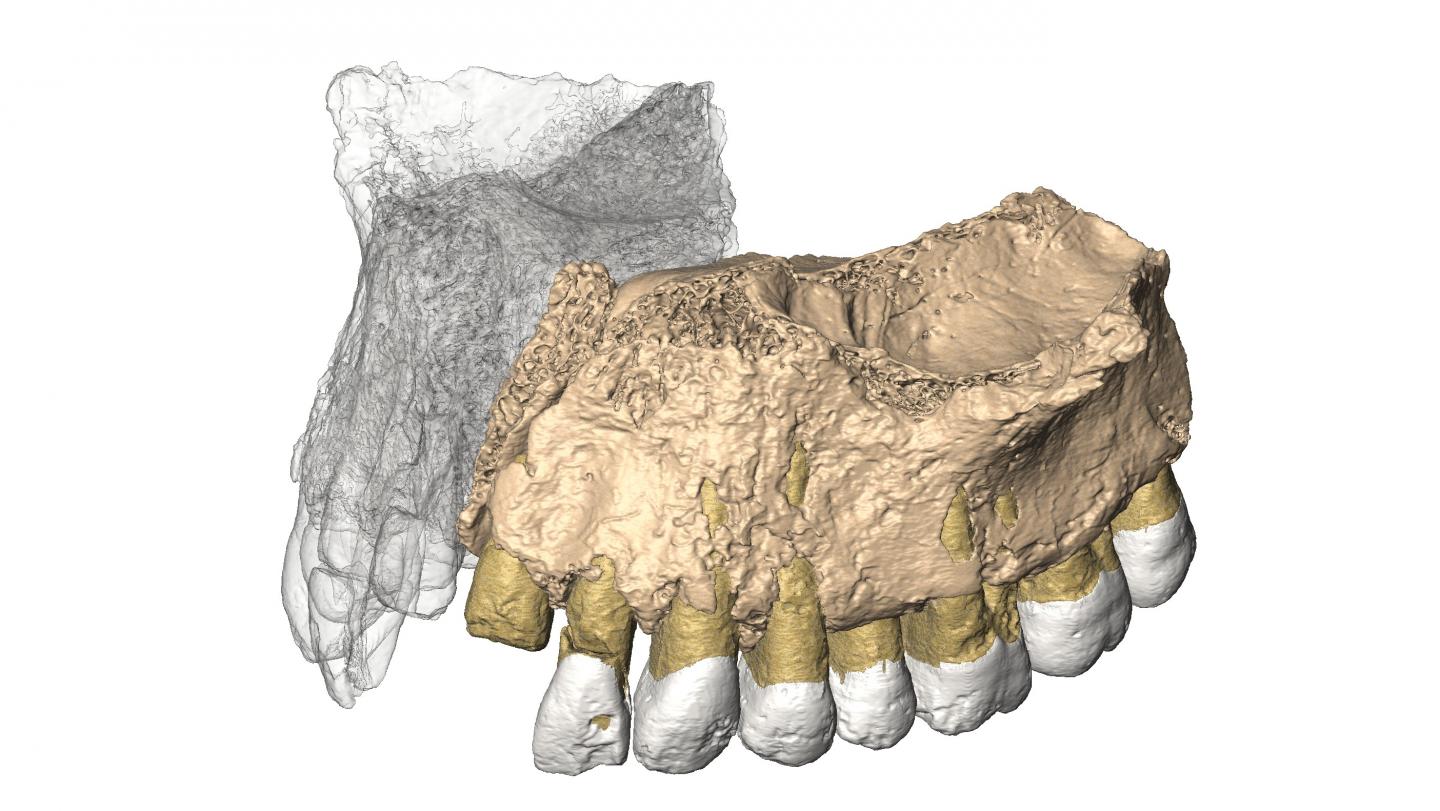
Featured image: Reconstruced maxilla from microCT images of the jawbone discovered in Israel. Image credit: Gerhard Weber, University of Vienna, Austria]]>
