Categories
Breaking News

New Research Shows Homo Erectus Shared Modern Human Qualities

Homo erectus in northern Kenya have provided experts from the Max Planck Institute for Evolutionary Anthropology in Leipzig a unique opportunity to study and understand the modern human ancestor’s movement patterns and social structure, using data that relates directly to their dynamic behaviors. Utilizing innovative analytical techniques, the team have been able to demonstrate that the H. erectus footprints have preserved evidence showing a walking style similar to that of modern humans, as well as a group structure that is also consistent with the social behaviors of humans. Habitual bipedal movement is a defining feature separating modern humans and other primates, and the evolution of this behavior within our clade would’ve had profound effects on our early ancestors’ biology. How and when a bipedal, human-like gait first emerged in hominins has long been debated, largely due to disagreements over how to infer biomechanics from skeletal remains. Additionally, certain characteristics of group structure and social behaviors which distinguish other primates and humans were believed to have emerged as a result of important evolutionary events, yet there’s no agreement on how to detect indications of group behavior through archeological or fossil records. Following the 2009 discovery of hominin footprints, found to be 1.5 million years old, near Ileret, Kenya; continued work in the region by the team from Max Planck led to the discovery of hominin trace fossils of unprecedented size for this time period, including five separate sites with a total of 97 preserved tracks that were created by a minimum of 20 Homo erectus individuals. Using an experimental method, the researchers have learned that the shapes of the footprints are indistinguishable from the shape of those of modern people who are habitually barefoot, and most likely reflect similar foot mechanics and anatomies. “Our analyses of these footprints provide some of the only direct evidence to support the common assumption that at least one of our fossil relatives at 1.5 million years ago walked in much the same way as we do today,” Kevin Hatala, with the Max Planck Institute for Evolutionary Anthropology and The George Washington University, said in materials from the Institute. Based on experimental approximations of body mass using the hominin tracks from Ileret, the team has also inferred the genders of numerous individuals who walked across these surfaces and, for the two largest excavated surfaces they have developed hypotheses in regard to the social structure of the H. erectus groups. At each of these two sites evidence exists of several adult males, which implies a certain degree of tolerance and even cooperation among them. Male cooperation underlies a variety of social behaviors which separate modern humans from other primates. “It isn’t shocking that we find evidence of mutual tolerance and perhaps cooperation between males in a hominin that lived 1.5 million years ago, especially Homo erectus, but this is our first chance to see what appears to be a direct glimpse of this behavioral dynamic in deep time,” Hatala said in the press release from the Institute. ]]>

Categories
Breaking News

Australopithecus afarensis Was Surprisingly Adaptable

Australopithecus afarensis fossils unearthed in Kenya suggest that the early hominid lived across a much broader area than previously thought. Until the latest discovery, all A. afarensis fossils had been found on the floor of the Great Rift Valley, a trench which marks the separation of the Nubian and Somali plates. The latest find marks the first time that fossils of the species have been identified east of the valley, suggesting A. afarensis lived much farther eastward than hitherto believed – as far as the highlands of Kenya. Emma Mbua of Mount Kenya University and Masato Nakatsukasa of Kyoto University led the international team responsible for the findings. In their report, published in the Journal of Human Evolution, they detail the fossilised teeth and forearm bones from an adult male and two infant A.afarensis discovered in an exposure eroded by the Kantis River in Ongata-Rongai, a settlement in the outskirts of Nairobi. “So far, all other A. afarensis fossils had been identified from the center of the Rift Valley,” explained Nakatsukasa in a press release. “A previous Australopithecus bahrelghazali discovery in Chad confirmed that our hominid ancestor’s distribution covered central Africa, but this was the first time an Australopithecus fossil has been found east of the Rift Valley. This has important implications for what we understand about our ancestor’s distribution range, namely that Australopithecus could have covered a much greater area by this age.” A. afarensis is one of the most well studied early human species. Based on the fossil record available, which includes specimens from over 300 individuals, paleontologists estimate the species lived between 3.85 million and 2.95 million years ago, a 900,000 year period four times longer than modern humans have existed. First discovered in 1974, with the famous ‘Lucy’ fossil, the species has played a ground breaking part in developing our understanding of human evolution. A.afarensis exhibited characteristics of both humans and apes. Their face and brain case were very much reminiscent of primates, as were their long, curved arms which would have allowed them to climb trees with ease. On the other hand, their small canine teeth, and body which stood on two legs were very similar to other early humans. Significantly, the Kantis region where the latest remains were unearthed would have been different to environments usually assumed to have been the domain of A. afarensis. Stable isotope analysis of the surrounding area revealed that three million years ago Kantis was a humid, plain like environment with markedly fewer trees than the other sites where evidence of A.afarensis has been discovered. “The hominid must have discovered suitable habitats in the Kenyan highlands. It seems that A. afarensis was good at adapting to varying environments,” Nakatsukasa noted in the press release. Nakatsukasa and Mbua’s findings force a reevaluation of the geographic distribution of some of our oldest ancestors, while also suggesting A.afarensis was much more adaptable than previously believed. For more information: www.sciencediret.com Image courtesy of Masato Nakatsukasa / Kyoto University]]>

Categories
Breaking News

Earliest Massacre in History Discovered

www.nature.com Image courtesy of Marta Mirazon Lahr]]>

Categories
Breaking News

Story of Human Evolution Challenged

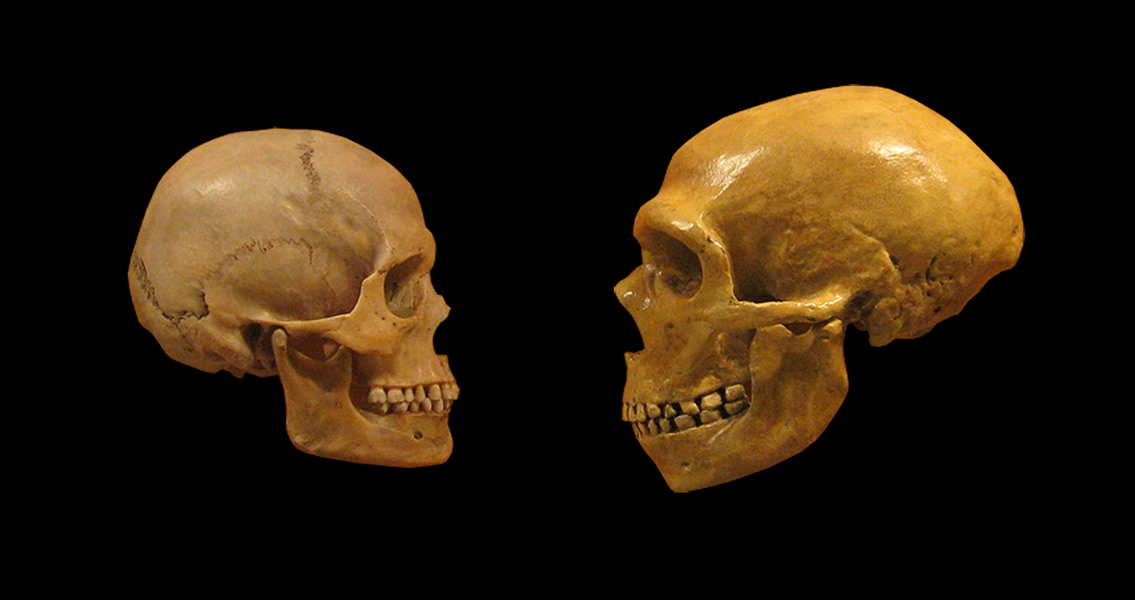
Homo, had evolved from smaller early humans becoming taller, heavier and longer-legged. This process eventually resulted in Homo erectus, which was able to migrate out of Africa and colonise Eurasia. Whilst we know that small-bodied H. erectus, averaging less than five feet tall and weighing under 50 kilograms, were living in southern Europe by 1.77 million years ago, the origin of the larger body size associated with modern humans has been elusive. The paucity of knowledge about the origins of larger members of the Homo genus is primarily a result of a lack of evidence. Previous estimates of body size had been based on well-preserved specimens which were easy to assign a species to. Since these samples are rare and disparate in terms of both space and time, little is known about geographical and chronological variation in the body sizes of the early Homo. A joint study between the Universities of Cambridge and Tübingen has shown that increases in body size occurred thousands of years after H. erectus left Africa; this growth in Homo body sizes primarily took place in the Koobi Fora region in modern Kenya. “The evolution of larger bodies and longer legs can thus no longer be assumed to be the main driving factor behind the earliest excursions of our genus to Eurasia,” said Manuel Will, co-author of the study which has been published in the Journal of Human Evolution. By using tiny fragments of fossil, the team were able to estimate our earliest ancestors’ height and body mass. Their findings, rather surprisingly, indicate a huge diversity in body size; this is particularly surprising as the wide variation we see in humans today was thought to be a relatively recent development. “If someone asked you ‘are modern humans 6 foot tall and 70kg?’ you’d say ‘well some are, but many people aren’t,’ and what we’re starting to show is that this diversification happened really early in human evolution,” said Dr Jay Stock, co-author of the study. Stock and Will are the first scientists in 20 years to compare the body size of humans from between 2.5 and 1.5 million years ago. They are also the first to use fragmentary fossils – many as small as toes, none longer than 5cm – to estimate body sizes. By comparing measurements of fossils from sites in Kenya, Tanzania, South Africa and Georgia, the researchers have revealed substantial regional variation in the size of early humans. Groups who lived in South African caves, for example, were 4.8 feet tall on average. Some of the skeletons found in Kenya’s Koobi Fora region would have stood nearly 6 feet tall, a height comparable to the average height of modern British males. “Basically every textbook on human evolution gives the perspective that one lineage of humans evolved larger bodies before spreading beyond Africa. But the evidence for this story about our origins and the dispersal out of Africa just no longer really fits,” said Stock. It appears that Stock and Will have rewritten the history of the development of early humans; diversity has deep roots amongst the Homo genus. www.sciencedirect.com Image courtesy of Wikimedia Commons user: DrMikeBaxter]]>