

Rasputin. Significantly, it was claimed Anderson had a foot deformity identical to Anastasia Romanov, adding further credence to her story. Others who had held a close relationship with the Romanovs reported Anna Anderson had knowledge about the Tsar’s family that could have only been possessed by one of his daughters. Although other relatives of the Romanovs labelled her an imposter, Anna Anderson insisted until her death in 1984 that she was Anastasia Romanova. In the 1990s, posthumous DNA tests proved she wasn’t a Romanov, although there are some who question the validity of those results. Subsequent DNA studies seemingly debunked Anderson’s claims once and for all, putting an end to suggestions that any of the Romanovs had escaped the execution in Yekaterinburg. In 2009, a scientific study pieced together DNA evidence from remains unearthed in two mass graves close to Yekaterinburg, and showed that the Tsar, his wife and his five children, had all been killed and then buried there. Yet the controversy around the fate of Anastasia and the other Romanov children has continued. In 2014, a book written by Russian historian Veniamin Alekseyev questioned the DNA evidence identifying the Tsar’s four daughters: Anastasia and her sisters, Olga, Marie and Tatiana. Alekseyev also claimed to have discovered archived documents which threw doubt on the official accounts of the fate of the Tsar and his family. Close to a century after the shootings at Ipatiev House, for some the fate of Anastasia Romanov and the other daughters of the Tsar is still far from certain. ]]>
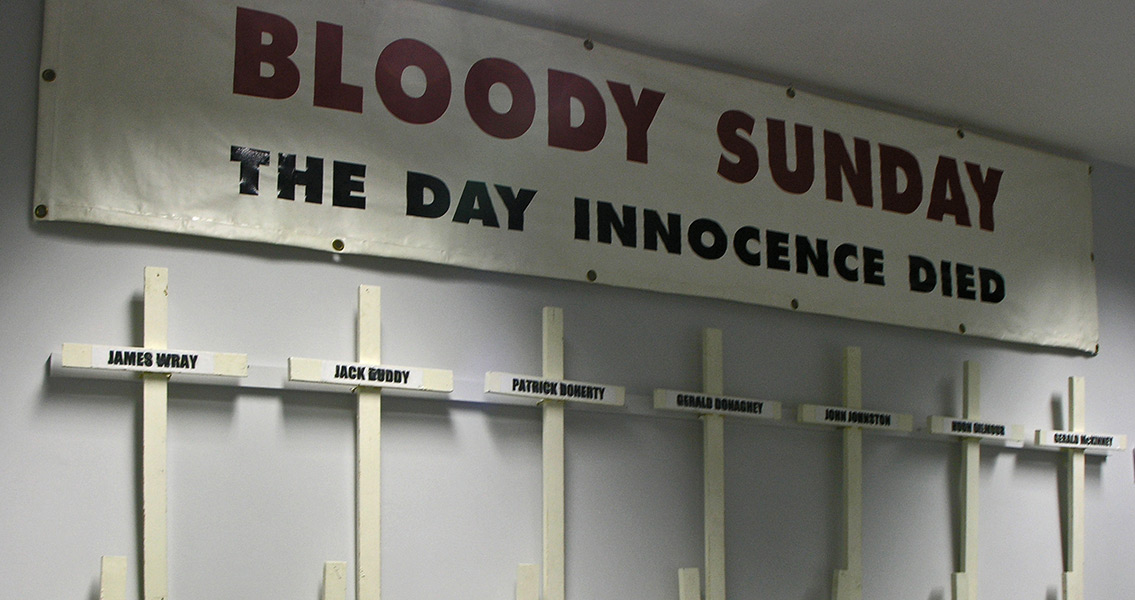
The Wolfe Tones – Go On Home British Soldiers Its depiction in Irish rebel songs such as ‘Go On Home British Soldiers’ shows that for many in Ireland the massacre was just another tragedy in a centuries old conflict between British imperialism and Irish nationalism. The Bloody Sunday massacre was absorbed into the tradition of rebel music which had for centuries railed against British interference in Ireland and Northern Ireland. It took decades for the British government to accept the responsibility of its military for the massacre. A controversial report, headed by High Court Justice Lord Widgery, was published in summer 1972. It exonerated the British troops, and suggested that the protesters had been carrying explosives and other weapons. It wasn’t until 2010 that a new report into the events was published, headed by Lord Savile it laid responsibility for the massacre with the British army and cleared all of the victims of any wrong doing. Among other crucial conclusions, it claimed the soldiers opened fire without warning and subsequently attempted to cover up their actions, and that the protesters were all unarmed. In November 2015 a former British soldier was arrested for questioning in regards to the shootings, showing that 44 years on, the Bloody Sunday massacre is yet to be truly resolved. Image courtesy of Wikimedia Commons user: SeanMack ]]>

www.nature.com Image courtesy of Marta Mirazon Lahr]]>

The Pinjarra Massacre took place on 28th October, 1834. The event is remembered as one of the most horrendous massacres of Aboriginal peoples in Australia’s history.
 Panorama of the Swan River Settlement, 1831[/caption]
The origins of the tragic events at Pinjarra came in the arrival of the first European settlers to Western Australia, in 1829. Led by Captain James Stirling, the Swan River Colony was quickly established in what is now known as the Peel region of Australia. This was a region which had been inhabited for thousands of years by the Bindjareb tribe, an indigenous people particularly renowned for their spear making ability.
Tensions quickly started to form between the white, European settlers and the Bindjareb tribe. While the Aboriginal people initially placed the Europeans into their folk traditions, interpreting them as the returning ghosts of their ancestors, Stirling declared the region a territory of England, arguing that the Bindjareb should be accountable to English law.
As the settlers expanded their territory, taking up more land as they established farms, settlements, and ultimately towns, conflict started to brew.
One key issue was a fundamental difference in agricultural practices. The Bindjareb people practiced firestick farming, a method where parts of the bush were torched to enable hunting and encourage regrowth of the land. For the white settlers, with little understanding of the firestick tradition, it seemed like an attack, especially on the occasions when the fires spread into the land they had started to cultivate.