Categories
Breaking News

‘King Arthur’ inscriptions prove multiculturalism of 7th Century Cornwall

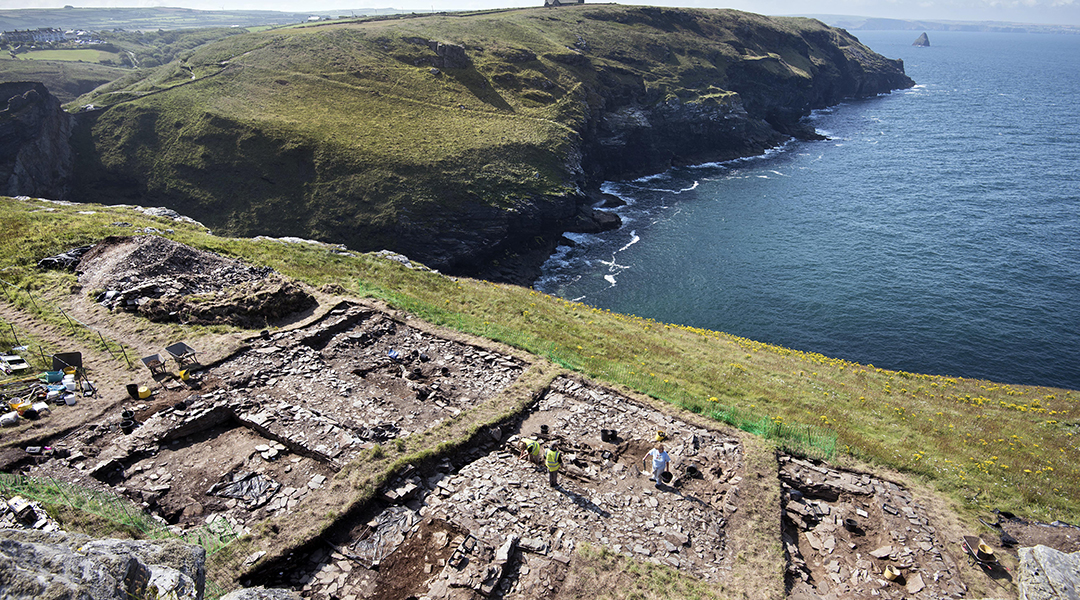
A court on the coast? The craggy Cornish coastline might not seem like an obvious choice for the location of a royal court. Nonetheless, English Heritage, which manages Tintagel Castle, says the find “lends further weight to the theory that Tintagel was a royal site with a literate Christian culture, and a network of connections stretching from Atlantic Europe to the eastern Mediterranean.” [caption id="attachment_8761" align="aligncenter" width="500"] Ancient writing inscribed in slate was discovered during an ambitious excavation at Tintagel Castle last summer. English Heritage has revealed the find ahead of it going on display at the Cornish castle. Credit: English Heritage / Emily Whitfield-Wicks[/caption]

Multiculturalism inspires early literacy

Measuring two feet long, the slate windowsill displays Latin and Greek inscriptions alongside Christian symbols. Roman and Celtic names ‘Tito’ and ‘Budic’ are legible, hinting at a thriving multicultural community in this part of Cornwall. The Latin words ‘fili’ (son) and ‘viri duo’ (two men) are also written. [caption id="attachment_8760" align="aligncenter" width="500"] Specialist digital imaging was created by Dr Tom Goskar to show the detail of the inscription. English Heritage has worked with a panel of experts to decipher the cryptic message from the past. Credit: English Heritage /Tom Goskar[/caption] It is believed that the scribe was practicing their handwriting while gazing out to sea. The decorative script can be likened to the illuminated Gospel manuscripts of the age, meaning that whoever wrote this would have been familiar with those texts. English Heritage Curator Win Scutt comments: “It’s incredible to think that 1300 years ago, on this dramatic Cornish cliff-top, someone was practising their writing, using Latin phrases and Christian symbols. We can’t know for sure who made these marks or why, but what we can say is that 7th Century Tintagel had professional scribes who were familiar with the techniques of writing manuscripts –– and that in itself is very exciting.” Writing from the early Middle Ages is rarely legible, but these words and symbols are clear enough to indicate that the person was familiar with both informal and formal scripts. Scutt continues: “Our ongoing research has already revealed the extent of Tintagel’s buildings and the richness of the lifestyle enjoyed here. This latest find goes one step further to show that we have a literate, Christian community, with strong connections from Atlantic Europe to the Mediterranean. Writing was a privileged pursuit, undertaken by specialist scribes attached to the Church or wealthy households. The discovery of this stone supports the idea that Tintagel was an important, thriving trade port, and a high-status settlement which could have been the seat of Cornish kings.” University of London’s Michelle Brown will decipher the inscription with the assistance of textual expert Oliver Padel. She considers the style of the writing to be as significant as the chosen words: “The survival of writing from this period is rare and this is a very important find, especially in terms of the continuity of a literate Christian tradition in post-Roman Cornwall. The lettering style and language used, as well as Christian symbols exhibiting Mediterranean influence and contacts, all reveal precious clues to the culture of those who lived at Tintagel in the 7th century.”

Deep research planned

The windowsill is not the first example of medieval writing to be unearthed at Tintagel Castle. In 1998, research revealed a stone inscribed with several words, including the Celtic name ‘Artognou’. Like the Artognou stone before it, this new windowsill is scheduled to undergo deep analysis. High resolution scanning is planned, which is likely to reveal just how the marks were engraved.

“We can’t ignore legends”

The legend of King Arthur was first brought to attention in the 12th Century by Geoffrey of Monmouth’s The History of the Kings of Britain. The debate over King Arthur’s existence continues; though Scutt considers the legend itself to have profound importance. “We can’t ignore legends,” he says. “This castle was built by Richard, Earl of Cornwall purely because of the Arthurian legend. There was no other reason for the castle to be here. These excavations will enable us to learn more about the older site, and we hope in turn they will encourage people to visit it.” For now, the stone will go on display at Tintagel Castle in Cornwall, UK.]]>

Categories
Editorial

King Arthur, Romans and Etruscans – The History News of 2016 (Part 1)

Where History Met Legend The Arthurian legend has long captured imaginations, and one of the biggest stories of 2016 involved the discovery of the remains of a royal palace at the fabled birthplace of King Arthur. Tintagel, a thirteenth century castle in Cornwall, has long been associated with the legend of King Arthur, the site purpotedly the place of his birth. Ongoing digs at the site by the Cornwall Archaeological Unit uncovered a series of one metre thick walls dating to the sixth century. The team behind the discovery believes these walls were part of a palace that was once part of Dumnonia, an ancient kingdom in the south-west of England. In excess of 150 glass and pottery fragments were also discovered at the site, suggesting its inhabitants were rather wealthy. If the findings are indeed evidence of a sixth century royal palace, it could fundamentally change our understanding of Tintagel – one of the most important archaeological sites in Europe. New Roman Revelations 2016 unearthed a host of new information about the history of the Romans, a wealth of archeological finds and new studies challenging existing ideas about life in the Roman Empire. In July, the discovery of a Roman settlement in the village of Ipplepen in the UK expanded the western boundaries of the Roman Empire by 20 miles. Archaeologists working on the Ipplepen Archaeological Project unearthed large amounts of pottery at the site, that had been made across the Roman Empire and imported to Britain, highlighting the extensive trade networks that connected the far corners of the empire. http://www.newhistorian.com/discovery-devon-expands-boundary-roman-rule-britain/6732/ In September, the callous image of the Roman family was challenged. For years, the discovery of the bones of tiny children at Roman cemeteries around Britain has been considered evidence of the widespread practice of infanticide among the ancient Romans. Using innovative new methods however, researchers from the Natural History Museum, Museum of London and Durham University were able to show that in fact many of these remains were those of stillborn children. Although not completely ruling out the practice of infanticide, the findings suggest it may not have been as widespread as previously believed. At the start of the year, a study published in the open access journal PLOS ONE provided the first hard proof that migrants from across the empire had made their way to settle in Rome itself. Janet Montgomery from the UK’s Durham University and Kristina Kilgrove from the US-based University of West Florida carried out isotope analysis on over a hundred sets of remains dating to the first through third centuries and excavated from Roman cemeteries. They found that many of the individuals studied had migrated to the Imperial capital from the Alps and North Africa. Fresh Insights Into a Mysterious Culture The Etruscans are one of the most fascinating yet mysterious ancient civilisations. The pre-Roman Italian culture had its origins around 700 BCE, and lasted until its eventual absorption into the Roman Empire in the fourth century BCE. Clearly a powerful, sophisticated people, little is known about the Etruscans, but in 2016 some tantalising clues into their lives were revealed. In March, archaeologists announced the discovery of a new religious text inscribed on an ancient piece of sandstone. Dated to the sixth century BCE, it is an incredible rarity due to the fact that most Etruscan texts found to date tend to focus on funerary practices. As the 500 pound slab is analysed, archaeologists hope to glean new information about Etruscan religion and expand their knowledge of the language of the ancient civilisation. Preliminary translations of the stone slab have already revealed the name of a pivotal Etruscan fertility deity – Uni. The discovery of an Etruscan gravesite in November pointed to a darker side to the early civilisation. It was found that the man interred in the 2,500 year old grave site had been shackled around the neck and ankles. It is believed that the man, aged between twenty and thirty, had died while wearing the chains. Often viewed as something of a benign, peaceful civilisation, the unusual burial adds to a growing body of evidence bringing that view into question. ]]>

Categories
Breaking News

Palace Found at Tintagel, Fabled Birthplace of King Arthur

Categories
Breaking News

The Myths of Glastonbury Abbey Shown to Be Just Myths

Categories
Book Reviews

The Struggle Of King Arthur And Mordred

The Origins of the Legend Historians continue to speculate if King Arthur, Mordred and the other scenes and players in the legend have any historical basis. For the most part the story is associated with fifth or sixth century Wales. If a prototype for Arthur did exist he might have been a Celtic chieftain rallying his forces to fight off the Saxon invaders. References have been found to figures that might have been the model for King Arthur in some of the scare writings that survive from the Saxon period in British history, but none of the associations made are conclusive. Two Medieval writers share the responsibility for publicising the tale and incorporating in it many of the elements familiar to us today. In 1138 Geoffrey of Monmouth wrote a history of the Kings of Britain. Many allege that he drew more on his imagination than on any older records that had come to his notice. Others claim that some of what he wrote corresponds with information in earlier documents that have now come to light. Whatever the authenticity of his facts, Geoffrey introduced his readers to a King Arthur, Queen Guinevere, Merlin the Wizard and of course, King Arthur’s arch enemy Mordred. In this version of the tale King Arthur goes to fight against the Roman Empire in Gaul (France of today). The evil Mordred takes advantage of the opportunity to usurp Arthur’s throne and take Queen Guinevere as his wife. The news reached King Arthur on campaign. He returns to his kingdom and fights a fierce battle with Mordred at a place called Camlann, Mordred is killed but Arthur is mortally wounded. In the late medieval period Thomas Malory published a revised and comprehensive version of the Arthur stories, entitled “The Death of Arthur” (Le Morte d’Arthur). The publication of this work coincided with the introduction of the printing press. Malory’s work became one of the first books printed in England and standardised many aspects of the Arthur legend, for example, the idea of Arthur and his knights sitting at the Round Table dates from this publication. The bitter enmity between Arthur and Mordred continues to form a key part of the story but in a key change from Geoffrey of Monmouth’s narrative Queen Guinevere remain loyal to King Arthur. Why have these tales survived the years? The fact that the reader of this article is likely to be familiar with tales of Arthur and Mordred is a testimony to their enduring power. Yet they are more than simple stories. The Arthur tales have contributed culturally to the shaping of Britain’s identity. Over all these years they continue to serve a useful purpose. People are attracted by the idea that there was once an age when chivalrous knights rode about the British countryside fighting treacherous enemies like Mordred, or even supernatural dragons and other monsters. During World War Two, tales of Arthur’s bravery against the country’s enemies provided a rallying point for resistance to German aggression. Today the interest is probably largely of an escapist nature. Regardless of whether or not there is a basis in history, it seems that tales of Arthur and Mordred still serve a purpose in our hi-tech age. References  The Legends of King Arthur and His Knights by James Knowles The Legends of King Arthur and His Knights by James Knowles PIBN:  1000104500 [gap height=”20″] Wikipedia King Author [gap height=”20″]  ]]>