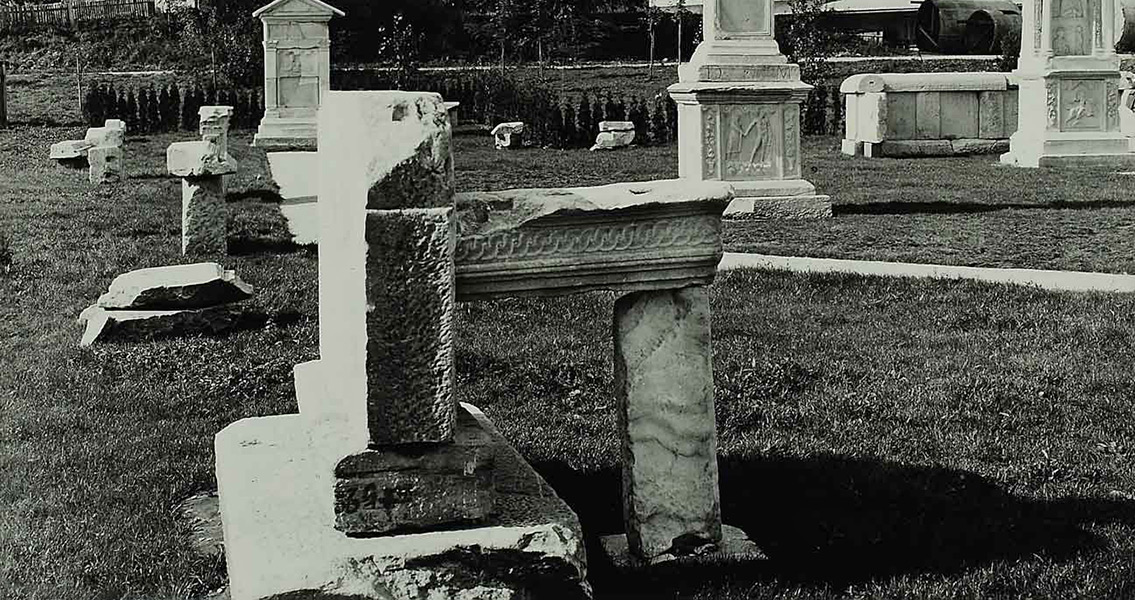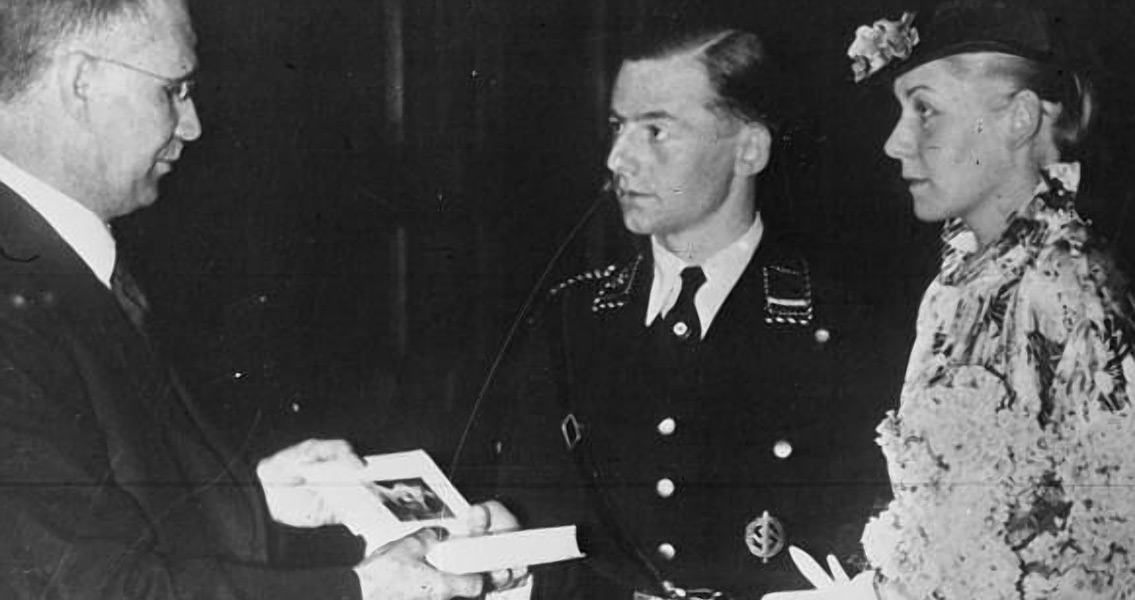
Mein Kampf, other books and historical materials describing the town of Falkenburg, as it was known then. Ordensburg Krössinsee was one of three educational centers constructed in the 1930s in Germany for the purpose of training future leaders of the Nazi Party. It was built near the town of Falkenburg in what was Germany at the time. Today it’s the town of Zlocieniec, Poland, and the former training camp is used by the Polish army The individual buildings and designated areas which made up the facility included a Hall of Honor, twenty separate living quarters, a dining hall, an educational hall, the commander’s house, administrative buildings, a house for female employees, a sick bay, a sports field, an arena for riding, horse barns and two towers (although four had been planned). A hotel, swimming pool and water sports facility were also planned but never constructed. To attend the educational center, cadets, called Ordens Junkers, had to be a minimum 5 feet 4 inches (1.63 m) tall and be between 23 and 26 years old. They were required to be racially pure, in good health and have no physical limitations. Classes included the study of politics, world history and philosophy, while afternoons were spent on battle tactics, military drills, equestrian techniques (a program for which it was recognized), and sports. In 1937, the facility was shared with the Hitlerjungen or Hitler Youth. Between 1933 and 1945, the Hitler Youth was Germany’s only official youth organization and consisted of the Hitlerjugend for males between the ages of fourteen and eighteen and the Deutsches Jungvolk for younger boys between ten and fourteen years old, as well as the League of German Girls. The Hitler Youth members would become the sole occupants of the camp following the invasion of Poland in 1939 and the start of World War II. The capsule and its contents have been transferred to the National Museum in Szczecin for translation, categorizing, preservation and display. ]]>




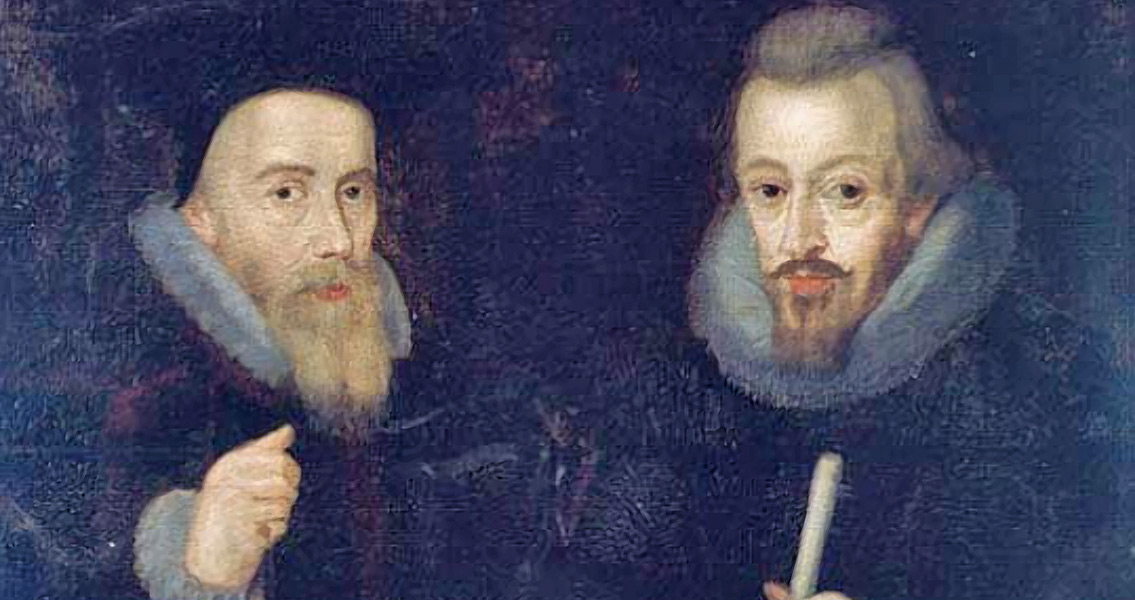
A Relation of the State of Polonia and the United Provinces of that Crown – and presented a version to King James I of England and VI of Scotland. An intriguing new study has focused on this text and drawn attention to its little-known author. Sebastian Sobecki, in his article recently published in the journal Renaissance Studies, examines the ties that Peyton enjoyed with a man extensively involved with state security: Robert Cecil, Secretary of State for both Elizabeth I and James I. Sobecki argues that John Peyton’s Grand Tour between 1596 and 1601 – where Peyton visited Germany, Bohemia, Poland-Lithuania, Switzerland and Italy – was an intelligence gathering operation to discover Spanish diplomatic activity in the Empire and in the Polish-Lithuanian Commonwealth. “Peyton’s reports are not ethnographical travel accounts or itineraries,” Sobecki writes. “Instead, [they] contain detailed and remarkably comprehensive accounts of the governance and political life of the countries he visited. In this regard, Peyton’s writings, although they are in English are closer to the factual qualities of Latin diplomatic writing.” A Relation of Polonia contains a vast amount of very nuanced information. The political structure of the Polish-Lithuanian Commonwealth forms the heart of the work, with particular discussion of the electoral system behind the Commonwealth’s royal elections. Some of the longest sections, with the most detailed treatment, concern the armed forces and warfare, Sobecki notes. In his description of the Polish people, Peyton noted that “they are large of body, tall, vprighte, and personable. The gentry full of ceremonies, ciuill [civil] and curteous in enterteinement, bountifull at table, costly in dyett, greate gourmandes, and quaffers, not sleepy, nor heavy in theire dronkennesse, as the Dutche, but furious, and quarrellsome, highe-mynded, and proude, but in a iollity, and not surly, as the Germans.” Sobecki notes that, despite this portrait of the Poles being very comprehensive by contemporary standards, Peyton’s real interests lay elsewhere. The sheer amount of administrative detail in Peyton’s work is unlike any other travel account of central Europe from the sixteenth or seventeenth centuries. Peyton’s works, for Sobecki, “amount to substantial and accurate studies of the type supplied confidentially by modern ambassadors to their governments. Throughout, the organizing principle of each text is the stake England held in the places Peyton visited. Trade, religious denominations, domestic political profiles and foreign relations and alliances – all these dominate Peyton’s reports.” To understand why Peyton compiled these works, Sobecki has explored Peyton’s relationship with Cecil. The 1590s saw an arms race between the Earl of Essex and Cecil, Sobecki explains. Essex, leading the anti-Cecil faction at court, increasingly relied on the provision of intelligence to boost his reputation. Cecil seized the opportunity given to him when appointed Secretary of State to build up a system of espionage that surpassed all others. “By the end of 1597, Cecil was England’s undisputed spymaster,” Sobecki writes. At about this time, Peyton’s father, Sir John Peyton, emerged as one of the most important pieces in Cecil’s domestic intelligence network. Sir John was even appointed to the post of Lieutenant of the Tower, a very sensitive office. “There is no shortage of notes and reports from Sir John to Cecil about prisoners’ activity and intelligence,” Sobecki notes, “including in-depth accounts of Raleigh’s emotional breakdown and the searching of Essex’s person.” The younger Peyton’s reports of Poland-Lithuania, therefore, seem to be works of espionage. Sobecki has clearly shown that Peyton the Younger’s accounts are no mere travel diaries for personal reflection, they are in-depth studies of central Europe undertaken by a man with close links to England’s security network. Sobecki’s work reveals that espionage and subterfuge were sophisticated operations in the Early Modern period. For more information: www.onlinelibrary.wiley.com Image courtesy of Wikimedia Commons user: Bascon]]>