Categories
Breaking News

Ichthyosaur Mystery Finally Solved As Two Become One

Journal of Systematic Palaeontology, published by Taylor & Francis. In the early nineteenth century the fossils of massive, mysterious sea creatures started to be unearthed around the coast of the United Kingdom. By 1821, scientists realised they had discovered a new, extinct group of sea dwelling reptiles and described the first ichthyosaur species: Ichthyosaurus communis. First appearing in the Triassic period, ichthyosaurs lived through the Jurassic and Cretaceous, ultimately dying out some 25 million years before the mass extinction event which wiped out the dinosaurs. Physically, ichthyosaurs were shaped like modern dolphins or sharks, yet the creatures were reptiles – evolved from an as yet unidentified land creature. Following the initial description of Ichthyosaurus communis in 1821, three more ichthyosaur species were quickly described – supposedly distinguished by the shape and structure of their teeth. Two of these species have since been designated as belonging to other types of ichthyosaur. The other, Ichthyosaurus intermedius, continued to be regarded as a relative of I.communis. For years confusion reigned as eminent scientists studied Ichthyosaur fossils unearthed on the coasts of Yorkshire, Dorset and Somerset. Ambiguity over the differences between I.communis and I.intermedius meant many fossils were identified on a possibly shaky basis. Lomax explained in a press release from the Taylor and Francis Group: “The early accounts of ichthyosaurs were based on very scrappy, often isolated, remains. This resulted in a very poor understanding of the differences between species and thus how to identify them. To complicate matters further, the original specimen of Ichthyosaurus communis is lost and was never illustrated. Similarly, the original specimen of I. intermedius is also lost, but an illustration does exist. This has caused a big headache for palaeontologists trying to understand the differences between the species”. Paleontologist Dr Chris McGowan was the first to suggest I. communis and I. intermedius could be the same species, in the 1970s. Since then, various studies have argued back and forth over whether the species should or should not be separated. Lomax and Massare’s study is the most comprehensive ever published comparing the species of ichthyosaur. The authors conclude that the two species are the same, and that characteristics of Ichthyosaurus intermedius can be found in other ichthyosaur species, including I. communis. The two authors have made countless other vital contributions to the study of ichthyosaurs over the years, including describing three new species and reassessing historical species. Their work is providing groundbreaking new insights into the spectacular reptiles that once dominated the earth’s seas. To read the full article please visit: http://www.tandfonline.com/doi/full/10.1080/14772019.2017.1291116 Image courtesy of London Natural History Museum]]>

Categories
Breaking News

Mystery of Maya Pendant’s Discovery Puzzles Researchers

Ancient Mesoamerica, can be found here]]>

Categories
Breaking News

Tully Monster Mystery Far From Solved

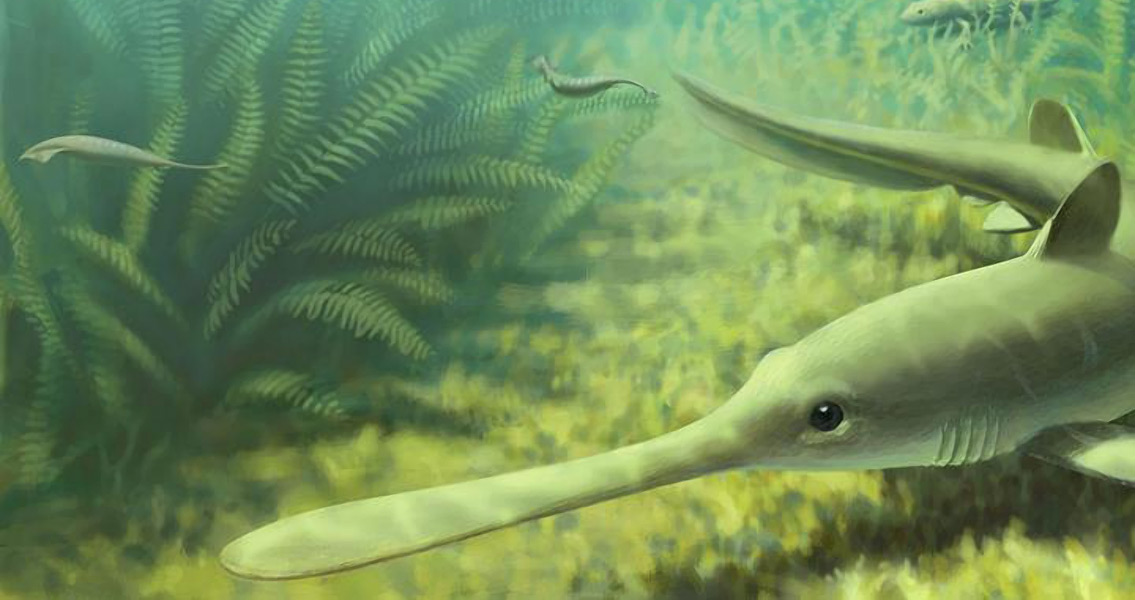
Tullimonstrum gregarium, aka the Tully Monster, a bizarre 300 million year old creature whose remains have been found exclusively in the state of Illinois, has long been a source of mystery to scientists. Made from a strange looking mixture of body parts – a long eel like body, tail fins resembling a squid’s back end and a long tentacle like neck culminating in a crab claw like mouth – Tully Monster has been almost impossible for scientists to categorise. Last year, two studies claimed to have finally brought the mystery of the Tully Monster to a close. The first claimed to have found evidence of a primitive backbone among Tully Monster fossils. It was a discovery which led the authors to conclude the creature had been a fish similar to a modern lamprey. Headed by PhD student Thomas Clements from the University of Leicester, UK, the second study also claimed to have convincing proof the creature was a vertebrate. The conclusion was based on evidence proving that two long stalks coming from the creature’s body were eyes. Clements’ team argued that such eye stalks are only known to exist in creatures with backbones. Now, a team of paleobiologists led by Lauren Sallan claim both studies are wrong. “This animal doesn’t fit easy classification because it’s so weird,” said Sallan, an assistant professor in the University of Pennsylvania’s Department of Earth and Environmental Science. “It has these eyes that are on stalks and it has this pincer at the end of a long proboscis and there’s even disagreement about which way is up. But the last thing that the Tully monster could be is a fish.” Published in the journal Paleontology, Sallan and colleagues’ report argues there is little convincing evidence Tully Monster was even a vertebrate. “It’s important to incorporate all lines of evidence when considering enigmatic fossils: anatomical, preservational and comparative,” said Sam Giles, a junior research fellow at the University of Oxford and a coauthor of the study. “Applying that standard to the Tully monster argues strongly against a vertebrate identity.” The team’s biggest criticism is the fact that none of the 1000 Tully Monster remains studied so far show signs of the structures believed to be universal in aquatic vertebrates. “You would expect at least a handful of the specimens to have preserved these structures,” Sallan said. “Not only does this creature have things that should not be preserved in vertebrates, it doesn’t have things that absolutely should be preserved.” As Sallan’s team point out, accurately classifying such an unusual creature is vital for the broader understanding of evolution. “Having this kind of misassignment really affects our understanding of vertebrate evolution and vertebrate diversity at this given time,” Sallan explained. “It makes it harder to get at how things are changing in response to an ecosystem if you have this outlier. And though of course there are outliers in the fossil record — there are plenty of weird things and that’s great–if you’re going to make extraordinary claims, you need extraordinary evidence.” Since its discovery in the 1950s Tully Monster has been through a host of different classifications. It seems the mystery surrounding its identity is far from solved. “Initially it was published as a worm,” Sallan said. “There is a well-constructed argument that it is some kind of mollusc, like a sea cucumber. And there’s another very strong argument that it’s some kind of arthropod, similar to a lobster.” Featured Image: An illustration depicts what Mazon Creek may have looked like 300 million years ago, complete with Tully monsters (the two small swimming creatures), a large shark and a salamander relative. Courtesy of John Megahan ]]>

Categories
Breaking News

Long Discovered Mummified Legs Belonged to Queen Nefertari

Categories
News

Spiritualists, Appendix and Punches – The Death of Houdini

Categories
Editorial

The Mystery Behind Emily Davison's Death

Categories
Breaking News

Did Immigration Destroy Cahokia, North America's First City?

Categories
Breaking News

Easter Island Inhabitants Weren't Wiped Out By War

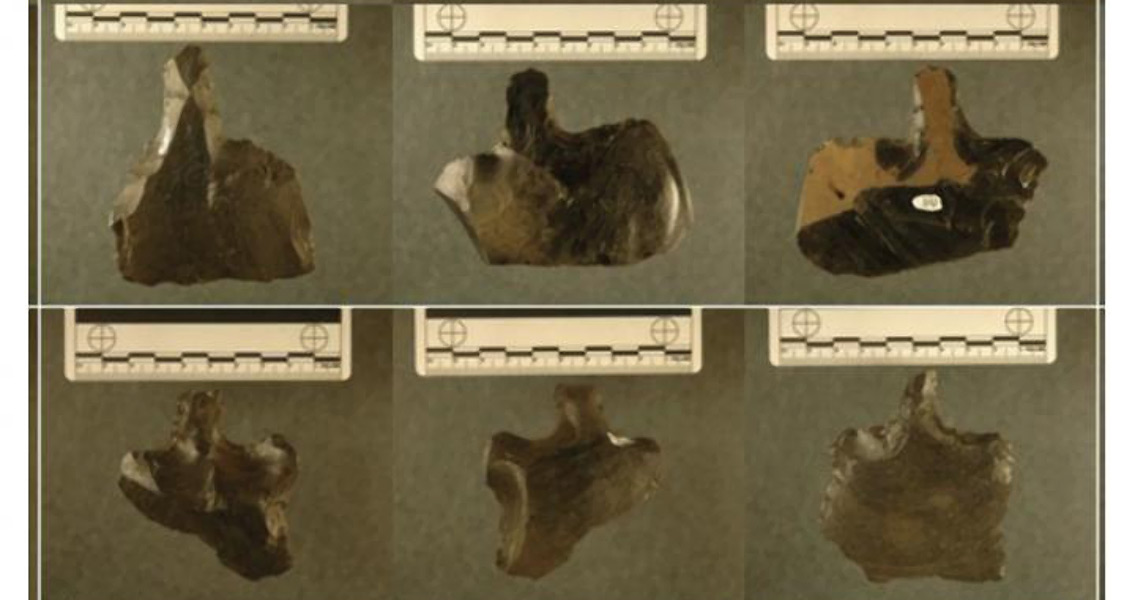
Antiquity. Famed for its impressive yet mysterious stone head statues, Easter Island, and the fate of the inhabitants who constructed the monolithic Mo’ai heads, has long captured the imagination. Multiple interpretations exist for the disappearance of the Rapa Nui, the small Polynesian civilisation that inhabited the isolated island off the coast of Chile. A popular hypothesis is that they were victims of their own expansion. Believing that the first inhabitants reached the island by canoe around 800 CE, the explanation goes that the small initial settlement rapidly grew into a population of several thousand. When Captain Cook first set foot on the 63 square mile island in 1774, only 700 Rapa Nui remained The hypothesis claims that the Rapa Nui’s slash and burn form of agriculture saw them permanently alter the once densely forested island, essentially driving themselves extinct. As the Rapa Nui population expanded, the forests of the island were wiped out. Deforestation meant the inhabitants had no wood to build boats, leaving them unable to launch deep sea fishing missions for food. Perhaps more terrifyingly, it also left them with no way to escape the isolated island. Leading on from this, the hypothesis claims that war broke out between the islanders as competition for resources became deadly. A key piece of evidence to support this theory is thousands of obsidian triangles found on the island’s coast, known as mata’a. The abundance of the objects, and their sharpness, has lead many archaeologists to conclude that they were weapons of war, evidence of the Rapa Nui’s violent demise. The new study has dramatically brought this interpretation into question, however. Led by Carl Lipo, anthropology professor at Binghamton University, a team of researchers have concluded that the triangular objects were not weapons, but general purpose tools instead. “We found that when you look at the shape of these things, they just don’t look like weapons at all,” said Lipo in a press release from Binghamton University. “When you can compare them to European weapons or weapons found anywhere around the world when there are actually objects used for warfare, they’re very systematic in their shape. They have to do their job really well. Not doing well is risking death.” Lipo’s team used morphometrics to analyse the shape variability of a photo set of some 400 mata’a collected from the island, allowing them to study the shapes in a quantitative manner. Both the variability in the shapes, and their differences from other weapons, led Lipo’s team to conclude the obsidian objects were unlikely to have been used for warfare. “You can always use something as a spear. Anything that you have can be a weapon. But under the conditions of warfare, weapons are going to have performance characteristics. And they’re going to be very carefully fashioned for that purpose because it matters…You would cut somebody {with a mata’a], but they certainly wouldn’t be lethal in any way.” Lipo said. The traditional interpretation of the Rapa Nui is that it was a failed society, one which brought about it’s own demise. The new findings however, pull this theory into doubt, and raise a host of new questions about the fate of the people who built the remarkable Easter Island Heads. Lipo and his team believe that the collapsed civilisation narrative is just a later European reading of the record, rather than an actual archaeological event. “What people traditionally think about the island being this island of catastrophe and collapse just isn’t true in a pre-historic sense. Populations were successful and lived sustainably on the island up until European contact.” For more information: www.journals.cambridge.org Image courtesy of Carl Lipo, Binghamton University]]>

Categories
Breaking News

Treasure Hunters Claim Discovery of Infamous Nazi Gold Train

Categories
Breaking News

The Mystery Behind the Doors in Tutankhamun's Tomb