Categories
Breaking News

New Tyrannosaur Discovered With a Scaly Face and Sensitive Nose

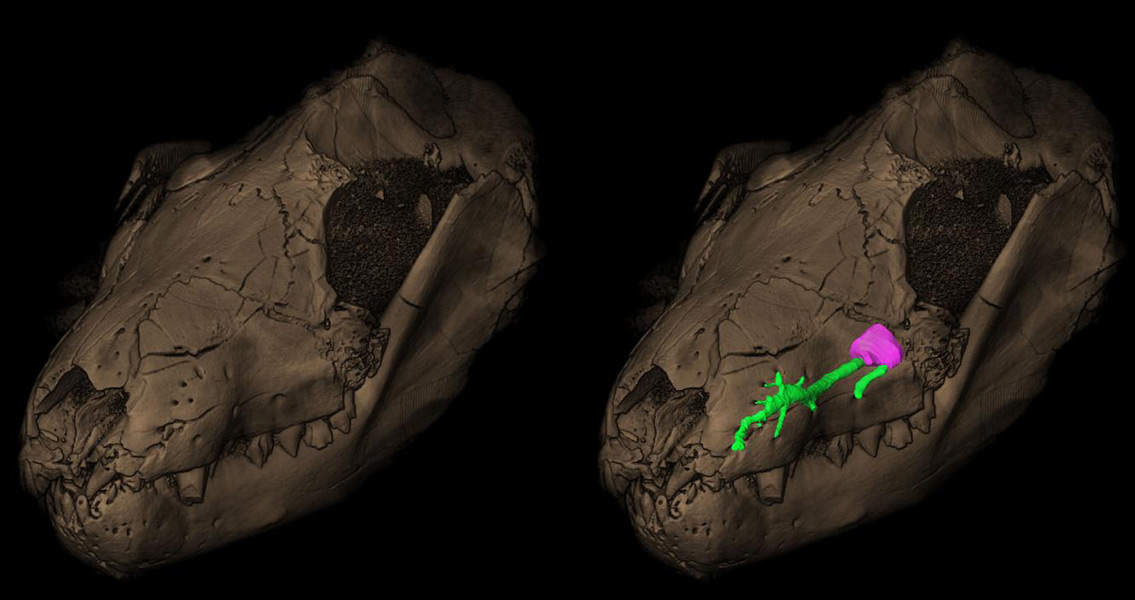
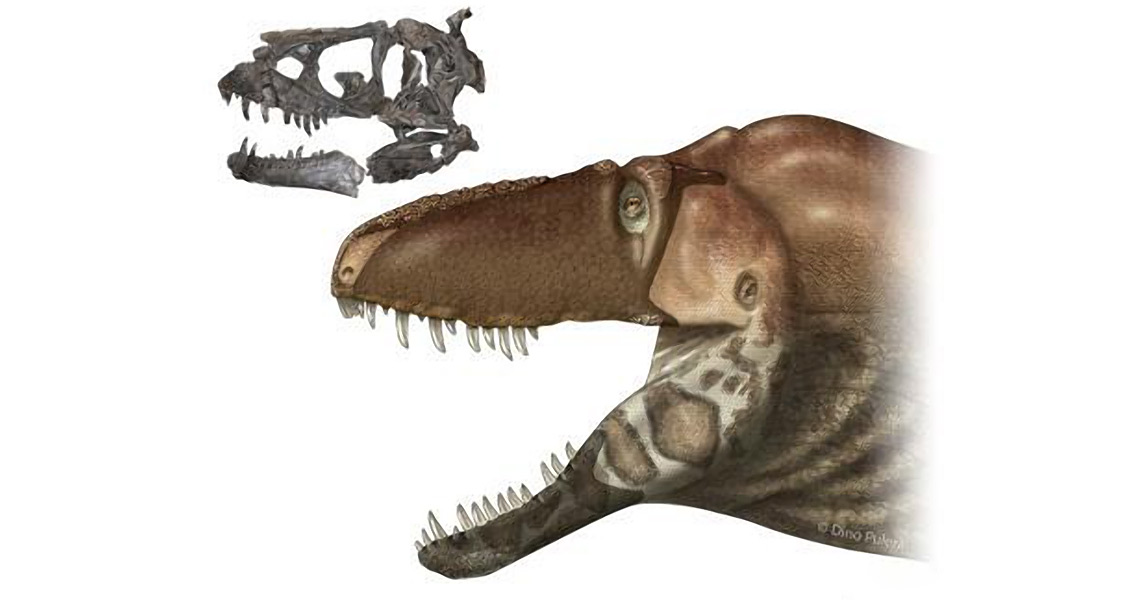
Daspletosaurus horneri – “Horner’s Frightul Lizard” – the new species is named after renowned paleontologist John “Jack” R. Horner. Horner, a former curator at the museum of the Rockies, discovered numerous dinosaur fossils in the region and also mentored local students towards scientific careers. “Being a tyrannosaur, they had really small arms,” said UNM Honors College Professor Jason R. Moore, who was involved in the discovery. “They wouldn’t be able to interact with their environment with their hands the way mammals do — find food, build nests, tend to eggs and young. In order to do these things, Daspletosaurus needed to use its feet or head. The discovery and analysis of the tyrannosaur shows that the dinosaur had a developed face sensitivity similar to the sensitivity in our finger tips, suggesting it could use its snout for all those complex ecological interactions, similar to the way crocodiles do today.” Published in Nature Publishing Group’s Scientific Reports, the study led by Thomas Carr of Carthage College’s Department of Biology in Wisconsin sheds new light on the development of the tyrannosaur lineage. “Daspletosaurus horneri was the youngest, and last, of its lineage that lived after its closest relative, D. torosus, which is found in Alberta, Canada,” explained Carr. “The geographic proximity of these species and their sequential occurrence suggests that they represent a single lineage where D. torosus has evolved into D. horneri.” The team’s research suggests the evolution of the tyrannosaurs was slow, the transition from D. torosus to D. horneri taking two million years. Carr and colleagues’ study stands to drastically enhance our understanding of tyrannosaurs, revealing a great deal about how their faces would have looked. “It turns out that tyrannosaurs are identical to crocodylians in that the bones of their snouts and jaws are rough, except for a narrow band of smooth bone along the tooth row,” explained Carr. “We did not find any evidence for lips in tyrannosaurs: the rough texture covered by scales extends nearly to the tooth row, providing no space for lips.” “However, we did find evidence for other types of skin on the face, including areas of extremely coarse bone that supported armor-like skin on the snout and on the sides of the lower jaws. The armor-like skin would have protected tyrannosaurs from abrasions, perhaps sustained when hunting and feeding.” Like crocodylians, tyrannosaurs had highly sensitive snouts and jaws, penetrated by numerous small nerve openings which would have allowed a multitude of branches of nerves to innervate the skin. This reveals a great deal about the development of the trigeminal nerve, responsible for sensations and motor actions in the face. “The trigeminal nerve has an extraordinary evolutionary history of developing into wildly different ‘sixth senses’ in different vertebrates, such as sensing magnetic fields for bird migration, electroreception for predation in the platypus bill or the whisker pits of dolphins, sensing infrared in pit vipers to identify prey, guiding movements in mammals through the use of whiskers, sensing vibrations through the water by alligators and turning the elephant trunk into a sensitive ‘hand’ similar to what has been done to the entire face of tyrannosaurs.” explained Jayc Sedlmayr, professor at the Louisiana State University Health Sciences Center New Orleans. Image courtesy of @Dino ]]>
Categories
Breaking News

Useful or Not, T. Rex-Like Limbs May Have Evolved Numerous Times

T. rex and G. shinyae had such disproportionate forearms remains a mystery. The function of such seemingly useless forelimbs has perplexed experts and amateurs alike. An initial theory was that T. rex used its arms to hold a mate, others have suggested the arms were used to hold prey in place, (an earlier study hypothesized the arms were capable of maneuvering more than 400 pounds) or to help itself stand up – assuming the dinosaur ever sat. The current theory is that these short forelimbs were, in actuality, totally useless. Researchers are hopeful that learning how these shortened forelimbs evolved may help solve the puzzle. The study has been published in the journal PLOS ONE. ]]>

Categories
Breaking News

Hair Allowed Therapsids to Outlive Dinosaurs

Scientific Reports, the new study suggests that something seemingly as trivial as hair, more specifically whiskers, allowed mammal like reptiles to outlive their ferocious competitors in the jungle. Dr Julien Benoit and his colleagues from the University of the Witwatersrand, Professors Paul Manger and Bruce Rubidge, studied the fossils of mammal like reptiles, known as therapsids, unearthed in the Karoo of South Africa. They found evidence that leads them to believe the therapsids may have evolved whiskers as a means to operate nocturnally during the Mesozoic Age, well before the ascendancy of the dinosaurs. “Whiskers are an amazing sensory tool to have when you are nocturnal and the evolution of whiskers possibly assisted in the survival of the therapsids – and more specifically the probainognathians – which eventually evolved into mammals as we know them today,” explained Dr. Benoit, in a press release from the University of Witwatersrand. An order of Triassic and Permian period reptiles, therapsids are widely considered the predecessors to modern mammals. It has long baffled scientists how this group of creatures were able to survive not only the competition from the dinosaurs, but also the mass extinction events that wiped out most dinosaur species. A rich fossil record exists of the therapsids, providing insight into their key role in the development of modern mammals. However, until now there was no evidence of hair among therapsids, meaning it was a development believed limited to mammals. Benoit’s team used a unique approach to solve the issue. Instead of looking for fossilised evidence of hair, they deployed scanning technology to search for the neural structures which could have allowed hair to develop in therapsids. Through computerised X-ray micro-tomography (CT scan) and digital three-dimensional modelling, Benoit discovered that therapsids had a shorter maxillary canal, a bony tube in the snout of the animal that houses the trigeminal nerve, than reptiles. The trigeminal nerve is responsible for motor functions in the face. Shortening of the maxillary canal allows for the movement of the trigeminal nerve, letting it extend into the soft tissue of the lips and nose where it innervates a creature’s whiskers. “This leaves the trigeminal nerve free to follow the movements of a flexible snout.” explained Benoit. “In reptiles this canal is long and the nerve is enclosed in the maxilla all along its length, which prevents any movement of the nose and lips,” The team’s research suggests that a mobile snout evolved between 240-246 millions years ago in the Prozostrodontia, a group of dog like therapsids which were direct ancestors of modern mammals. Research carried out on mutant mice suggests that two mammalian features, the cerebellum and the trigeminal nerve, were controlled by the same gene: MSX2. This is the gene that regulates the development of mammary glands and body hairs. As Benoit explained, “This is the gene that makes us mammals”. It seems, based on the team’s CT studies of probainognathians, the group to which Prozostrodontians belong, that MSX2 underwent a significant change in its expression 240-246 million years ago. This could have triggered the evolution of a host of mammalian traits, including hair and whiskers, an enlarged cerebellum, complete ossification of the skull roof, and more importantly, the mammary glands. Developing whiskers would have allowed therapsids to operate in the jungle at night, providing them a key advantage over dinosaurs. The animals may have been afforded the opportunity to hunt without coming into contact with their dangerous rivals. “Our research has shown that these features of mammals were already present in advanced therapsids, prior to the appearance of mammals,” says Benoit. “It also has implications for understanding how mammals survived the domination of dinosaurs during the Mesozoic period and the subsequent evolutionary success of mammals.” For more information: ww.nature.com Image courtesy of Wits University ]]>

Categories
Breaking News

Origins of the T.rex: Brains Came Before Brawn

Timurlengia euotica, were discovered over the course of nine years during international expeditions to the Kyzylkum Desert of Uzbekistan. The creature lived around 90 millions years ago, and slots into a 20 million year gap in the fossil record of tyrannosaurs. Although a fellow tyrannosaur, T.eutoica is not the ancestor of T-Rex. About the size of a horse, Timurleniga could have weighed up to six hundred pounds. Its long legs mean it was likely a fast runner. “Timurlengia was a nimble pursuit hunter with slender, blade-like teeth suitable for slicing through meat,” explained Hans Sues, chair of the Department of Paleobiology at the Smithsonian’s National Museum of Natural History, in a press release. “It probably preyed on the various large plant-eaters, especially early duck-billed dinosaurs, which shared its world. Clues from the life of Timurlengia allow us to fill in gaps and better understand the life and evolution of other related dinosaurs, like T. rex.” Perhaps surprisingly, the study, published in the Proceedings of the National Academy of Sciences, suggests that brains came before brawn in the evolution of Tyrannosaurs. Prior to the development of their giant size and strength, Tyrannosaurs developed keen senses and cognitive abilities. These heightened abilities allowed them to reach the top of the food chain after other large meat eating dinosaurs had gone extinct, 80 – 90 million years ago. Although typically associated with North America, T.rex’s and other Cretaceous dinosaurs mostly had their routes in Central Asia. “The discoveries from the Kyzylkum Desert of Uzbekistan are now helping us to trace the early history of these animals, many of which later flourished in our own backyard in North America.” Sues said in the press release. The new species was discovered while Sues and a team of paleontologists led by Steve Brusatte at the University of Edinburgh were sorting through the bones brought back from the Kyzylkum Desert. CT scans of the brain case allowed the team to reconstruct Timurlengia’s brain and gather insights into the development of its abilities. “The ancestors of T. rex would have looked a whole lot like Timurlengia, a horse-sized hunter with a big brain and keen hearing that would put us to shame,” explained Brusatte. Tyrannosaurs originated in the Jurassic Period around 170 million years ago, but they were barely the size of a human. 100 million years later, in the Cretaceous Period, they had evolved into animals like T-rex, which weighed up to 7 tons. The fact Timurlengia was so small, despite living some 80 million years after tyrannosaurs had first appeared, indicates the group’s terrifying size only occurred relatively late in their evolutionary history. For more information: www.pnas.org Image courtesy of © Proceedings of the National Academy of Sciences]]>

Categories
Breaking News

T-Rex Bone Speaks of Cannibalism

a study of Tyrannousaurus fossils in museums in North America revealed four specimens which had bite marks on them, made by a large animal. Since the largest carnivore in the region at the time was the T-Rex, the researchers concluded that the eater must have been another T-Rex, suggesting cannibalism was a common behaviour among Tyrannosauri. Earlier this year, British researchers studied in Alberta, Canada, the remains of a Daspletosaurus, another species from the Tyrannosaurus family, which bore traces of multiple fights and cannibalism. The Daspletosaurus was smaller than the T-Rex and had apparently become a victim of a bigger genetic cousin, who also snacked on it after its death. The evidence pointing in that direction included bite marks and even one puncture wound to the back of the head, which was the result of a particularly hard bite, according to the researchers who studied the skull. The cousin in question, however, was not T-Rex because the Daspletosaurus lived 75 million years ago, the BBC writes, before that most famous of the Tyrannosaurids came onto the scene. For more information: TYRANNOSAUR CANNIBALISM: A CASE OF A TOOTH-TRACED TYRANNOSAUR BONE IN THE LANCE FORMATION OF EASTERN WYOMING Image courtesy of Wikimedia Commons user: David Monniaux]]>