Categories
Breaking News

History News of the Week – New Insights on the fate of the Rapa Nui

Easter Island mystery – ‘Ecocide’ didn’t lead to the Rapa Nui’s demise New scientific research is challenging the popular belief that the ancient inhabitants of Rapa Nui, aka Easter Island, were wiped out due to over exploitation of natural resources. It is often proposed that the Rapa Nui islanders cut down giant forests of palm trees on Easter Island, leaving them without wood to build canoes for fishing. The theory states that the absence of fish forced them to eat chickens, rats and agricultural crops. The island’s climate and infertile soil meant crop productivity started to decrease as the island’s inhabitants ate more and more. Conflict erupted as competition arose over the dwindling resources, and the population essentially wiped itself out through having destroyed the island’s ecosystem, a theory of their fate dubbed ‘ecocide’. New research from scientists at the University of Bristol, published in the American Journal of Physical Anthropology, is throwing the ecocide theory into question, showing through isotopic analysis of bones, soils and plant remains from Rapa Nui that the population had a diet of equal parts seafood and terrestrial food. Catrine Jarman, lead author of the study and PhD student at the University of Bristol’s Department of Anthropology and Archaeology, said: “We also discovered that agricultural crops consumed must have been planted in soils that were deliberately managed and manipulated to provide better yields. “Previous work has shown that plants of Rapa Nui were grown in rock mulch gardens and planting enclosures known as manavai. These had been carefully constructed and deliberately managed, and our study showed that the islanders may have added fertilisers.” Put simply, the new results suggest the Rapa Nui islanders adapted to the island’s harsh environmental conditions by managing their gardens and manipulating soils for better crops. Contrary to the idea of this ancient people recklessly wiping out the environment that had sustained them, it shows they demonstrated astute environmental awareness and stewardship to overcome nutrient poor soils. Jarman concluded: “This research highlights the unique and varied environmental adaptations that Pacific Islanders have shown through time. “Polynesians developed sustainable economies in ways that we are now better understanding through interdisciplinary research. Lessons from the past and from traditional island societies have value and relevance today.” Ancient Greek theatre had a wooden stage thousands of years ago An investigation by a Japanese architectural researcher suggests a high possibility that a wooden stage existed in the theater of the ancient Greek City of Messene during the Greek Classical period (ca. 369 BCE). During the Messene theatre’s 2007 excavation, a large storage room and three stone rows were discovered beside the stage by a group from the History of Western Architecture Laboratory of Kumamoto University. Similar features had also been discovered in Ancient Greek theatres at Megalopolis and Sparta. After studying the three sites in depth, a Kumamoto University researcher determined the stone rows remaining in the Megalopolis theater would have been used to set up wooden background picture panels, and the stage storage room would have likely been the custodian of such panels. In Hellenistic theatre, a one-story construction known as a proskenion was installed on the stage as background, behind which was another two story construction known as a skene that served as both a dressing room for actors and additional stage background. Traditionally, it’s been assumed that the skene and proskenion were wheeled around the stage as a single, large construction. The new research however, suggests they might have been moved separately. “A large force would have been required to move stage equipment as large as the proskenion and skene,” said Associate Professor Ryuichi Yoshitake who led the research project. “In previous studies, there was a theory that the proskenion and skene were simultaneously moved along just three stone rows, but I think it is more logical that the proskenion and skene each had their own set of two stone rows to move along. I came to this conclusion due to the positions of three stone rows and the fact that it would have been quite difficult to move the heavy proskenion and skene together using a single axle with three wooden wheels.” The findings have been published in the German language science journal Archäologischer Anzeiger. A new method to chart humans’ domestication of seeds Scientists from University College London have used synchrotron light to document for the first time the rate of evolution of seed coat thinning, a major mark of crop domestication, from archaeological remains. It marks the first-time scientists have been able to measure coat thickness throughout an entire seed. Published in the journal Science Reports, the authors present evidence for seed coat thinning between 2,000 BCE and 1,200 BCE in the legume horsegram (Macrotyloma uniflorum), a bean commonly eaten in southern India. “Seed coat thickness is a great indicator of domestication, as thinner coats will mean faster germination of a seed when it is watered,” explained Dorian Fuller, co-author on the paper. “But conventional methods of looking at the seed coat require breaking and destroying archaeological specimens.” “Being able to look at the seed coat thickness without breaking the sample is possible by other methods, but you can only look at a spot on the seed,” added Charlene Murphy, co-author on the paper. “The beamline at Diamond has allowed us to look at the entire seed, and has shown considerable variation within individual specimen’s seed coat thickness.” The team’s results suggest that domestication of horsegram took place during the second millennium BCE, with seed coats fairly fixed in thickness by the early centuries CE. The findings also suggest that the high-resolution X-ray computed tomography method could be used to study a variety of domesticated grains and pulses. Featured image: New isotopic analyses of bones, soils and plant remains from Rapa Nui, Chile (Easter Island) provide evidence contrary to the widely-held belief that the ancient civilization recklessly destroyed its environment. Courtesy of Terry Hunt ]]>

Categories
Editorial

A Short History of Ancient Theatre

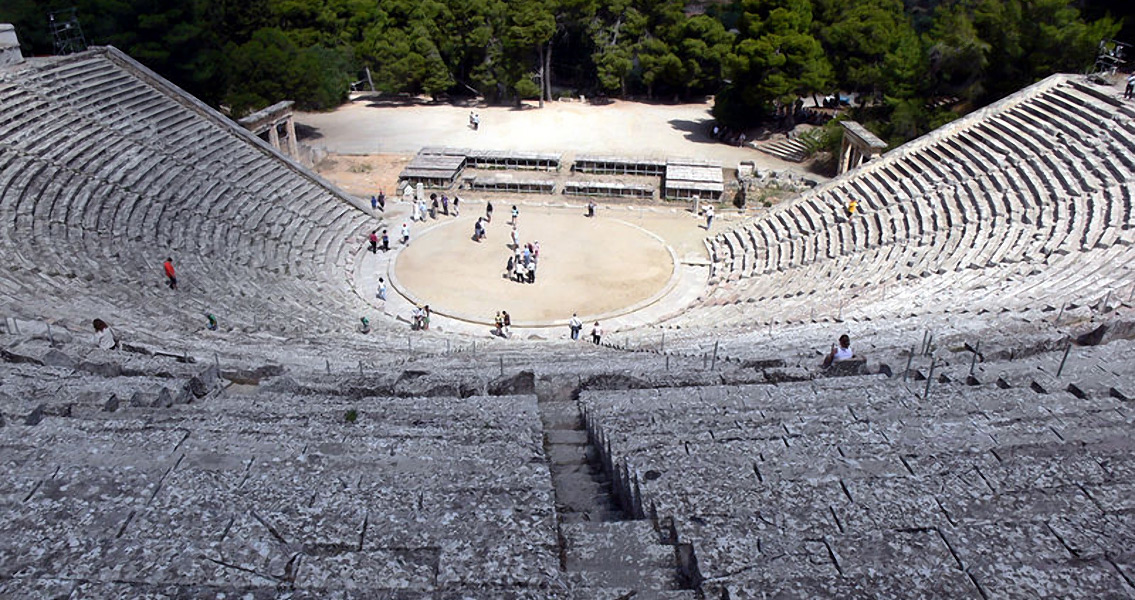
Cennarium bring it back to our lives in the digital format. Theatre is here to stay, so let us take a short look at the historical timeline of its development. Primitive Tribal Dance (8500 BCE) Dancing was an integral part of most shamanistic rituals. Body movements naturally accompanied rites of passage and were present in spirit- appeasing performances. Dancing was then primitive, to say the least. It had been synchronised with rhythmic chanting and drumming with simple instruments such as sticks and stones. Shamanism and Ritual (pre-2500 BCE) The shaman is the holy person of a tribe. He communicates with the divine through elaborate rituals. The fact that shamanism foreshadows theatre is evident in the existence of theatrical elements that are present in a shamanistic ritual. These include song, dance, music, characterization, hypnotism, illusion, clowning, and ventriloquism. Rituals were spectacular performances through which humans tried to ensure success in battle, hunting, and life in general. They used various significant artefacts, which now serve as proof for the fact that the first theatrical performances arose from such rituals. One of the first records of a ritual depiction of a myth was as early as 2500 BCE and was performed annually in Egypt. First Recorded Dramatic Production (1887 BCE) The first ever recorded dramatic production is the Egyptian Passion Play that celebrated the mythical and divine king Osiris. The play was held annually for several centuries and it depicts the struggles and triumphs of the Egyptian king and god. As stated by Greek historians, those plays were so realistic that some of the actors consequently died from the severity of their wounds. Dance as Entertainment (1400 BCE) It is not an easy task to determine the exact date of the origin of dance as we know it today. Unfortunately, there are not many artefacts or cave paintings that clearly depict or represent dancing. However, some Egyptian paintings have been found to represent scantily clad girls who danced to music played by seated musicians. The dancing occurred in tombs, as the women tried to bring delight to the deceased and bring them happiness during their next world residence. This is probably one of the earliest representations of dance as entertainment. Dramatic Dance, Myth and Storytelling (800 BCE- 600 BCE) Dancing was definitely a precursor of the theatre as we know it and today it is its integral part. Variations of a dramatic dance included animal imitation, gymnastics and synchronised rhythmic movements. As time went by, people added sound, costumes and masks so as to make the event more spectacular. Since the creation of language, myths and stories were used as devices for learning and entertainment. Oral storytelling was extremely important when it comes to the development of theatre. The epic tales allowed people to elaborate on a certain myth, modify its elements and develop characters in various different ways to create new stories. It is in a similar way that the Greek theatre came to be, through the rites of Dionysus, and it incorporated elements of the aforementioned ecstatic dances. Greek Theatre (600 BCE- 400 BCE) The cult ceremonies of the fertility and wine god Dionysus are directly connected to the origins of the Greek theatre. These performances included female devotees who danced themselves into a state of trance. Besides dancing, they also ripped apart and devoured the raw flesh of sacrificial animals. The Dionysians then went on to develop a more structured version of theatre. More precisely, it was the Dionysian priest Thespis who first introduced a new element to the Greek theatre. He engaged in a first ever dialogue with the chorus and in that way became the world’s first actor. This event also marks the birth of theatre as we would recognise it today. Tragedians (500 BCE) Theatrical performances and contests became integral parts of the festival which was held in the honour of Dionysus. Unfortunately, there are not many tragedies that survived as full texts, but those that did are truly works of geniuses. Namely, there are three extremely important Greek tragedians: Aeschylus, Sophocles and Euripides. Aeschylus – He added a second actor and in that way increased the potential for drama. He wrote around 80 plays, out of which 7 are preserved. He won the prize for the best tragedy in 484 BCE. Sophocles – He added a third actor, thus expanding the possibilities for achieving an even greater dramatical effect. He defeated Aeschylus in 468 BCE when he won the prize for best tragedy. While Aeschylus dealt with topics of great public interest, Sophocles was concentrated on personal interaction between characters. Euripides – He introduced an unconventional view of the Greek myth. He represented mythological characters as having human frailties and by doing so, he influenced the later schools of tragic drama. The Beginning of Greek Comedy (500 BCE) An annual comedy competition started taking place in Athens in 486 BCE. Unfortunately, only one comedy author’s work was saved, namely, Aristophanes: a comedy genius who won the prize many times. Most of his plays heavily rely on the devices that are central to the ongoing tradition of comedy. He satirised basic character flaws while putting the characters in a ridiculous setting. A good example of such a play is The Frogs, which was written mainly to satirise Euripides. Architecture At first, the Greeks sat on hillsides to watch the performance on a temporary wooden stage. In 400 BCE the “venue” got an upgrade in the form of a stone auditorium. This is known today as the theatre of Dionysus and represents a reconstruction from the Roman period. The best example of a classical Greek theatre is Epidaurus, which was built in around 340 BCE. Roman Comedy (300 BCE- 200 BCE) It is well known that Greece heavily influenced Rome in most cultural matters, but this is especially true when it comes to theatre. In the decades before and after 200 BCE, there were two Roman comedy writers who achieved lasting fame. One of them was named Plautus and is famous for his body of work that resembled entertainment similar to a farce. The other one is Terence and he was mostly known for his comedy of manners. However, neither of them ever invented a single plot. They were all based on Greek drama, while the setting of all Terence’s plays was actually Athens. Roman plays were held as a part of a broader event: the Roman games (which were essentially a harvest festival). Consequently, the audience was scarce and inattentive. The main events were chariot races and boxing matches, while the clowns and plays were more of a sideshow act. What is also interesting is the fact that the Roman circus and gladiators were much more popular than the theatre. Romans found greater excitement in the gladiator’s’ arena while watching a fight to the death, than in the theatre. Senecan Tragedies The date of these writings cannot be exactly pinpointed due to the lack of any ancient references. According to a nineteenth-century German scholar, Friedrich Leo, Seneca’s tragedies were written essentially for recitation. Others believe that the tragedies were in fact performed during Seneca’s lifetime. Unfortunately, we cannot be certain solely on the basis of the existing evidence. Nevertheless, Senecan tragedies are of great value. They were written in blank verse and were not all reworks of Greek dramatists. Senecan tragedies include Hercules Hercules, Furens, Troades, Phoenissae, Phaedra, Thyestes, Hercules Oetaeus, Agamemnon, Oedipus, Medea and Octavia. Seneca’s works heavily influenced medieval tragic drama and still remain of great value. And Then There was Silence With the rise of Christianity and the fall of the Roman Empire many festivals were abated. The last records of Roman theatre could be associated within the Byzantine Empire. When the seat of Roman power shifted to the Northern Roman Empire, so did the festivities. Various dances, including a form of ballet, together with pantomime and recitations from comedies and dances became increasingly popular. Unfortunately, by 400 CE the theatre was completely banished because of its association with the pagan gods, the lack of moral constraints and the ridicule of the church by the mimes. After the collapse of the Roman Empire and during the upheaval in Europe, the theatre did not play any significant roles because it was suppressed by the church and reduced to folk tales. It reemerged in the late tenth century when the Christians introduced dramatic elements into the Easter liturgy to make it more interesting and captivating. These dramatic integrations led to the development of the Medieval Christian drama. It is worth noting that this article only covers the development of the Western theatre. The Eastern theatre was unimpacted by the Christian censorship and continued its steady course of development.]]>
Categories
Editorial

Joseph Grimaldi (1778-1837)

A Family of Clowns As the family name suggests, the Grimaldi family came from Italy. They had been living in England for half a century when Joseph was born. They made their living from comic performances and acting in the London theatres. Joseph’s father, Joseph Giuseppe Grimaldi, was an accomplished entertainer but a harsh parent who regularly beat his children. Joseph’s mother was a 14 year old dancer taken into his father’s apprenticeship. His father was 60 years old at the time of his birth. Joseph’s mother was not the only woman in his father’s life. He had a few mistresses. Born into such a family it was not surprise that Joseph Grimaldi began his stage career at an early age. He was only a toddler when his father took him on stage with him to take a bow on the stage of the famous Drury Lane Theatre in 1780. With no compulsory education law in those years the young boy only received the most rudimentary education. He was raised a child actor to appear in support of his father. Sometimes he had to play the role of animals. It is recorded that once his father brought him on the stage in the guise of a pet monkey with a chain around his neck. His father swung him round so fast by the chain that he was thrown off the stage into the orchestra pit. He survived this fall and many cuts and bruises. This turned out to be a good preparation for the athletic clowning style that brought him later fame. Joseph Grimaldi’s father died when he was just 10 years old. He had developed a paranoid fear of death, and especially being buried alive. In the 1700s the poor state of medicine made this a real concern, but nevertheless Grimaldi Senior went a little too far in his fears. He asked his daughter to cut off his head after his death just to make sure that he would not be buried alive. He offered her the princely sum of five pounds for performing this grisly duty. Joey the Clown The young Joseph Grimaldi was forced to become the main supporter of his family at such a young age. The famous theatre manager Richard Sheridan gave him employment at the Drury Lane Theatre for a pound per week. His mother was also employed as a dancer. Over the next few years he continued to play a series of child, animal and dwarf roles on the London stage. In 1794 he had his first major breakthrough in the Thomas John Dibdin pantomime “The Talisman; or, Harlequin Made Happy” During this era productions build around the comic characters of Harlequin and Clown were the mainstays of comic theatre. Into this particular milieu, Grimaldi found that his comic acting skills fitted very well. He developed his unique clown identify with the painted face. He also entertained the audience with acrobatics and sword play. Not infrequently he caused himself injury through his energetic performance. Another popular element in his performance was the way he used satire to poke fun at characters or stereotypes that his audience easily recognised amongst their own family or acquaintances. He also courted audience participation. In a tactic that is followed by pantomime performers today he asked the audience if he should do a certain move or trick. Invariably his audience shouted yes and egged him on. He also coined the “here we come” catchphrase which successive generations of clowns have borrowed. Some of his comic songs have also stood the test of time and you might hear them sung today where clowns perform. In the first decade of the nineteenth century Joseph Grimaldi rose to the position of the leading comic performer of Regency England. His performance as clown in the Mother Goose pantomime in 1806 brought the theatre an amazing 20,000 pounds in takings. In 1815 along with his fellow clown Jack Bologna, he earned 1,743 pounds in the course of just 56 performances. Theatrical Family Life In 1799 Joseph Grimaldi married Maria Hughes, daughter of Sadler’s Wells Theatre manager Richard Hughes. His wife died in childbirth in 1801. Joseph was devastated by his wife’s death. To take his mind off his grief he added to his performing schedule by performing at both Drury Lane and Sadler’s Wells theatres each night. During one of his routines he accidentally shot himself in his foot. His mother arranged for a dancer called Mary Bristow to attend to him in his sickness. A relationship developed and in the end of 1801 they married. By Mary Bristow he had his only child, Joseph Samuel. With his career at its peak they could afford to take a country cottage at Finchley, which was in those days a country village outside London. Just as Joseph had been introduced to the stage at an early age by his father, he decided to do the same with his own son. Joseph Samuel also developed into an accomplished pantomime performer but he remained in the shadow of his famous father and came to resent it. The Unhappy Clown It is a well-known phenomenon that comic entertainers are often struggling to cope with depression. A story is told that Joseph Grimaldi once went to a leading doctor for treatment for his depressed condition. The doctor was not aware of his patient’s identity. He recommended that the man go to see a performance of Joseph Grimaldi the clown to cheer him up. The patient looked the doctor straight in his face and said to him, “I am Joseph Grimaldi.’ Another time he is recorded as saying that while he makes other people laugh he remains “grim all day” (a clever play on his name). Grimaldi’s acrobatic stunts and numerous injuries in the course of his performances took their toll on his health. In 1821 he collapsed after a performance and from this point on his health went continually downhill. He gave a farewell performance at Drury Lane Theatre in 1827. His wife’s spendthrift habits and people taking advantage of his own lack of skills in money management led to the Grimaldi family’s fall into poverty. His own son became an alcoholic. The drunken friends and ladies of the street he brought home aggravated his parents suffering. Joseph Samuel Grimaldi died age 30. His parents made a suicide pact but their attempt to take poison was botched. Mary Grimaldi died in 1834. Joseph continuing living on his own in abject poverty relieved by visits to the tavern to drink and talk about better times. He died on 1st June 1837, probably from alcoholism. Charles Dickens edited Grimaldi’s memoirs. He had a strong admiration for the clown whom he saw while a young child in 1812. The book was a great success and still makes an entertaining read. ]]>