Categories
Breaking News

Ancient dirty dishes shed light on early climate change – and how farmers adapted

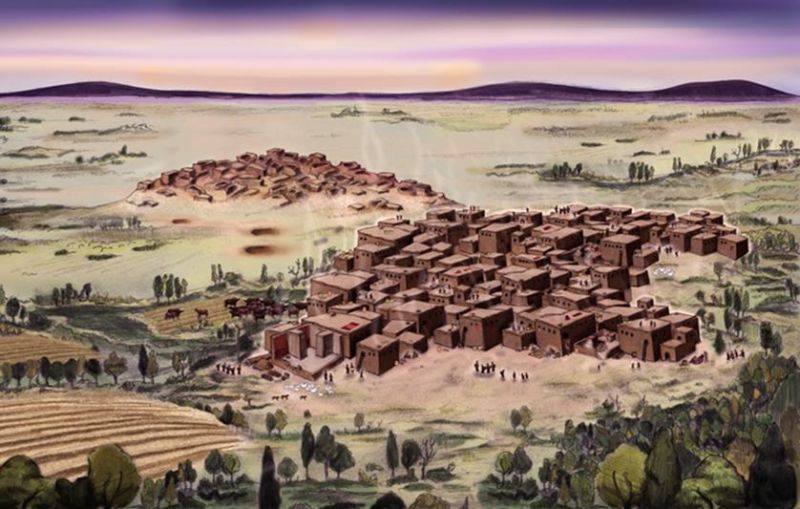
A major climate event Looking closely at the Neolithic and Chalcolithic city settlement of Çatalhöyük in southern Anatolia, Turkey, the study takes into account farming practices in the period spanning 7500 BC to 5700 BC. When the city was most intensely occupied around 8,200 years ago, there was a sudden decrease in global temperatures. It became a well-documented event in the history of climate change, and was caused by a huge amount of glacial meltwater from a massive freshwater lake in northern Canada.   [caption id="attachment_8875" align="aligncenter" width="800"] An artist’s reconstruction of the east and west mounds at Çatalhöyük. Image Credit: Çatalhöyük Research Project[/caption]

Pragmatic farming during drought

The research centres on animal bones found at the excavation site. Scientists have concluded that the herders of the city turned towards sheep and goats, as they fared better during times of drought than cattle. By looking at the cut marks on the animal bones, we can also find more information on butchery practices. They indicate desperation in the community: the high number of cut marks on the bones during the time of the temperature drop shows how the populace exploited any meat available as food would have been scarce.

Dirty dishes

Ancient cooking pots with traces of animal fats have also been analysed in the study, which makes this the first time compounds from animal fats found in pottery are shown to carry evidence for the climate event. [caption id="attachment_8874" align="aligncenter" width="500"] In situ pottery at the archaeological site of Çatalhöyük. The pottery has been at the centre of recent research shedding light on the ways ancient farming practices adapted to climate change. Image credit: Çatalhöyük Research Project.[/caption]

Inevitable impacts

The paper brings together researchers from the University of Bristol’s Organic Geochemistry Unit (School of Chemistry) and the Bristol Research Initiative for the Dynamic Global Environment (School of Geographical Sciences). Co-authors of the paper include archaeologists and archaeozoologists involved in the excavations and the study of the pottery and animal bones from the site. Dr Mélanie Roffet-Salque lead the research. She says: “Changes in precipitation patterns in the past are traditionally obtained using ocean or lake sediment cores. “This is the first time that such information is derived from cooking pots. We have used the signal carried by the hydrogen atoms from the animal fats trapped in the pottery vessels after cooking. “This opens up a completely new avenue of investigation – the reconstruction of past climate at the very location where people lived using pottery.” Co-author, Professor Richard Evershed, adds: “It is really significant that the climate models of the event are in complete agreement with the H signals we see in the animal fats preserved in the pots. “The models point to seasonal changes farmers would have had to adapt to – overall colder temperatures and drier summers – which would have had inevitable impacts on agriculture.”]]>

Categories
Breaking News

History News of the Week – New Insights on the fate of the Rapa Nui

Easter Island mystery – ‘Ecocide’ didn’t lead to the Rapa Nui’s demise New scientific research is challenging the popular belief that the ancient inhabitants of Rapa Nui, aka Easter Island, were wiped out due to over exploitation of natural resources. It is often proposed that the Rapa Nui islanders cut down giant forests of palm trees on Easter Island, leaving them without wood to build canoes for fishing. The theory states that the absence of fish forced them to eat chickens, rats and agricultural crops. The island’s climate and infertile soil meant crop productivity started to decrease as the island’s inhabitants ate more and more. Conflict erupted as competition arose over the dwindling resources, and the population essentially wiped itself out through having destroyed the island’s ecosystem, a theory of their fate dubbed ‘ecocide’. New research from scientists at the University of Bristol, published in the American Journal of Physical Anthropology, is throwing the ecocide theory into question, showing through isotopic analysis of bones, soils and plant remains from Rapa Nui that the population had a diet of equal parts seafood and terrestrial food. Catrine Jarman, lead author of the study and PhD student at the University of Bristol’s Department of Anthropology and Archaeology, said: “We also discovered that agricultural crops consumed must have been planted in soils that were deliberately managed and manipulated to provide better yields. “Previous work has shown that plants of Rapa Nui were grown in rock mulch gardens and planting enclosures known as manavai. These had been carefully constructed and deliberately managed, and our study showed that the islanders may have added fertilisers.” Put simply, the new results suggest the Rapa Nui islanders adapted to the island’s harsh environmental conditions by managing their gardens and manipulating soils for better crops. Contrary to the idea of this ancient people recklessly wiping out the environment that had sustained them, it shows they demonstrated astute environmental awareness and stewardship to overcome nutrient poor soils. Jarman concluded: “This research highlights the unique and varied environmental adaptations that Pacific Islanders have shown through time. “Polynesians developed sustainable economies in ways that we are now better understanding through interdisciplinary research. Lessons from the past and from traditional island societies have value and relevance today.” Ancient Greek theatre had a wooden stage thousands of years ago An investigation by a Japanese architectural researcher suggests a high possibility that a wooden stage existed in the theater of the ancient Greek City of Messene during the Greek Classical period (ca. 369 BCE). During the Messene theatre’s 2007 excavation, a large storage room and three stone rows were discovered beside the stage by a group from the History of Western Architecture Laboratory of Kumamoto University. Similar features had also been discovered in Ancient Greek theatres at Megalopolis and Sparta. After studying the three sites in depth, a Kumamoto University researcher determined the stone rows remaining in the Megalopolis theater would have been used to set up wooden background picture panels, and the stage storage room would have likely been the custodian of such panels. In Hellenistic theatre, a one-story construction known as a proskenion was installed on the stage as background, behind which was another two story construction known as a skene that served as both a dressing room for actors and additional stage background. Traditionally, it’s been assumed that the skene and proskenion were wheeled around the stage as a single, large construction. The new research however, suggests they might have been moved separately. “A large force would have been required to move stage equipment as large as the proskenion and skene,” said Associate Professor Ryuichi Yoshitake who led the research project. “In previous studies, there was a theory that the proskenion and skene were simultaneously moved along just three stone rows, but I think it is more logical that the proskenion and skene each had their own set of two stone rows to move along. I came to this conclusion due to the positions of three stone rows and the fact that it would have been quite difficult to move the heavy proskenion and skene together using a single axle with three wooden wheels.” The findings have been published in the German language science journal Archäologischer Anzeiger. A new method to chart humans’ domestication of seeds Scientists from University College London have used synchrotron light to document for the first time the rate of evolution of seed coat thinning, a major mark of crop domestication, from archaeological remains. It marks the first-time scientists have been able to measure coat thickness throughout an entire seed. Published in the journal Science Reports, the authors present evidence for seed coat thinning between 2,000 BCE and 1,200 BCE in the legume horsegram (Macrotyloma uniflorum), a bean commonly eaten in southern India. “Seed coat thickness is a great indicator of domestication, as thinner coats will mean faster germination of a seed when it is watered,” explained Dorian Fuller, co-author on the paper. “But conventional methods of looking at the seed coat require breaking and destroying archaeological specimens.” “Being able to look at the seed coat thickness without breaking the sample is possible by other methods, but you can only look at a spot on the seed,” added Charlene Murphy, co-author on the paper. “The beamline at Diamond has allowed us to look at the entire seed, and has shown considerable variation within individual specimen’s seed coat thickness.” The team’s results suggest that domestication of horsegram took place during the second millennium BCE, with seed coats fairly fixed in thickness by the early centuries CE. The findings also suggest that the high-resolution X-ray computed tomography method could be used to study a variety of domesticated grains and pulses. Featured image: New isotopic analyses of bones, soils and plant remains from Rapa Nui, Chile (Easter Island) provide evidence contrary to the widely-held belief that the ancient civilization recklessly destroyed its environment. Courtesy of Terry Hunt ]]>
Categories
Breaking News

Scientists Say Irrigation Used in Prehistoric Olive Cultivation

The Jerusalem Post, the international team of archaeologists – spearheaded by the Zinman Institute of Archaeology from the University of Haifa – announced the find this week, remarking that with such a large quantity of olive pits, it is highly likely that these early farmers would have needed to employ irrigation techniques. Professor Daniel Rosenberd, the co-leader of the research project, stated that the revelation that ancient agrarian societies were relying on artificial irrigation could result in a fundamental change in how scientists and historians understand how sophisticated these ancient farmers were. Rosenberg and his colleague: Dr. Florian Klimsh from the German Archaeological institute, believe that the prehistoric settlements found here in northern Israel in close proximity to Jordan were instrumental in the developmental process of the Near Eastern cultures and cities of antiquity. Despite this, little is known about these ancient settlements today. In order to broaden that knowledge, the recent research into the region focused on gathering botanical evidence to make determinations regarding what the conditions would have been in the Jordan Valley seven thousand years ago. Doing so could help shed light on not just agricultural practices and diet but also the economy of the region and how these settlements were organized socially, researchers say. It is well known that olives were being used in the region at this time, based on other documented evidence. However, with the sheer number of olive seeds found on site, Rosenberg said that several questions were raised which necessitate a new look at how ancient farmers irrigated their crops – and how the olive and olive oil trade operated during the time as well. Data collection over the past four years has already revealed much regarding the lives of these ancient farmers, with evidence pointing to the inhabitants growing different plant species concurrently. These plants, which all had differing maturation cycles, were meant to be used as a back-up in the event of a poor harvest. ]]>

Categories
Breaking News

Insects Not Humans The World's First Farmers

www.plos.org Image courtesy of Wikimedia Commons user: PHP Ninja ]]>

Categories
Breaking News

Research Shows That Farming was Hand Delivered to Europe

Proceedings of the National Academy of Sciences. Image courtesy of Wikimedia Commons user: Zde ]]>

Categories
Breaking News

Millet Played Pivotal Role in Ancient Agriculture

Categories
Breaking News

Ancient DNA Provides an Evolutionary Roadmap

Categories
Breaking News

How Hunter-Gatherers Became Farmers, Examined

New research has, however, challenged this model. “The concept of intensification has become widely linked to hunter-gatherer research,” Christopher Morgan explains in an article published in the most recent edition of the Journal of Archaeological Research. Intensification, Morgan states, has been used to explain the evolution of human behaviour, the origin of farming, and the development of rank in complex hunter-gather societies. “This has led to diverse and even contradictory applications of the concept of intensification, to the point that a critical assessment of its current methodological and theoretical applications to the archaeology of hunter-gatherers is overdue.” One of the key problems Morgan has with the intensification model is that it does not analyse the conditions which gave rise to increased agricultural production. It is unclear, Morgan argues, whether increasing population, climate change, or changes in social behaviour drove intensification. Further, the intensification model does not examine whether abundance or scarcity drove the development of agricultural societies. Particularly in North America, it is unclear if hunter-gatherers were starving, and consequently intensified in search of a means to supplement their diet, or if they had such a surplus of food that they could explore how to increase production further. Morgan is particularly hostile to the intensification model as it is often used loosely. “One side of this divide uses intensification in a descriptive sense, where it is simply taken to mean any increase in economic productivity. The other uses intensification in an explanatory sense, where it is employed to explain how people solved population-resource imbalances,” he argues. Interesting though the intensification model is, it obviously has significant problems. How far we can apply this model to early societies is debatable. Morgan views intensification as an important consideration in the debate, but warns that over-use of the model can hamper our understanding of the past. With proper refinement and analysis, however, intensification has the potential to open the door to a much more nuanced understanding of how diversification occurred. For more information: www.link.springer.com Image courtesy of Wikimedia Commons user: Cropbot]]>

Categories
Breaking News

Largest Ever Roman Water Basin Uncovered During Metro Extension

Categories
Breaking News

Ancient People Grew Crops on the “Roof Of The World”

Image courtesy of: Bluemoose]]>