


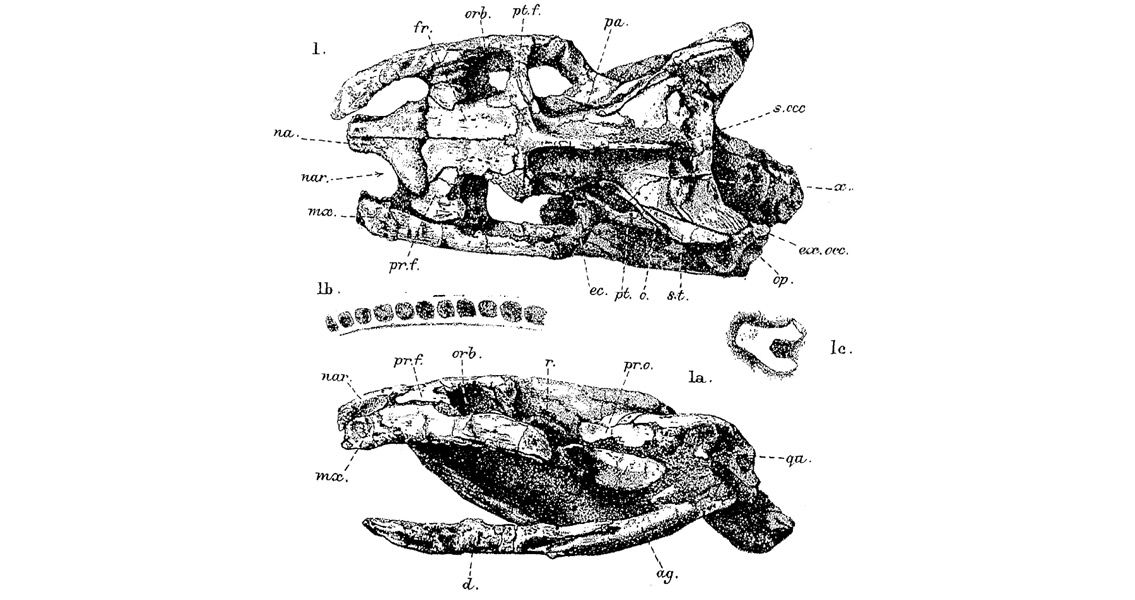
Dinilysia patagonica. The scientists subjected a D.patagonica skull to CT scanning and then constructed three-dimensional virtual models in order to compare the ancient snake’s bony inner ear structures to those of modern snakes and lizards. The results point to snakes losing their legs around when they began to adapt to digging and burrowing in the ground, and not when they slipped into the sea. The lead scientists, in the research study published recently that described their findings, say that D.patagonica was likely to have been a burrower – and that modern crown snakes had ancestors that burrowed as well. The researchers used the shape of the inner ear to provide ectomorphic indicators for snake habits, as these details are often not preserved in fossilized remains. These specialized cavities in modern snakes control their ability to hear and their sense of balance, much in the way that the inner ear structures of D.patagonica are suggested to have done. The use of 3D modelling, based on the data gathered from the CT scans of the fossil, revealed distinctive structures that were analogous to those that burrowing animals have to provide them with additional abilities to avoid predators and hunt prey. These specialized adaptations are markedly absent from modern snakes that live above ground or spend time in the water. Such activities were common before modern snakes developed, but Dr. Norell and Dr. Yi claim that burrowing was an exclusive habit for evolutionary ancestors of crown snakes, as both D.pataognica and a theorized crown snake ancestor both possessed large inner ear chambers that have been associated with the ability to detect low-frequency sounds. This suggests that crown snakes had the ancestral ability to detect vibrations in substrate in order to detect predators and prey alike. The new findings may help paleontologists begin to fill in the gaps left in the narrative of snake evolution. The scientists said that the snake was easily more than 1.8 meters in length from snout to tail, crowning it as the largest burrowing snake ever. Additionally, the research findings have offered clues about an even older ancestor that may be the originator for all modern snakes alive today. For more information: www.advances.sciencemag.org ]]>
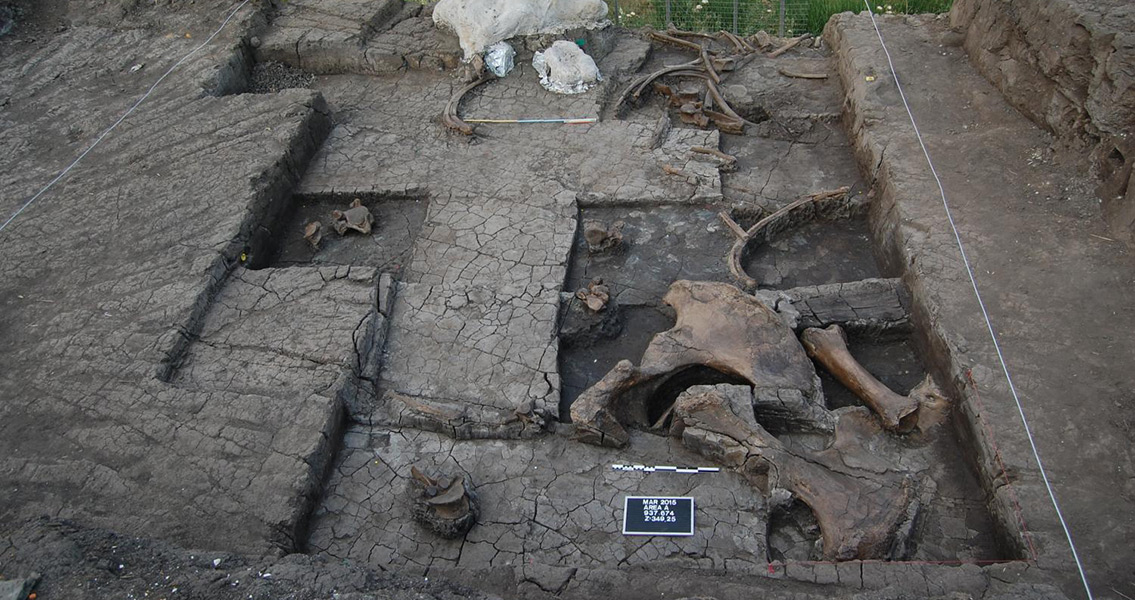
Elephas antiquus, more commonly known as the straight-tusked elephant, a long-extinct species that is thought to be the progenitor of the African elephant. Marathousa 1 was likely to have been a butchering site based on the types of stone artifacts found in close proximity to the remains of the elephant. Additionally, highly distinctive kerf marks were left behind on the bones of the elephant, ostensibly a result of the stone tools as they were used to separate the elephant meat from its bones. So far, early analysis results seem to indicate that the site dates to the Middle Pleistocene, putting it roughly between 300,000 and 600,000 years old. According to Katerina Harvati, a professor with Tübingen University’s Center for Human Evolution and Paleoenvironment, the Greek site is unique due to several of its characteristics. In a press release published by the University, she remarked that the Megalopolis site is the only one in the Balkan region where evidence of an early Paleolithic elephant being butchered had been uncovered. Easily one of the most ancient archaeological sites within the entire country, Marathousa 1 lies within what would have been an epicenter for human migration routes into Europe while also acting as a refuge for human, animal, and plant populations during ice ages. Harvati said that research into the region and its Paleolithic importance has largely gone unnoticed because of Greece’s role in Classical history. Much of the scholarship has revolved around the Hellenistic period and eschewed the Lower Paleolithic as a result. Despite this, the researcher added that Marathousa 1 was and continues to be a high-value site for revealing the secrets behind how humanity dispersed into Europe and how early humans adapted to and behaved within the region as a whole. Professor Havarti, along with her colleagues from both Germany and Greece, hopes to aid in closing the Paleoanthropology research gap that exists in southeastern Europe as a result of this previous focus on the Classical period. Image courtesy of Greek Ministry of Culture ]]>


www.pnas.org ]]>
www.schweizerbart.de ]]>
