American President James Madison Declares War on Britain
On June 1, 1812, the fourth American President, James Madison declared war on Britain. His decision was spurred by what he and other congressmen believed to be ongoing issues with the British government. They seemed to have scant regard for American citizens, as the British government would force men to join the Royal Navy without warning, there were trade restrictions imposed as a result of the ongoing war between Britain and France, along with many other complaints. President Madison had surmised that Britain would have been distracted by the current war and Canada (a territory they hoped to capture) would give in easily. The fact that the American soldiers were low in numbers, and lacking in confidence and discipline, was not seen as an important factor. Due to this poor judgment the war was expected to be quick and easy, it would not be.
The United States at that time was in opposition to the ongoing war between France and Britain. Britain on the other hand saw America as a threat not only because of their stance on the Napoleonic wars but also because their naval empire was growing, leaving Britain feeling vulnerable on the seas. There was also rivalry regarding Britain’s recruitment of what America recognized as naturalized American citizens. The Royal Navy would, without warning, go after British born sailors who had deserted their fleet. While this angered Americans, Britain ignored it and continued. Britain apparently did not take into account that America was uncomfortable with the fact that they did not recognize naturalized American citizens and Britain continued to round them up, leading America to believe that Britain did not think they were not good enough to naturalize former British citizens.
After days of deliberations voting was finally complete, and on June 18, more than two weeks after it was declared by the president, the Americans officially began war with Britain by launching their attack at the Canadian borders, seizing parts of what was known then as British North America. Ironically, a peace message was sent by Lord Liverpool on June 23, less than a month after he came into power. Following the assassination of Spencer Percival, the previous Prime Minister, Lord Liverpool’s ascent to the post of Prime Minister came with a need for a change in the relationship between the United States and Britain. Though the peace message was sent, because of the lengthy trip across the continents, President Madison never received it in time. Similar to the lengthy time it took for the message of peace to reach American soil, such was the fate of the declaration of war that was sent by the president.
Both Armies Ill-Prepared
Though the US army was sparse (with less than 12000 soldiers), an effort was made to expand the army when it became evident that the fighting would go on longer than was anticipated. This proved difficult for the Americans as there were no real motivation for men to willingly want to become a part of the fighting. When up against the British forces they were near powerless as the raw recruits were no match for the highly experienced British soldiers, who had cut their teeth fighting the armies of Napoleon. Another blow to the US army was the lack of funding; the pay was low and was a turn off to potential recruits. Service men involved in the fighting were mostly volunteering and there was a lack of discipline. In fact, more time was spent evading the British army than was spent defending the country. On the other hand for much of the war the British forces were largely engaged in fighting on the European mainland.
The US army led by General William Hull, on June 12, 1812, invaded the Canadian town of Sandwich. A month later in Detroit, they surrendered to a smaller group of British soldiers, who were under the command of Major General Isaac Brock. The Americans were adamant in their quest to take over Canada and launched another attack in the Niagara Peninsular some months later. This again proved futile as even though Major General Brock was killed, the British were able to once again defeat them. This constant defeat prolonged the war longer than The US had hoped. The US army would later reorganize their troops but they were never able to conquer Canada.
By 1814, Napoleon had abdicated, giving the British Army more elbow room to focus on the War in America. This placed the war in a different light as Britain could now allow for more troops to be deployed to the US. They sent veteran soldiers to fight led by Major General Robert Ross and Rear Admiral George Cockburn, who were two major players in the Burning of Washington. An attack was launched on New York, however the American Army was finally getting its composure and had gained requisite experience to be recognized as worthy foes. Britain was not about to acquiesce however, as another attack was launched, this time at Chesapeake Bay. For the British army, the Chesapeake Bay attack was a definite success.
The Attack on Washington
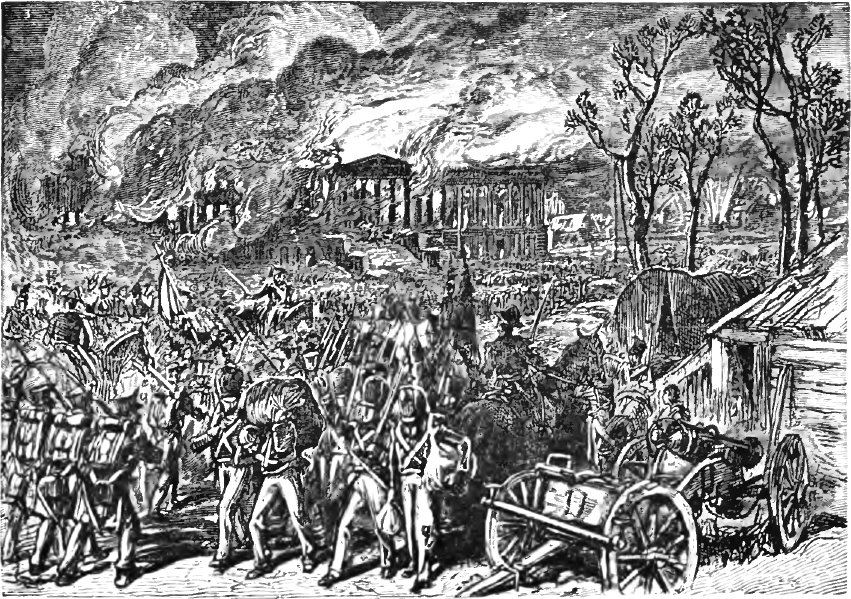
The attack on Washington was led by Major General Robert Ross and would go down in history as possibly the most brazen attack on the US capital. Such was its severity that there were talks to relocate the capital to another state. British soldiers marched through the streets of Washington and set fire to many public buildings. Word reached the White House that the British soldiers were on their way, before the army had reached the White House, it was abandoned. First lady Dolley Madison stayed behind and, with the help of a few slaves, she was able to secure the valuables before the soldiers arrived. When they did, they did not hesitate to partake of the feast that was prepared for the president’s dinner and then proceeded to destroy the building. Fuel was added to the fire to prolong the burning straight into the night, luckily the walls remained intact and were later restored during a cleanup exercise. The burning of the White House was condemned by many European leaders and Britain was frowned upon for behaving lewdly on international soil. In return Britain lashed out by saying the American had started the war initially, they believed their actions were justified based on the US invasion of Canada. Nonetheless, it had placed Britain in a bad light. Following the burnings, there was an effort to relocate the capital to another state but with quick funding from Washington businessmen, the buildings were hastily restored in time for the inauguration of James Monroe, who succeeded Madison in 1817.
Victory for the US and Birth of the Star Spangled Banner
Following the attack on Washington, America struggled to secure their dignity and was able to secure one small victory with the battle of Fort McHenry. The British thought it was the perfect place to launch an attack because of the close proximity to the capital, but they were firing from too far out which proved futile. Plans to go ashore for a more intimate attack were abandoned. On the morning after the bombardment, the American flag remained standing proud, signaling victory for the US. The flag flying amidst the darkness of dawn was an observation made by attorney Francis Scott Key which led him to write a poem that eventually became “The Star Spangled Banner”. The song itself was originally written as a poem entitled “Defense of Fort M’Henry”.
On September 3, 1814, Scott Key was on a mission to negotiate the release of a popular doctor who had been captured by the British soldiers. Key was selected by the American President to be a prisoner-of- war exchange officer. On the said morning, he and fellow lawyer John Stuart Skinner went aboard Major General Robert Ross’s ship, the HMS Tonnant, to present their case. They bore letters signed by president Maddison and by soldiers vouching for the doctor’s kind-heartedness. They were able to witness first hand planning of the attack by Ross and his fellow soldiers. They were themselves kept prisoner until those plans were executed as they were seen as a threat. They were however able to witness the attack from their own boat and seeing the American Flag waving to signal victory, he was inspired to write the lyrics to “The Star Spangled Banner”. Though Key was the writer, it was on the initiative of Skinner, who Keys showed his work, that the poem was eventually published. The poem was set to a key of an already popular British song known as the “Anacreontic Song”. It was adopted into song and became the US national anthem in 1931 under the guidance of President Herbert Hoover.
The Treaty of Gent
In 1814, in Belgium at a town called Ghent, both parties agreed to meet and began peace talks. Both the US and Britain had concluded that they had achieved what they intended. Border restrictions were removed and territories that were captured during the war were given back to the party that was the original owner. Many of the issues were resolved, but ironically the issues that had initially led to the war were not mentioned in the treaty. The treaty of Ghent did not happen overnight, achieving a common decision was a war within itself. Some points were agreed upon while others were in total disagreements. One issue was the migrant slaves who were lured away during the war. To add to their numbers Britain had used a number of tactics to overcome the Americans, one such action being that they welcomed American slaves with open arms, promising them freedom and a ticket to fight against the Americans. Many slaves took advantage of this opportunity and migrated to England and eventually settled in parts of Canada. These slaves were never returned and America thought Britain was being unfair and in violation of the treaty. Britain eventually agreed to reimburse slave owners a sum of $1 204 960.
After being at loggerhead five months of negotiations later, they were finally at an agreement. Both America and Britain suffered severe loss and it is still unclear as to who really won. Each country was of the view that they had won the war. Both parties suffered casualties and monetary losses that put their country at a loss. Britain’s debt increased significantly which was one of the factors that led to a closure of the war and talks of peace. Canada was one of the biggest parties to gain as they had successfully retained freedom from United States and still remained a part of the British Empire. “Precis of the Wars in Canada” gives full details on the war as it happened in Canada. The end of the Anglo- American war saw a growing friendship between the two countries and both parties have long since enjoyed over 200 years of peace, described in more recent times as a “special relationship”.]]>
 The Voynich manuscript is a pictorial codex hand-written in a mysterious writing system, named after Polish book dealer Wilfrid Voynich, who purchased it in 1912. The pages of the codex, which was written on vellum, have been carbon dated to the early 15th century, between 1404 and 1438. The content features illustrations of exotic plants, stars, and mysterious human figures, as well as many pages written in an unknown text. Its origin is unknown, with the earliest confirmed owner a Polish alchemist named Georg Baresch.
Professor Bax has begun to unlock the mystery meanings of the Voynich manuscript using his wide knowledge of mediaeval manuscripts and his familiarity with Semitic languages such as Arabic. He is working through it letter by letter using careful linguistic analysis.
He explained, “I hit on the idea of identifying proper names in the text, following historic approaches which successfully deciphered Egyptian hieroglyphs and other mystery scripts, and I then used those names to work out part of the script.”
“The manuscript has a lot of illustrations of stars and plants. I was able to identify some of these, with their names, by looking at mediaeval herbal manuscripts in Arabic and other languages, and I then made a start on a decoding, with some exciting results,” he added.
The term for Taurus is one of the words he managed to identify. Other than that, a constellation of of seven stars which may be the Pleiades, and also a picture of the plant Centaury, a known mediaeval herb, as well as a number of other plants.
Professor Bax was reported to have conducted a lecture that focused on the procedure and problems in decoding the manuscript, and also discussed moves to identify the underlying language of the manuscript. The Voynich manuscript has earned a reputation for being ‘the most mysterious’ manuscript on the planet. Even though he has so far managed to crack only part of the manuscript, that alone is quite a breakthrough and will no doubt pave a path for like-minded enthusiasts to join the manuscript-decoding party.
The Voynich manuscript is a world-renowned case in history of cryptography. Many cryptographers, professional and amateur, have tried and fail. Even codebreakers from World War 1 and World War 2 were unable to penetrate into its inscrutable content. Its obscure reputation grew with the emergence of some rather grand theories. Some suggested it was the work of a young Leonardo da Vinci, various secret groups, or even Aztecs. Some even went further and proclaimed it was transcribed by something not from this earth, while other, more pessimistic people stated that the manuscript might be nonsense.
Even though the manuscript is not fully decoded yet, Professor Bax’s work would undoubtedly serves as a much-needed trigger that would launch the journey of its full decipherment to its eventual success.]]>
 Said to have been based on Mark Twain’s Memoir, Life on the Mississippi, The Adventures of Huckleberry Finn follows the life of a young adventurous boy (Huck Finn) as he runs away from both his guardian, the Widow Douglas and his father Pap. He accidentally teams up with another runaway, a slave named Jim.
As the two set off they hope to find freedom from different things; Huck from both the thought of being “civilized” and his drunken father, and Jim from his current life. Jim is a slave and is running away to become a free man so he can in turn free his family from slavery.
The two unlikely friends journey down the Mississippi in what turns out to be a series of adventures filled with death, disguise and eventually not just the growth and maturity of their friendship but also of Huck. The river, on which their journey is set, is an important motif and acts as both the agent that brings the two closer to their destination as the motion that pushes Twain’s story along.
The Mississippi is the fourth largest river in the world and stretches over ten US states. What has made the Mississippi River so famous is not only the importance it plays to those towns surrounding it but the way in which Mark Twain uses the river in many of his literary works as an important motif.
Twain retells his experiences on the Mississippi river in a memoir published in 1883, centered on his life as a steamboat pilot. It follows his journeys on the Mississippi from St Louis to New Orleans. His own experiences were what inspired the 1834 novel, The Adventures of Huckleberry Finn. Twain’s recount of Huck’s journey along the river maps the road to the young boy discovering himself.
One of the most obvious features of the river is the way in which it provides a hidden getaway for anyone who wants a quick way out of town. Because the river spans so many states, one could easily hide in one of the many towns that the river passes though. The river acts as a back road and is the first option for making hasty retreat.
It begins as a friendly journey as Jim and Huck gain a raft and food that has been washed up. Twain seems to point out how giving the river can be and how much they can hide comfortably on this hidden trail, but it doesn’t stay calm for too long.
Their subsequent encounters with hoodlums, thieves, liars and murderers shows that just like the river that can be friendly on some days and rough and engulfed in fog on other days, such are their experiences; they might be able to sail smoothly and bask in the sunshine and the quietude on parts of their adventures, but not far downstream they can encounter rough waters.
Another astounding feature worthy of mentioning is the way in which Twain seems to compare the Mississippi river with the aristocracies. Huck ends up meeting a family known as the Grangerfords and realizes they have been locked in a feud for years with their neighbors, the Shepherdsons , a family with whom they attend church. There is no difference with life on the Mississippi and life among these people.
Their longstanding feud erupts when two members of either family decided to elope. The feud turns deadly and seems to reflect Huck’s earlier experiences on the river where a feud between friends ended in death. There is a stark comparison between the two worlds as Huck seems to have been caught in between the two.
 Twain’s love for the Mississippi river is no doubt evident in the novel. It is portrayed not just a long and winding avenue that leads out of town and away from potential conflicts but a road that enables one to find themselves.]]>