Categories
Breaking News

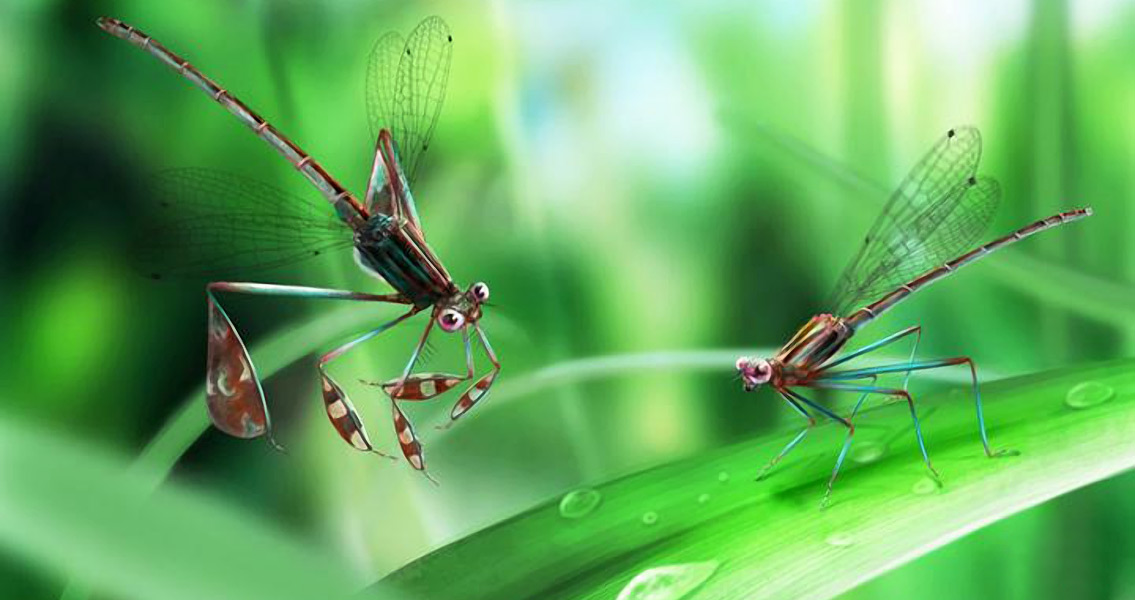
Amber From the Cretaceous Preserves Damselfly Courtship Ritual

Yijenplatycnemis huangi in honor of the donor of the amber, Huang Yijen from Taiwan. The preserved Y. huangi specimens showcased large, expanded pod-like forelegs that would have improved chances of mating successfully by both attracting females as well as helping to fend off other suitors. These characteristics are commonly found in similar modern insects, the most common being the male Platycypha caligata damselfly found in Africa, who use their enlarged forelegs in an almost identical manner. East Asian damselfly species also exhibit similar traits as well, including feather-like legs that are only apparent in males. These modern East Asian damselfly males put on a display with their legs in front of females, and Dr. Zheng and Professor Wang believe the legs of Y. huangi would have been used in a similar manner. The fossil specimens have legs that are much more expanded than any other modern damselfly species, which could be an indication that Y. huangi’s forelegs were an extreme adaptation for courtship behavior. The excessively large forelegs of Y. huangi could have also played other crucial roles – both making males more easily noticeable by females of the species and also in warding off predators. The researchers say that Y. huangi’s forelegs were so large that they would have moved slower due to air resistance, attracting female attention more efficiently and increasing mating opportunities. Meanwhile, the pod-like shape and coloration of the ancient damselfly’s legs could have been used to distract or intimidate predators. The pigmentation of the legs, which are partially covered with a pair of brown bands and feature an eye-shaped spot, are similar to the wing spots on some modern butterfly species. These wing spots were also present on a species of extinct lacewings from the Early Middle Cretaceous. Dr. Zheng and Prof. Wang state in their study that the spots on Y. huangi’s legs were likely too small to do much in the way of deflecting predators. Instead, these dots may have been more similar to the “eyespots” on peacock feathers, providing yet another way to garner the attention of the females of the species. The research paper, recently published in the journal Scientific Reports, can be found here Image courtesy of Image by YANG Dinghua]]>
Categories
Breaking News

Beetles Discovered in Amber Pollinated Orchids 20 Million Years Ago

American Entomologist, the new study by George Poinar Jr. from Oregon State University describes beetles preserved in fossilised amber with orchid pollen in their mouths. Pollination is crucial to the reproduction of plants. Pollen grains produced in the anther, the male part of a flower, must be transferred to a stigma: the female part of a flower, of a plant from the same species. Central to this process are pollen vectors, creatures which play a key role in pollination by transporting the pollen between the flowers. Insects are the most common pollen vectors, with bees and butterflies the ones most likely to spring to mind, but certain beetles are also known to pollinate plants. “My paper points out that beetles may play a more important role in pollinating orchids than originally thought, and that they have been doing so for some 20 million years,” said Poinar, in a press release from the Entomological Society of America. Although it is already known that some present day beetles use orchids for nectar, no fossil evidence has ever been found showing beetles pollinating orchids in their evolutionary past. The evidence presented by Poinar’s study is therefore hugely significant. The first specimen in the study was a hidden-snout beetle discovered in amber from the Dominican Republic. After closer analysis, it was found the beetle had pollinaria from an orchid known as Cylindrocites browni attached to its thorax. A second specimen, a toe-winged beetle, was found in amber from Mexico. This time, pollinaria from an orchid described as Annulites mexicana was found attached to the beetle’s mouth parts. It is estimated that the beetle in Dominican amber was alive between 20 and 45 million years ago, while the beetle in Mexican amber is thought to date to between 22 million and 26 million years ago. Curiously, the current day descendants of the two beetles under study are not among the species of beetle usually associated with orchid pollination. No modern day hidden-snout beetles have been seen visiting orchid plants and no toe-winged beetles have been seen with pollinaria. Poinar says that this doesn’t necessarily mean the current-day toe-winged and hidden-snout beetles aren’t involved in pollination. Rather, it’s an anomaly that could be explained by their secretive behaviour, and the difficulty this leads to when it comes to gathering data about them. “While no present-day cryptorhynchid weevils or ptilodactyline beetles are known to carry pollinaria, past and future collections of these and other beetles should be examined to search for attached pollinaria,” Poinar said. “Orchids may have evolved beneficial associations with a much wider range of beetles and other insects than we thought possible.” Image courtesy of Entomological Society of America]]>

Categories
Breaking News

Amber Necklace May Prove Viking Presence in Istanbul

Categories
Breaking News

Plague May Be Older Than Mankind

Categories
Breaking News

Archaeologists Find Ritual Site in Poland