Categories
News

Important Questions Answered about Evolution of Hominin Diet

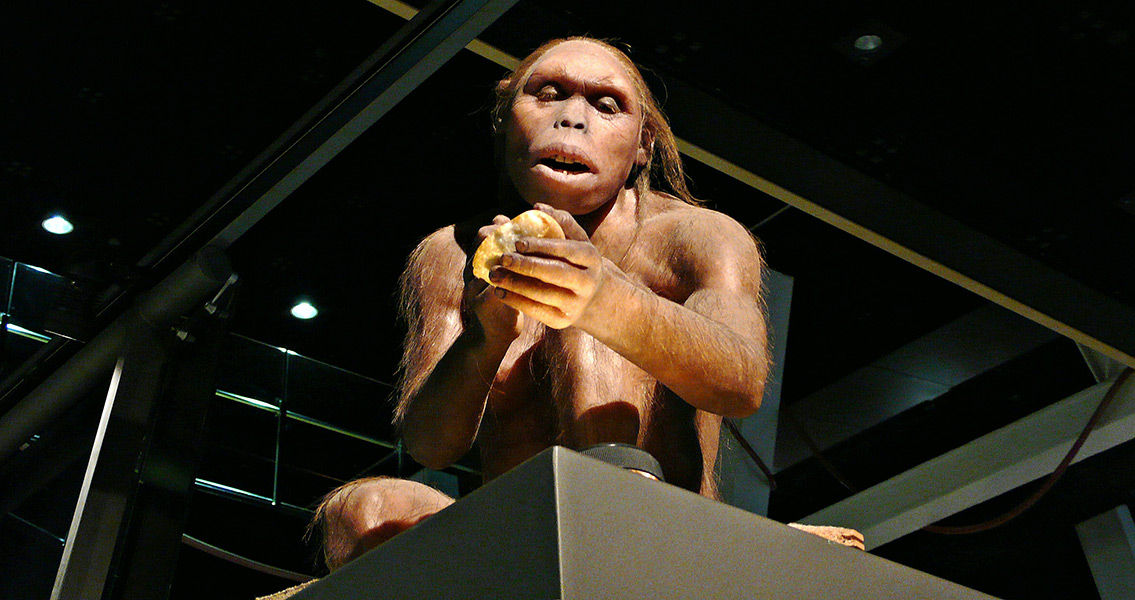
Theropithecus oswaldi, during the early Pliocene. Most plant groups are placed into one of three categories, C3, C4 and CAM (Crassulacean acid metabolism). The main difference between the plants concerns the photosynthesis process: C4 plants process atmospheric carbon into a compound with four carbon atoms, whereas C3 convert it into a compound with just one. CAM plants on the other hand, are capable of using either pathway for photosynthesis. The crucial consequence of this difference is that C4 plants are much more suited to growing in a hot, dry climate – they photosynthesize at a faster rate and in a way which involves significantly less water loss. Examples of C4 plants include maize, millet, papyrus and sugarcane, while C3 plants include rice, wheat, spinach, potatoes and yams. By expanding their diet to include C4 plants, hominins may have been able to increase the variety of environments in which they could survive, or increase their chances of survival in more changeable environments. 152 fossil teeth from the Woranso-Mille site in Ethiopia were subjected to analysis as part of the study. The distinct carbon isotope signatures of C3 and C4 plants mean that the composition of an animal’s diet can easily be determined through their tooth enamel. This method allowed the scientists involved to fill in gaps about the chronology of the evolution of early hominin diets. “Fossil teeth from the Woranso-Mille paleontological study area are well-suited to fill the temporal gap in the isotopic record of hominin diet because they are part of a record of Pliocene mammalian fossils that spans 3.76–3.2 Ma”. The Pliocene is one of the most important periods in the evolution of humans, when early hominins left the trees and increasingly walked on two legs, and their diets diversified massively to include a much wider range of food sources than their ancestors. Consuming C4 foods was a crucial part of this transition. As the study explains, “The incorporation of C4 resources into hominin diet signifies increased dietary breadth within hominins and divergence from the dietary patterns of other great apes.” The analysis showed that both hominins and Theropithecus included substantial amounts of C4 foods in their diet as far back as 3.76 million years ago. In comparison, other primates and mammals showed evidence of widespread C4 consumption much earlier, as far back as the late Miocene period (11.6 to 5.3 million years ago). Although occurring at a similar time, the diversification into a C4 diet had different consequences for Theropithecus and hominins. For Theropithecus, it marked the beginnings of a dietary specialisation which culminated in them assuming the role of a grazer among the mammal species of Africa. For hominins on the other hand, the transition came in the wake of significant dentognathic changes which were part of a general broadening of their diets. As the study concludes, these changes played a significant role in the development and spread of hominins, and were subsequently vital to human evolution. “The unequivocal incorporation of C4 resources by hominins and cercopithecids as early as 3.76 Ma demonstrates that primates were expanding the types of food resources and potentially the environments that they were able to exploit.” For more information: www.pnas.org Image courtesy of Wikimedia Commons user: Thamizhpparithi Maari]]>

Categories
Breaking News

People In Pompeii Led Healthy Lives

Categories
Breaking News

Inuit DNA Changed to Suit Harsh Arctic Environment

“Greenlandic Inuit show genetic signatures of diet and climate adaptation“ ]]>

Categories
Breaking News

Grass-Based Foods in Hominin Diet Earlier Than Thought

Australopithecus afarensis diversified their diet, are important, because the dietary shift was directly linked to bipedalism and a better adaptability. When the first primates emerged on the evolutionary scene, they were pretty much tree-bound, which meant they were also bound to a certain limited number of habitats. By learning to walk on the ground, and upright at that, their hominin heirs gained access to more food sources and could move over greater distances, which meant they could survive and thrive in more diverse habitats than their ancestors. It is possible that climate change had a role to play in the dietary changes they observed, but the authors of the study report that they were unable to establish such a link firmly, instead suggesting that the emergence of new primate species was an important factor as it changed the ecology of the already existing primate communities. One of these new species was the now extinct baboon Theropithecus oswaldi, which joined the primate community around 3.76 million years ago, around the time the dietary change started to take place. It is with relation to these primates that Levin’s team found something very interesting. It appears that these large baboons started eating grass and grass-based foods before their teeth changed shape to be more suitable for grazing. This shape change only happened after they learned to walk on the ground. Study co-author Johannes Haile-Selassie from the Cleveland Museum of National History told Heritage Daily that the results “indicate that form does not always precede function. In the earliest baboons, dietary shift toward grass occurred before its teeth were specialized for grazing.” For more information: “Dietary change among hominins and cercopithecids in Ethiopia during the early Pliocene” Image courtesy of Wikimedia Commons user: Rehman Abubakr ]]>

Categories
Breaking News

Porridge Pre-Dates Farming, Study Finds

an earlier study, it played a major role in the evolution of the human brain. What’s more, in those times of hunter-gathering societies, heated and ground oats were easier to carry when the communities moved around as they did. Those Palaeolithic inhabitants of what is now Apulia weren’t alone in their realisation of the benefits that starch could bring them, Mariotti Lippi told Vox. Earlier studies have shown that people living at the time in central Italy ate bulrush, and in the Middle East, starch was supplied by wild wheat. There is also evidence of starch consumption from Moravia, in the eastern Czech Republic, and Russia, although what sources it was derived from for now remains unclear. One such study, conducted again by Italian researchers, looked at plant remains on grinding stones from around 30,000 years ago and found that Stone Age inhabitants of Italy, Russia, and the Czech Republic ground fern roots to make them easier to cook and digest. The lead researcher in that study, Anna Revedin from the Italian Institute of Prehistory and Early History, told New Scientist that grinding technology may have played an important part in improving Stone Age people’s survival chances in the colder seasons. Commenting on the research to New Scientist, Matt Pote, an archaeologist from University College London, said that plant-based diets had numerous benefits, which could easily be seen in the direct link between the consumption of processed grains over the last twenty millennia and the advancements of human society. According to him, the link between diet, plant food processing experiments and cultural sophistication is an area worth studying in greater depth. Another academic, Erik Trinkaus from Washington University, told the website that the discovery made by Mariotti Lippi’s team adds to evidence about the advances made by the Gravettian culture, which inhabited these parts of Europe during the Upper Palaeolithic. In fact, he says it is possible people processed and ate grains even earlier than 32,000 years ago because even older grinding stones have been found. In any case, evidence is mounting that what modern dieters call the Palaeo diet is probably far from what people actually subsisted on in that period. Image courtesy of Wikimedia Commons user: Keypunch ]]>

Categories
Breaking News

Carbohydrates Helped Make Humans Smarter

“The Importance of Dietary Carbohydrate in Human Evolution” ]]>

Categories
Breaking News

New Study Challenges Body Mass Increase Hypotheses

Homo erectus. In a press release by the university, as quoted by Science Daily, Grabowski explains that the research team found no evidence of any difference in body mass in the fossils of the earliest Homo samples and the fossils of australopiths, which are among the earliest known hominin species. This led the team to suggest that it wasn’t body size increase that drove the separation of Homo from the earlier hominins. Earlier hypotheses have tried to link this separation of the lineages with an increase in body mass resulting from the inclusion of meat in early hominins’ diets, comments Bernard Wood, Human Origins professor at George Washington University. According to him, these are simple assumptions that have not been tested and have now been refuted by Grabowski’s study. One other interesting finding made by Grabowski’s team is that sexual dimorphism, the size difference level between males and females within a species, was not that different between early hominins and H.erectus. It is true the dimorphism was more pronounced in pre-Homo species than in H.erectus, but the difference was not as great as in other primates, such as gorillas. What’s more, it narrowed down to the present-day level long after the Homo genus had separated from its ancestors. This finding has a direct bearing on evolutionary hypotheses that suggest the monogamous social structure of human communities evolved very early on. Instead, based on the fact that pronounced sexual dimorphism is characteristic of polygamous structures, it is possible to hypothesise that the monogamous, modern social structure was a relatively late occurrence. One reason for the persistent assumptions about body mass is that most anthropological studies in recent years have relied on research of early hominins’ done by Henry McHenry in 1992. Since 1992 however, an abundance of new fossils have been unearthed and scientists have learned more about the complexity of human evolution, the press release notes. What Grabowski’s study does is “build on and update McHenry’s result”, at the same time using new, innovative methods of examining samples of human fossils. The authors of the study hope that their results will become the new standard for body mass estimates for human fossils. Wood, for his part, says the study is one more step towards the debunking of a lot of misconceptions about human evolution. This belief is supported by several recent studies that have shed more light on evolution, including evidence that species hybridisation occurred between modern humans and Neanderthals, for instance, and that the first humans out of Africa were not H.erectus but Homo Habilis, a species which, incidentally, was smaller in size than H.erectus. For more information: “Body mass estimates of hominin fossils and the evolution of human body size” Image courtesy of Wikimedia Commons user: Commie cretan]]>

Categories
Breaking News

Early Humans Butchered Elephants, Half a Million Years Ago

PLOS ONE, provides the first direct evidence of Palaeolithic humans having used stone tools in preparing animal carcasses and hides. It is known that early humans developed Acheulian technology around 1.5 million years ago. Acheulian technology is a sophisticated method of making tools, where two faces of hand axes or scrapers are flaked off to form a blade. These Acheulian tools have often been found alongside animal bones, but the evidence that humans had used these tools specifically to butcher animals was circumstantial. “At the Revadim quarry, a wonderfully preserved site a half-million years old, we found butchered animal remains, including an elephant rib bone which had been neatly cut by a stone tool, alongside flint handaxes and scrapers still retaining animal fat,” said Prof. Barkai. “It became clear from further analyses that butchering and carcass processing indeed took place at this site.” By examining the surfaces and edges of the tools to determine their function, (a technique known as ‘use-wear analysis’) and using Fourier Transform InfraRed (FTIR) residue analysis to identify prehistoric organic compounds, researchers were able to show direct proof of flint tools being used in butchering animals. The team also undertook some experimental archaeology, creating replicas of the blades to determine how they may have been used. They found that the hand axe made a very useful multipurpose tool; a prehistoric ‘Swiss army knife’ good for cutting bones, tough sinews and hide. The scraper, however, was a much more specialised tool. With its slimmer and more fragile blade, it was much better suited to separating fur, fat and muscle, the team found. Prof. Barkai believes that these tools come from a very important part of human development. “There are three parts to this puzzle: the expansion of the human brain, the shift to meat consumption, and the ability to develop sophisticated technology to meet the new biological demands. The invention of stone technology was a major breakthrough in human evolution,” Prof. Barkai said. “Fracturing rocks in order to butcher and cut animal meat represents a key biological and cultural milestone.” For more information: www.journals.plos.org Image courtesy of Wikimedia Commons user: Fæ ]]>

Categories
Breaking News

New Research Reveals Why Pig-Use in Middle East Declined

Journal of Archaeological Research, attempts to examine why the pig disappeared from the human subsistence system in the Middle East. Redding’s research is important for our understanding of the historical reasons behind cultural practices which prohibit the consumption of pork. Wild pigs were indigenous to the Middle East and occurred throughout the area. “From archaeological faunal data, we now know that wild pigs were present in the Early Neolithic of Egypt in the Fayyum and the Nile Delta,” Redding writes in his report. These wild pigs spread and their domestication followed, with the first attempts to domesticate the animals in the Middle East occurring around 11,000 BCE. Earlier research had found that domestic pigs were common in the Fertile Crescent between 5,000 and 2,000 BCE. As pigs are not useful work animals and do not provide secondary resources such as wool or eggs, it is clear that pigs were being eaten in the area until at least the first millennium BCE. Why this changed has been a puzzle for researchers. One of the reasons why pigs did not continue being consumed in the Middle East could have been their water needs. Pigs are unable to cool themselves with sweat glands and require substantial amounts of drinking water, much more than cattle or goats. This constant need for water makes pigs “difficult to move in arid and semiarid environments, since they must be moved from water source to water source and only in cooler weather,” Redding notes. This would not have presented much of a problem, however, as pigs were used in a subsistence manner, rather than traded for profit. Redding proposes that pigs may have been replaced by another domestic animal: the chicken. Chickens would have presented a significant challenge to the continued farming of pigs, as they had competing food and labour needs. In this situation, humans would have had to make a decision between pigs and chickens. Chickens have several advantages over pigs. First, they are a more efficient source of protein than pigs; chickens require 3,500 litres of water to produce one kilo of meat, pigs require 6,000. Secondly, chickens produce eggs, an important secondary product which pigs do not offer. Third, chickens are much smaller and can thus be consumed within 24 hours; this eliminates the problem of preserving large quantities of meat in a hot climate. Finally, chickens could be used by nomads. While neither chickens nor pigs can be herded in the same way as cattle, chickens are small enough to be transported. “Under these circumstances, the chicken becomes a major protein resource,” Redding states. The chicken, therefore, provided Middle Eastern populations with a more efficient protein resource. Pigs became a redundant animal in the subsistence system, but they were not entirely replaced. “Indeed, contrary to expectations based on the religious prohibition of the pig, it never disappeared from the Middle East,” Redding concludes. For more information: www.springer.com Image courtesy of Wikimedia commons user: Fæ ]]>

Categories
Breaking News

Hominid Diet was Surprisingly Varied