Categories
Sylvia: The Pankhurst Who Was Too Radical?

Theropithecus oswaldi, during the early Pliocene. Most plant groups are placed into one of three categories, C3, C4 and CAM (Crassulacean acid metabolism). The main difference between the plants concerns the photosynthesis process: C4 plants process atmospheric carbon into a compound with four carbon atoms, whereas C3 convert it into a compound with just one. CAM plants on the other hand, are capable of using either pathway for photosynthesis. The crucial consequence of this difference is that C4 plants are much more suited to growing in a hot, dry climate – they photosynthesize at a faster rate and in a way which involves significantly less water loss. Examples of C4 plants include maize, millet, papyrus and sugarcane, while C3 plants include rice, wheat, spinach, potatoes and yams. By expanding their diet to include C4 plants, hominins may have been able to increase the variety of environments in which they could survive, or increase their chances of survival in more changeable environments. 152 fossil teeth from the Woranso-Mille site in Ethiopia were subjected to analysis as part of the study. The distinct carbon isotope signatures of C3 and C4 plants mean that the composition of an animal’s diet can easily be determined through their tooth enamel. This method allowed the scientists involved to fill in gaps about the chronology of the evolution of early hominin diets. “Fossil teeth from the Woranso-Mille paleontological study area are well-suited to fill the temporal gap in the isotopic record of hominin diet because they are part of a record of Pliocene mammalian fossils that spans 3.76–3.2 Ma”. The Pliocene is one of the most important periods in the evolution of humans, when early hominins left the trees and increasingly walked on two legs, and their diets diversified massively to include a much wider range of food sources than their ancestors. Consuming C4 foods was a crucial part of this transition. As the study explains, “The incorporation of C4 resources into hominin diet signifies increased dietary breadth within hominins and divergence from the dietary patterns of other great apes.” The analysis showed that both hominins and Theropithecus included substantial amounts of C4 foods in their diet as far back as 3.76 million years ago. In comparison, other primates and mammals showed evidence of widespread C4 consumption much earlier, as far back as the late Miocene period (11.6 to 5.3 million years ago). Although occurring at a similar time, the diversification into a C4 diet had different consequences for Theropithecus and hominins. For Theropithecus, it marked the beginnings of a dietary specialisation which culminated in them assuming the role of a grazer among the mammal species of Africa. For hominins on the other hand, the transition came in the wake of significant dentognathic changes which were part of a general broadening of their diets. As the study concludes, these changes played a significant role in the development and spread of hominins, and were subsequently vital to human evolution. “The unequivocal incorporation of C4 resources by hominins and cercopithecids as early as 3.76 Ma demonstrates that primates were expanding the types of food resources and potentially the environments that they were able to exploit.” For more information: www.pnas.org Image courtesy of Wikimedia Commons user: Thamizhpparithi Maari]]>

Australopithecus afarensis diversified their diet, are important, because the dietary shift was directly linked to bipedalism and a better adaptability. When the first primates emerged on the evolutionary scene, they were pretty much tree-bound, which meant they were also bound to a certain limited number of habitats. By learning to walk on the ground, and upright at that, their hominin heirs gained access to more food sources and could move over greater distances, which meant they could survive and thrive in more diverse habitats than their ancestors. It is possible that climate change had a role to play in the dietary changes they observed, but the authors of the study report that they were unable to establish such a link firmly, instead suggesting that the emergence of new primate species was an important factor as it changed the ecology of the already existing primate communities. One of these new species was the now extinct baboon Theropithecus oswaldi, which joined the primate community around 3.76 million years ago, around the time the dietary change started to take place. It is with relation to these primates that Levin’s team found something very interesting. It appears that these large baboons started eating grass and grass-based foods before their teeth changed shape to be more suitable for grazing. This shape change only happened after they learned to walk on the ground. Study co-author Johannes Haile-Selassie from the Cleveland Museum of National History told Heritage Daily that the results “indicate that form does not always precede function. In the earliest baboons, dietary shift toward grass occurred before its teeth were specialized for grazing.” For more information: “Dietary change among hominins and cercopithecids in Ethiopia during the early Pliocene” Image courtesy of Wikimedia Commons user: Rehman Abubakr ]]>

www.sciencedirect.com Image courtesy of Wikimedia Commons user: Kameraad Pjotr ]]>

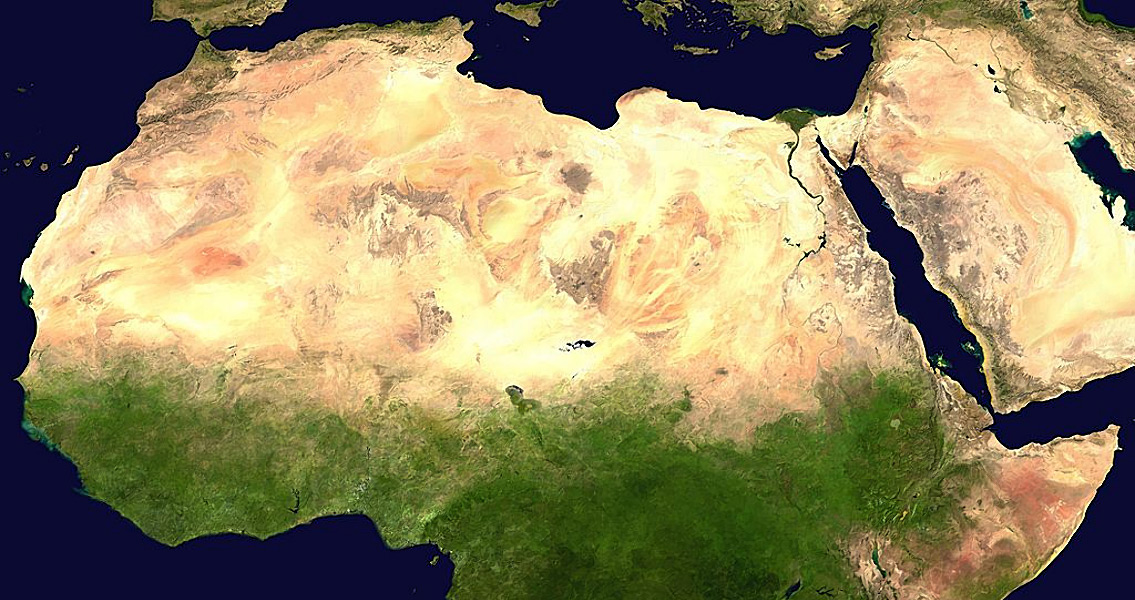
Live Science, the lead author Luca Pagani said that what is most exciting for the team is shedding light on an important stage of the evolution of all European and Asian peoples. This will deepen the understanding of billions of people of their “biological history”. Another of the authors, Toomas Kivisild from the University of Cambridge, told media that the results give a clear map of how modern humans moved out of Africa, even though they do not account for all the aspects of the process or give it any precise timing. One additional benefit of the study is that science has gained a neat genomic database of the genetic diversity present in Ethiopia and Egypt, which can be used as reference in other studies, Phys.org notes. Some questions related to this major exodus in the evolution of humans are still waiting to be answered however, says co-author Chris Tyler-Smith from the Wellcome Trust Sanger Institute. One such question is whether the route through Egypt was the only mass migration of that period, or were there other groups that left the continent without their genetic makeup surviving to the modern day? This question could be answered by the examination of ancient genomes from the areas through which such a migration would have passed. It has been established that the route through Ethiopia was indeed used, but probably by fewer people who did not go beyond the Arabian peninsula and whose genetic makeup has left no trace in the modern day, Pagani told Live Science. Image courtesy of Wikimedia Commons user: NASA]]>

Australopithecus deyiremeda, as the new human ancestor has been named, lived in the Afar region of Ethiopia some 3.3 million to 3.5 million years ago. This means it would have lived alongside Australopithecus afarensis, another hominin species from the Afar region whose most famous representative, “Lucy”, was discovered in 1974. A. afarensis lived in what is now Ethiopia, between 2.9 million and 3.8 million years ago. “The new species is yet another confirmation that Lucy’s species, Australopithecus afarensis, was not the only potential human ancestor species that roamed in what is now the Afar region of Ethiopia during the middle Pliocene”, said Dr. Yohannes Haile-Selassie, curator of physical anthropolgy at the Cleveland Museum of Natural History and the project team leader of the study, in a press release. The fossil specimens were found on 4th March, 2011, in the Woranso-Mille Paleontological Project study area, situated in the centre of the Afar region, about 325 miles north east of Ethiopia’s capital Addis Ababa, and just 22 miles north of the site where Lucy’s remains were unearthed. Differences in jaw bone mark the two species apart. A. deyiremeda had thick enamel teeth of a different shape and size to Lucy, and a more robust lower jaw. The anterior teeth were also comparatively smaller in A. deyiremeda, suggesting it had a different diet. A. deyiremeda‘s discovery adds to the increasing ambiguity about the process of human evolution. For much of the twentieth century the general consensus among scientists, based on available sources, was that during the Pliocene period only one human ancestor species existed at any time. In 1995, a hominin species called Australopithecus bahrelghazali was discovered in Chad, and in 1999 another called Kenyanthropus platyops was discovered in Kenya. Both of these species were reported to have lived at the same time as Lucy, although this assertion was met with skepticism from the scientific community over whether they really were separate species or simply another example of A. afarensis. Skeptics in the scientific community may still need to be convinced that A. deyiremeda is indeed a distinct species but its discovery adds further weight to the idea that the evolution of homo sapiens was not just a straight line from A. afarensis. “Some of our colleagues are going to be skeptical about this new species, which is not unusual. However, I think it is time that we look into the earlier phases of our evolution with an open mind and carefully examine the currently available fossil evidence rather than immediately dismissing the fossils that do not fit our long-held hypotheses”, said Haile-Selassie. For more information: www.cmnh.org Image courtesy of Wikimedia Commons user: Chartep]]>

Fiteha Negest, the traditional legal code of Ethiopia, officially enshrined slavery in the structure of Ethiopian society. In the early twentieth century, Ethiopia had between two and four million slaves, out of a total population of about eleven million people. This huge proportion of the population were considered the property of their owners, and deprived of any form of property ownership. Slavery was so rife that Abba Jifar II, king of Jimma (r.1878-1932), an independent kingdom in Ethiopia with a slave-based economy, exchanged two slaves for two dogs, and paid his dentist five slaves for a treatment. One reason for this continuation of slavery, Mohammed suggests, was warfare. The southward expansion of the Ethiopian state under the military campaigns of Menilek II (ruled 1889-1913) had created numerous prisoners of war. Slavery reached its zenith in this period, as thousands of prisoners were sold in slave markets. “In other words, warfare resulted in the continuation of slavery in Ethiopia,” Mohammed writes in his study. At the beginning of the twentieth century, “many states and kingdoms were at war for slave raiding.” Constant warfare meant a constant need for weapons. Foreign traders were the only source of firearms and ammunition in Ethiopia. These traders operated through coastal chiefs who collected taxes and tribute on slaves. Many Ethiopian rulers, such as Menilek, tried to outlaw slavery, but were unwilling to interfere with anything that could disrupt the importation of firearms. There was also little pressure to stop the slave trade from the international community, Mohammed argues. He states that Britain, “the champion of the Trans-Atlantic Slave Trade” as he describes the country, had little desire to suppress slavery in eastern Africa, and therefore did not get involved. Only when Ethiopia sought to join the League of Nations in 1923, did real change occur. The League required Ethiopia to abolish slavery, in accordance with its conventions. In response to this demand, Ethiopia’s regent, Tafari Mokonnen Woldemikael, declared the trading of slaves in Ethiopia a crime punishable by death. Tafari became Emperor Haile Sellasse I, and continued his programme of abolishing slavery. With the abolition of slavery in Ethiopia, the kingdom of Jimma ceased to exist as an independent entity. As such, it became integrated with the rest of Ethiopia. Mohammed’s study effectively traces the long history of slavery in Ethiopia, and offers clear explanations of why it had such deep roots. Although much has been written about the abolition of slavery in Europe and the United States, Mohammed’s work provides a unique insight into the anomalies behind its persistence in Ethiopia. Image courtesy of Wikimedia commons user: Antoinetav For more information: www.academicjournals.org]]>

www.aber.ac.uk Image courtesy of Wikimedia commons user: Black-Velvet]]>