Categories
Breaking News

Mass Grave Revealed to be Viking Army Burial – The History News of the Week

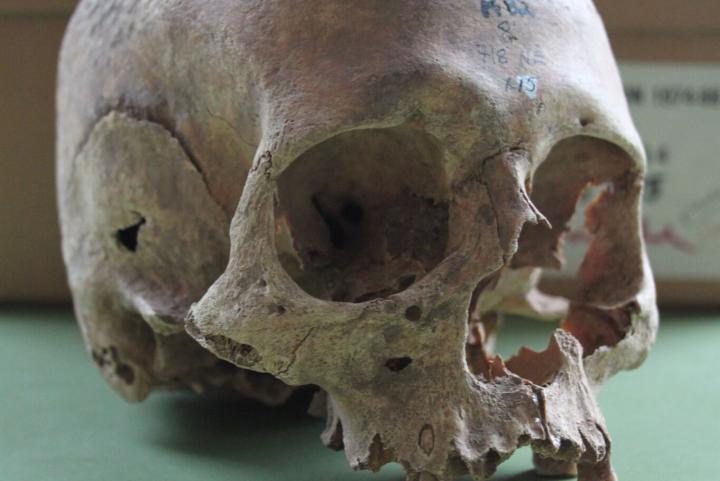
Mass Grave Could be Viking Army Burial A mass grave discovered in the 1980s could be a burial site for the war dead of the Viking Great Army, according to new research. Initial excavations at the site at St Wystan’s Church in Repton, Derbyshire, UK unearthed several Viking graves and a charnel deposit of nearly 300 people underneath a shallow mound in the vicarage garden. Later radiocarbon dating seemed to suggest that the grave consisted of bones collected over several centuries, throwing doubt on whether it was a mass Viking burial. However, the new scientific research, led by Cat Jarman from the University of Bristol, shows that in fact all the bones are consistent with a date in the late ninth century. The mound appears to have been a burial monument linked to the Great Viking Army. According to historical records, the Great Viking Army wintered in Repton in 873 CE, driving the Mercian king into exile. One room of the burial site was packed with the remains of a minimum of 264 people, around 20% of whom were women. Viking weapons and artefacts were found among the remains, including knives, axes and pennies. Mostly aged between 18 and 45 when they died, several of the male sets of remains showed signs of violent trauma. Viking Swords at Bergen museum (2) Jarman and team re-dated the remains, showing that contrary to what the previous carbon dating had suggested, the remains were all consistent with a single date in the ninth century, and the Great Viking Army. Jarman said: “The previous radiocarbon dates from this site were all affected by something called marine reservoir effects, which is what made them seem too old. “When we eat fish or other marine foods, we incorporate carbon into our bones that is much older than in terrestrial foods. This confuses radiocarbon dates from archaeological bone material and we need to correct for it by estimating how much seafood each individual ate.” The study has been published in the journal Antiquity. According to Jarman, the research could be a starting point for learning more about the Great Viking Army. “The date of the Repton charnel bones is important because we know very little about the first Viking raiders that went on to become part of considerable Scandinavian settlement of England. “Although these new radiocarbon dates don’t prove that these were Viking army members it now seems very likely. It also shows how new techniques can be used to reassess and finally solve centuries old mysteries.” Prehistoric Weapons Recreated Archaeologists from the University of Washington have recreated the weapons used by hunter-gatherers in the post-Ice Age Arctic up to 14,000 years ago. Janice Wood, a recent anthropology graduate, and Ben Fitzhugh, a professor of anthropology, reconstructed projectiles and points from ancient sites in what is now Alaska, and studied the qualities that made them effective hunting weapons. Their study, published in the Journal of Archaeological Science, focused on hunting weapons from the earliest archaeological records of Alaska (10,000 to 14,000 years ago), when a range of different projectiles and points were in use. Their study has provided insights into the technological choices made by prehistoric Alaskans. “The hunter-gatherers of 12,000 years ago were more sophisticated than we give them credit for,” Fitzhugh said. “We haven’t thought of hunter-gatherers in the Pleistocene as having that kind of sophistication, but they clearly did for the things that they had to manage in their daily lives, such as hunting game. They had a very comprehensive understanding of different tools, and the best tools for different prey and shot conditions.” Wood travelled to the area around Fairbanks, Alaska, and crafted 30 projectile points of various kinds, staying as close to the original materials and manufacturing processes as possible. Projectiles were made from poplar, with birch tar used as an adhesive to affix the points to the tips of the projectiles. The anthropologist then tested how well each point could penetrate and damage two different targets: blocks of ballistic gelatin (a synthetic gelatin meant to mimic animal muscle tissue), and a fresh reindeer carcass purchased from a local farm. Instead of an atlatl, a kind of throwing board used by ancient Alaskans, Wood used a maple recurve bow to shoot the arrows. Three different types of point were tested: composite microblades, stone and bone. It was found that the microblades were more effective on smaller prey, due to their versatility and ability to inflict more damage. The bone points penetrated more deeply and created narrower wounds, suggesting they could be used to stun larger prey such as bison. The stone points could have cut wider wounds, especially on larger prey, resulting in quicker kills.Iceage Weapon or Tool For Wood, these findings show that the hunter-gatherers were sophisticated enough to recognise which points to use and when. “We have shown how each point has its own performance strengths. It has to do with the animal itself; animals react differently to different wounds. And it would have been important to these nomadic hunters to bring the animal down efficiently. They were hunting for food.” The authors believe that the research could also shed new light on debates over whether human hunting practices could have led to the extinction of certain species. “I see this line of research as looking at the capacity of the human brain to come up with innovations that ultimately changed the course of human history,” she said. “This reveals the human capacity to invent in extreme circumstances, to figure out a need and a way to meet that need that made it easier to eat and minimised the risk.” History of Dice Revealed in New Study New research has charted the history and development of dice, revealing how they’ve changed over the last 2,000 years to become unbiased, with every number having an equal probability of being rolled. The research was led by Jelmer Eerkens, professor of anthropology at the University of California, Davis. It reveals that in the Roman era, many dice were lopsided, in contrast to the perfect cubes seen today. It also highlights that Roman dice varied drastically in shape, size, material and the configuration of numbers. Between 400 CE and 1100 CE, dice are apparently extremely rare in the archaeological record, corresponding with the Dark Ages. According to Eerkens and colleagues’ research, a new awareness of the importance of form in dice became apparent around 1450, reflecting the onset of the Renaissance. “A new worldview was emerging — the Renaissance. People like Galileo and Blaise Pascal were developing ideas about chance and probability, and we know from written records in some cases they were actually consulting with gamblers,” he said. “We think users of dice also adopted new ideas about fairness, and chance or probability in games.” “Standardising the attributes of a die, like symmetry and the arrangement of numbers, may have been one method to decrease the likelihood that an unscrupulous player had manipulated the dice to change the odds of a particular roll,” Eerkens continued. Eerkens and his co-author, Alex de Voogt of the American Museum of Natural History, looked at hundreds of dice in museums and archaeological depots across the Netherlands, assembling a set of 110 carefully dated, cube shaped dice to analyse. For Eerkens, dice present a fascinating artefact for archaeologists, embodying shifting worldviews. “In this case, we believe it follows changing ideas about chance and fate.” The study has been published in the journal Acta Archaeologica. Featured image is one of the female skulls from the Repton charnel. Image credit: Cat Jarman]]>
Categories
Breaking News

Rare Medieval Black Death Burial Pit Discovered in England

The Telegraph. A total of 48 sets of skeletal remains – 21 of them belonging to children – were found at the site, which at one time was a monastery hospital. Researchers say that it seems quite clear that the local community was overwhelmed when the Black Death came to the region, forcing them to cope in the only way they could – by burying their dead in one mass grave. One of the worst plagues to ever blaze across humanity, the Black Death claimed the lives of anywhere from 75 to 200 million people in Europe from 1346 through 1353; according to historical records, Lincolnshire was struck by the disease in the early months of 1349. The Black Death as a whole completely changed the social landscape of Europe in a myriad of ways in addition to the massive loss of life. Sheffield University researchers partnered with scientists from Canada’s McMaster University, sending tooth samples from the deceased in order to extract ancient DNA from the pulp of these teeth. Analysis confirmed the presence of Yersinia pestis, the bacterium behind the Black Death, according to Sheffield University’s Dr. Hugh Wilmott. Dr. Wilmott, from the university’s Department of Archaeology, remarked that while the death toll in England from the disease was astronomical – up to 50 percent of the population – it’s extremely rare to find multiple graves within the country. For the most part, local communities seemed to simply treat fatalities from the Black Death in an ordinary way – in fact, the only other two sites dating to the fourteenth century where the Y. pestis bacterium has been found were London cemeteries with accompanying historical documentation detailing how the burgeoning numbers of urban dead necessitated the opening of new burial grounds. The discovery of this completely unexpected and previously unknown fourteenth century burial ground in the rural reaches of Lincolnshire stands as a unique event in the history of the Black Death in England, the scientist stated. If anything, it clearly illustrates how the community at the time was completely unprepared to withstand such a terrible threat. More analysis is slated to be undertaken, with research into the skeletal remains as a whole. This will enable researchers to identify the gender and age of each set of remains, as well as create a detailed study of any other illnesses and ailments they might have suffered from, using the telltale signs left behind in their skeletal structure according to the University of Sheffield’s Dr. Diana Mahoney Swales. ]]>

Categories
Breaking News

Mass Graves Show Cahokia Was Not Male Dominated

American Antiquity, the focus of the new study is Mound 72: a massive burial site discovered in 1967 by archaeologist Melvin Fowler. The impressive Mound 72 held five mass graves, the smallest containing only twenty bodies, the biggest over fifty. Dozens of other bodies were buried individually or in groups there, some directly over the mass graves. By the end of his study, Fowler had identified 270 bodies in the mound. Some of them had been placed in cedar litters, leading Fowler and his team to conclude they had been people of high status during life. Later studies determined that all of the bodies had been interred between 1000 CE and 1200 CE. Cahokia was at its peak during this period, with historians claiming the city’s population was as high as 20,000 during the eleventh century. “Mound 72 burials are some of the most significant burials ever excavated in North America from this time period,” said ISAS (Illinois State Archaeological Survey) director Thomas Emerson, who conducted the most recent study with physical anthropologist Kristin Hedman and skeletal analysts Eve Hargrave of ISAS, Dawn Cobb of the Illinois State Museum Society, and Andrew Thompson of the University of Cincinnati College of Medicine. “Fowler’s and others’ interpretation of these mounds became the model that everybody across the east was looking at in terms of understanding status and gender roles and symbolism among Native American groups in this time.” Fowler’s remarkable discovery, and subsequent interpretation of Mound 72, were hugely influential. However, Emerson and colleagues have found that some of the original conclusions were based on inaccurate or incomplete information. According to them, a key misunderstanding relates to the beaded burial, where two bodies were buried on top of each other on a partial bed of beads. Several other bodies, interred at the same time, were buried around the centrally placed pair. For Fowler, this unique burial was interpreted as two high status males surrounded by their servants. The pattern of the beads around the bodies was thought to resemble a bird’s head. In many Native American traditions birds are associated with warriors and supernatural beings, something which led Fowler to conclude the beaded burial represented mythical warrior chiefs. This interpretation came to be taken as evidence that Cahokia was a male dominated hierarchy, but the new analyses by Emerson and his team have thrown this conclusion into doubt. Firstly, they found that there were in fact 12 bodies involved in the beaded burial, not just six as previously reported. Most dramatically, the team concluded that the two bodies at the centre of the burial were a male and a female, not two males. Further study by the team revealed other inconsistencies. There were other male and female pairs in or near the burial. There was also evidence of the bones of disarticulated bodies being gathered up and placed for burial next to these important couples. The team even found the remains of a child. “We had been checking to make sure that the individuals we were looking at matched how they had been described,” said Hedman. “And in re-examining the beaded burial, we discovered that the central burial included females. This was unexpected.” “The fact that these high-status burials included women changes the meaning of the beaded burial feature,” Emerson explained. “Now, we realize, we don’t have a system in which males are these dominant figures and females are playing bit parts. And so, what we have at Cahokia is very much a nobility. It’s not a male nobility. It’s males and females, and their relationships are very important.” It’s a conclusion which fundamentally changes the image of Cahokia society, showing it to be class based rather than split along gender lines. For Emerson, this wasn’t a surprise based on his experience at other Cahokia sites. “For me, having dug temples at Cahokia and analyzed a lot of that material, the symbolism is all about life renewal, fertility, agriculture,” he said. “Most of the stone figurines found there are female. The symbols showing up on the pots have to do with water and the underworld. And so now Mound 72 fits into a more consistent story with what we know about the rest of the symbolism and religion at Cahokia.” The scientist believes the misinterpretation of Mound 72 is an example of archaeologists projecting the practices of other North American indigenous cultures onto the Cahokia, and subsequently missing much of what made the civilisation unique. “When the Spanish and the French came into the southeast as early as the 1500s, they identified these kinds of societies in which both males and females have rank,” he said. “Really, the division here is not gender; it’s class.” Emerson said “People who saw the warrior symbolism in the beaded burial were actually looking at societies hundreds of years later in the southeast, where warrior symbolism dominated, and projecting it back to Cahokia and saying: ‘Well, that’s what this must be… And we’re saying: ‘No, it’s not.'” Graphic by Julie McMahon]]>

Categories
News

Mass Grave Reveals Violence in Neolithic Europe

Proceedings of the National Academy of Science, Christian Meyer, Christian Lohr, Detlef Gronenborn and Kurt W. Alt argue that the mass grave is adding to the continued reappraisal of the extent of warfare and violence in Central Europe during the early Neolithic. An extensive study of the mass grave in Schöneck-Kilianstädten has shown that twenty six individuals buried there were killed by either blunt force or arrow injuries. The bodies were then thrown into a commingled mass grave. Significantly, according to the authors, the grave demonstrates “a pattern of intentional mutilation of violence victims.” There is clear evidence among the remains of the mass grave of an intentional, sytematic breaking of the victims’ lower limbs. Half of the skeletons had perimortem fractures, according to the study authors, suggesting the victims were either tortured shortly before death or mutilated afterwards. Such a pattern of violence has not been observed before at Neolithic sites. The fact that the remains were scattered around, seemingly randomly, is also unusual. In other Linear Pottery burials each person was given their own grave within a graveyard. Bodies were often carefully buried alongside grave goods such as possessions or pottery. The researchers take this as evidence that Schöneck-Kilianstädten must have been the site of a massacre where normal burial rites and customs were abandoned. Taken alongside other Neolithic massacre sites in central Europe at Talheim, Germany, and Asparn/Schletz, Austria, the team believe the mass grave at Schöneck-Kilianstädten adds to the mounting evidence of moments of extreme mass violence towards the end of the Linear Pottery Culture. “The new evidence presented here for unequivocal lethal violence on a large scale is put into perspective for the Early Neolithic of Central Europe and, in conjunction with previous results, indicates that massacres of entire communities were not isolated occurrences but rather were frequent features of the last phases of the LBK (Linear Pottery Culture).” Sometimes referred to as the New Stone Age, the Neolithic was a period defined by the development of new stone technology. It also saw farmers migrate west from Anatolia (what is now Turkey) into Europe, displacing the nomadic people and fishermen who had inhabited the continent previously. Settlements and communities sprung up across the continent as people built houses, cultivated land and started to decorate pottery. The extent to which these early settlements were blighted by conflict and violence however, has remained unclear. The end of nomadic lifestyles could have created increasing competition between different communities for access to the best land, rivalries which may have been intensified through climate conditions such as drought. The excavation of the Schöneck-Kilianstädten site has added crucial evidence to the study of large scale violence in the Linear Pottery Culture. The discovery, along with the other sites in Germany and Austria, has allowed researchers to start piecing together the nature, extent, and causes of warfare in the Central European Neolithic. For more information: www.pnas.org Image courtesy of Wikimedia Commons user: Joostik ]]>