Categories
Breaking News

Research Shows “Lucy” Could Walk Upright and Swing Through Trees

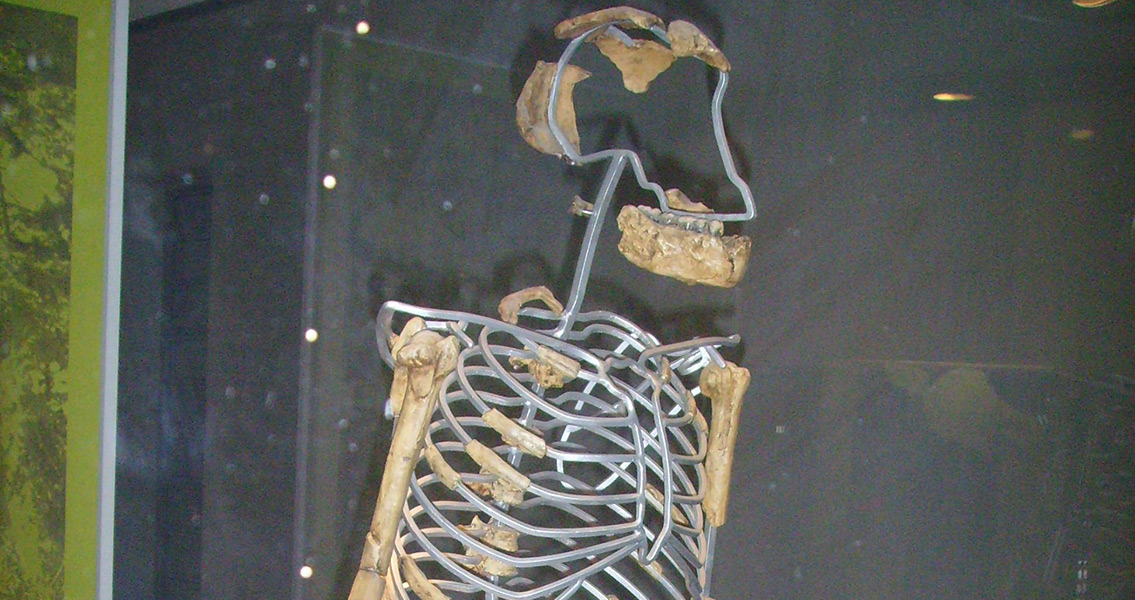
New Scientist. The debate may finally be settled based on the work completed by Christopher Ruff with Johns Hopkins University School of Medicine in Baltimore, Maryland, along with his colleagues. Using CT scans taken of Lucy’s skeleton, they studied the cross sections of both (left and right) upper arm bones along with the left thigh bone — the thigh bone from the right leg was never found. What the team discovered was that Lucy’s arm bones had thick walls, suggesting unusual strength. Bone strength is considered a “use it or lose it” characteristic directly related to an animal’s behavior and not inherited; meaning that at least some australopiths were at home on the ground and in trees. “It would not be present unless Lucy mechanically loaded her upper limbs more than most modern humans,” Ruff told New Scientist. “Ours is the best evidence to date that A. afarensis actually spent a significant portion of their time engaged in arboreal behaviour.” Over the course of a person’s life, bone structure changes depending on the way we use, or don’t use, our bodies. Human thigh bones typically have thicker walls due to all of our walking, our arm bones however, have relatively thin walls because we seldom use them to carry or lift our full body weight. Chimpanzees on the other hand develop arms with thick-walled bones because of their tree climbing. Previously, Ruff and his team discovered injuries to Lucy’s skeleton that indicated she may have died from a high fall, most likely from a tree. That study also suggested that Lucy spent a significant amount of time climbing trees, but it was far from conclusive. “I could fall out of a tree and present the same injuries as they suggest Lucy had,” Harcourt-Smith says in the article. The study has been published in the online journal PLOS One. ]]>

Categories
Breaking News

Original Site of the Plymouth Colony Identified

Categories
Breaking News

Findings Tip the Scale to Earhart Surviving Plane Crash

Categories
Breaking News

The Relationship Between Early Man and Eurasian Cave Lion Studied

Panthera spelaea, the Eurasian cave lion, a species that was larger than an African lion without the mane, became extinct approximately 14,000 years ago, but the reasons behind its disappearance have never been completely understood. Archeological findings show that between 50,000 and 10,000 years ago, Upper Paleolithic humans did in fact hunt animals both large and small, however, evidence of lion hunting is rare. In an attempt to determine if early humans hunted the cave lion, thereby contributing to its extinction, Marián Cueto, with the Universidad de Cantabria, Spain, and her colleagues examined nine fossilized toe bones from the claw of a cave lion, looking for evidence the cats were exploited by humans. The feline bones were unearthed at La Garma, the Upper Paleolithic cave site located in northern Spain. What researchers found was that a majority of the bones did in fact show signs of having been modified by stone tools used by humans, along with signs of a specific technique, similar to the one used by modern hunters to keep the claws attached to the fore while skinning it. The research suggests that the toe bones may have been part of a single lion pelt, possibly covering the floor of the occupied cave. The La Garma site is known to have been associated with human rituals, and it’s possible the Eurasian cave lions had some symbolic meaning for Upper Paleolithic humans. While the analysis doesn’t offer definitive findings which would conclude the Upper Paleolithic humans hunted cave lions for their pelts, it also doesn’t offer any findings to the contrary, and other evidence has been found showing that cave lions and early humans did interact in some capacity. The cave, situated on La Gama Mountain, is divided into different levels. In the upper section there are human burial sites, the intermediate level holds a large number of palaeontological remains, primarily bones. The most important remains, however, are found on the lower level where there are three intact spaces with numerous examples of painted art, including an amazingly realistic black horse, and a number of symbols painted red. Also found are representations of goats and bison and still more panels are covered with hand prints. The drawings date to between 28,000 and 13,000 years ago. Prehistoric humans ventured into the La Garma cave to perform sacred rituals. They navigated hundreds of yards through the dark, until they reached one of the circular stone huts (each with a horse skull in the center) where their religious ceremonies took place. Untouched for thousands of years, La Garma acts as a time capsule, with everything remaining exactly as it was during the Upper Paleolithic era. The nature of the ceremonies is unknown, however, the discovery of just foot bones indicates that aside from the pelts, the claws of the lion were also brought into the cave. The research has been published journal in the online journal PLOS ONE. Image courtesy of Wikimedia Commons user: Pit1233 ]]>

Categories
Breaking News

Mass Graves Show Cahokia Was Not Male Dominated

American Antiquity, the focus of the new study is Mound 72: a massive burial site discovered in 1967 by archaeologist Melvin Fowler. The impressive Mound 72 held five mass graves, the smallest containing only twenty bodies, the biggest over fifty. Dozens of other bodies were buried individually or in groups there, some directly over the mass graves. By the end of his study, Fowler had identified 270 bodies in the mound. Some of them had been placed in cedar litters, leading Fowler and his team to conclude they had been people of high status during life. Later studies determined that all of the bodies had been interred between 1000 CE and 1200 CE. Cahokia was at its peak during this period, with historians claiming the city’s population was as high as 20,000 during the eleventh century. “Mound 72 burials are some of the most significant burials ever excavated in North America from this time period,” said ISAS (Illinois State Archaeological Survey) director Thomas Emerson, who conducted the most recent study with physical anthropologist Kristin Hedman and skeletal analysts Eve Hargrave of ISAS, Dawn Cobb of the Illinois State Museum Society, and Andrew Thompson of the University of Cincinnati College of Medicine. “Fowler’s and others’ interpretation of these mounds became the model that everybody across the east was looking at in terms of understanding status and gender roles and symbolism among Native American groups in this time.” Fowler’s remarkable discovery, and subsequent interpretation of Mound 72, were hugely influential. However, Emerson and colleagues have found that some of the original conclusions were based on inaccurate or incomplete information. According to them, a key misunderstanding relates to the beaded burial, where two bodies were buried on top of each other on a partial bed of beads. Several other bodies, interred at the same time, were buried around the centrally placed pair. For Fowler, this unique burial was interpreted as two high status males surrounded by their servants. The pattern of the beads around the bodies was thought to resemble a bird’s head. In many Native American traditions birds are associated with warriors and supernatural beings, something which led Fowler to conclude the beaded burial represented mythical warrior chiefs. This interpretation came to be taken as evidence that Cahokia was a male dominated hierarchy, but the new analyses by Emerson and his team have thrown this conclusion into doubt. Firstly, they found that there were in fact 12 bodies involved in the beaded burial, not just six as previously reported. Most dramatically, the team concluded that the two bodies at the centre of the burial were a male and a female, not two males. Further study by the team revealed other inconsistencies. There were other male and female pairs in or near the burial. There was also evidence of the bones of disarticulated bodies being gathered up and placed for burial next to these important couples. The team even found the remains of a child. “We had been checking to make sure that the individuals we were looking at matched how they had been described,” said Hedman. “And in re-examining the beaded burial, we discovered that the central burial included females. This was unexpected.” “The fact that these high-status burials included women changes the meaning of the beaded burial feature,” Emerson explained. “Now, we realize, we don’t have a system in which males are these dominant figures and females are playing bit parts. And so, what we have at Cahokia is very much a nobility. It’s not a male nobility. It’s males and females, and their relationships are very important.” It’s a conclusion which fundamentally changes the image of Cahokia society, showing it to be class based rather than split along gender lines. For Emerson, this wasn’t a surprise based on his experience at other Cahokia sites. “For me, having dug temples at Cahokia and analyzed a lot of that material, the symbolism is all about life renewal, fertility, agriculture,” he said. “Most of the stone figurines found there are female. The symbols showing up on the pots have to do with water and the underworld. And so now Mound 72 fits into a more consistent story with what we know about the rest of the symbolism and religion at Cahokia.” The scientist believes the misinterpretation of Mound 72 is an example of archaeologists projecting the practices of other North American indigenous cultures onto the Cahokia, and subsequently missing much of what made the civilisation unique. “When the Spanish and the French came into the southeast as early as the 1500s, they identified these kinds of societies in which both males and females have rank,” he said. “Really, the division here is not gender; it’s class.” Emerson said “People who saw the warrior symbolism in the beaded burial were actually looking at societies hundreds of years later in the southeast, where warrior symbolism dominated, and projecting it back to Cahokia and saying: ‘Well, that’s what this must be… And we’re saying: ‘No, it’s not.'” Graphic by Julie McMahon]]>
Categories
Breaking News

New Evidence of Neanderthal Cannibalism Found in Belgium

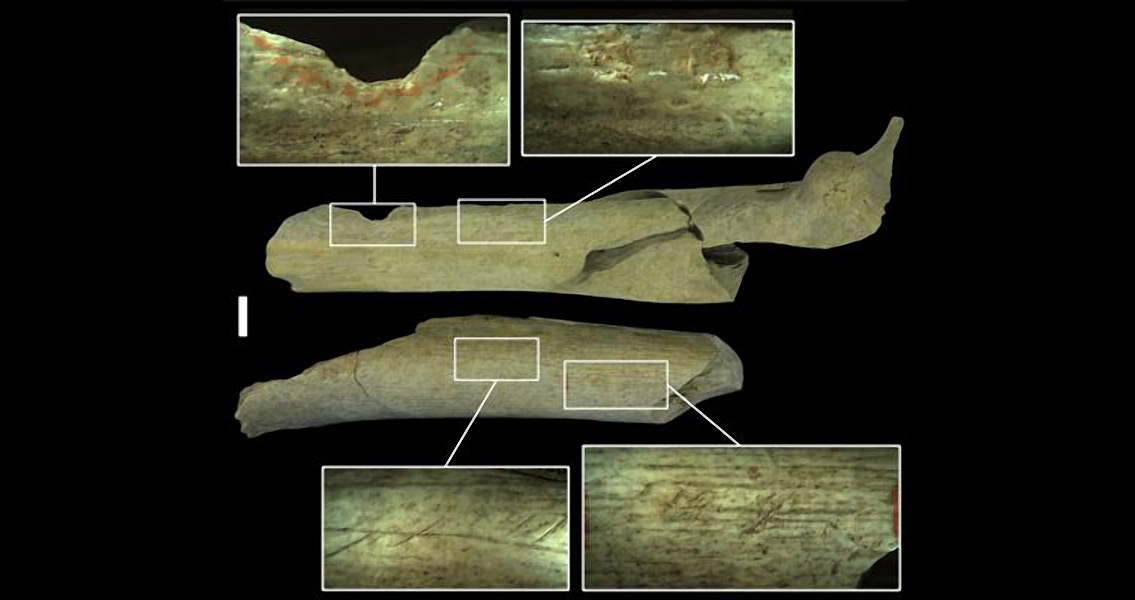
Scientific Reports, has helped expand the knowledge of known Neanderthal behavior in relation to the dead in northern Europe. As more and more insights are gradually revealed about the behavior of the Neanderthals, humanity’s closest extinct relatives, it becomes apparent that they displayed significant variability in their actions and customs. This perhaps shouldn’t be surprising, that different groups of Neanderthals had different practices, just as is the case among different groups of humans. This diversity of practices is clearest in the ways the Neanderthals dealt with their dead. At some sites, there is evidence that they buried the deceased. At others, there is evidence of cannibalism, that they broke the bones and ate the meat of other Neanderthals for food. These cannibalistic practices have been discovered at sites in both France and on the Iberian Peninsula. Neanderthals lived between roughly 200,000 and 30,000 years ago in Eurasia. Their appearance was similar to modern humans, though they were shorter, stockier, and had angled cheek bones, prominent brows and wide noses. Evidence has been found that they used tools, controlled fire, and in some cases (Chapelle-aux-Saints in France, and Sima de las Palomas on the Iberian Peninsula for example) buried their dead. Until the latest study however, the paucity of remains discovered north of latitude 50º meant it had been difficult to gain insight into how Neanderthals in the northern latitudes treated their dead. A third of the Neanderthal remains discovered at the Troisième caverne had cut marks, and a plethora had been crushed to extract marrow. The Neanderthal remains had been treated in a similar manner to horse and reindeer bones at the site, suggesting that all three species had been prepared and consumed in similar ways. Other Neanderthal remains at the site showed signs of having been used as soft percussors to shape stone. It is the fourth time a site has been found with evidence Neanderthals used the bones of their deceased to shape stone tools, joining Krapina in Croatia, and Les Pradelles and La Quina in France. Whereas the previous sites only contained a few examples of bones being used on tools, five sets of remains at Goyet had been used as retouchers. Due to their remarkable state of preservation it has been possible to date the remains at Goyet to between 40,500 and 45,500 years old. It has also been possible to extract the mitochondrial DNA of the remains, revealing that the Neanderthals at the cave were most similar genetically to those found in Feldhofer (Germany), Vindija (Croatia) and El Sidrón (Asturias, Spain). Such genetic similarity over such large distances suggests that the Neanderthal population of Europe was quite small. Earlier studies of partial Neanderthal skeletons discovered at Feldhofer, Germany and Spy, Belgium, showed evidence that Neanderthals had interred their dead. This latest study only adds to the increasingly complicated image of the contrasts between the different groups of humanity’s extinct cousins. Image courtesy of Asier Gómez-Olivencia et al.]]>

Categories
Breaking News

Humans as Meat-Eaters – a Million Year History

Categories
Breaking News

Archaeologists Discover a Neolithic Burial Ritual Like No Other

Categories
Breaking News

Remains of Executed Prisoner Found in Ontario Jail

Categories
Breaking News

Search for Mona Lisa Model Reaches Dead End