Categories
Breaking News

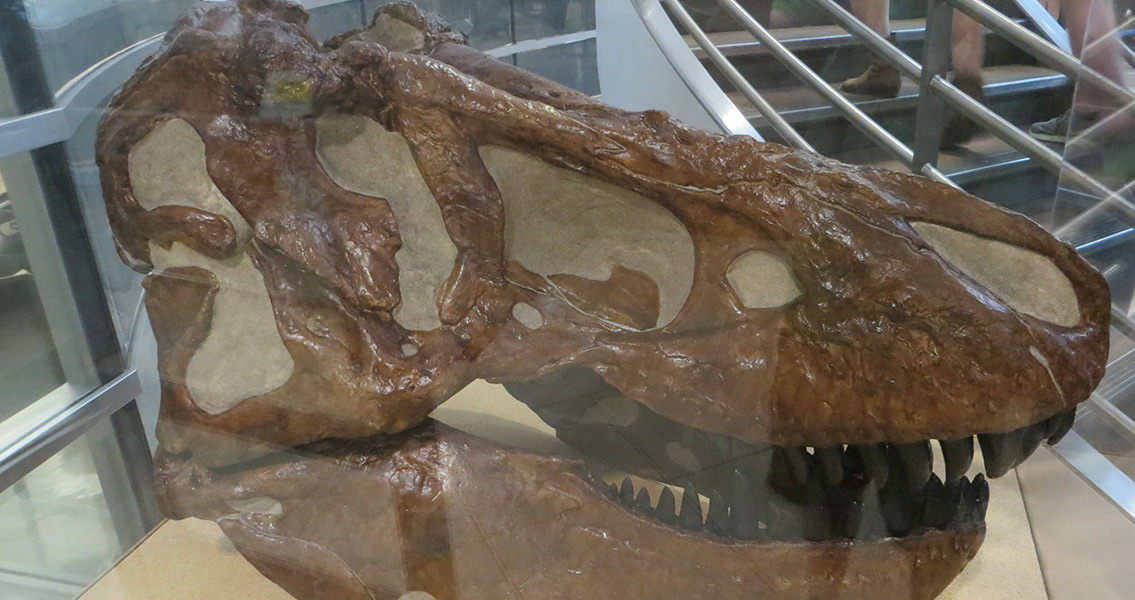
Open Wide: T. Rex Had a Major Bite
Allosaurus fragilis, and a third specimen – a herbivorous theropod known as Erlikosaurus andrewsi. The simulations were held up against several bird and crocodile species – the closest living relatives of dinosaurs – in order to have a comparison point for maximum jaw gape and muscle strain. According to the results of the study, carnivorous theropods like the Allosaur and the Tyrannosaur were capable of opening their mouths an impressive and perhaps terrifying 90 degrees at the maximum. Meanwhile the Erlikosaurus, the herbivorous relative of the meat-eating pair, could only open its mouth as wide as around 45 degrees. Additionally, the bite force that the Tyrannosaur could sustain over a wide variety of jaw angles was prodigious, a strong indication that the carnivore was easily capable of rending flesh and crushing bone in order to feed on its prey. The results were eye-opening but not necessarily unexpected, Dr. Lautenschlager said in the press release. The jaw gapes of modern herbivores is almost universally smaller than that of predatory animals living today, the scientist remarked; the fact that this trend was also apparently present in theropods millions of years ago shows commonalities in evolution and biology. Image courtesy of Wikimedia Commons user: WildFrogs]]>

Categories
Breaking News

Ancient Syrian Mosaic Found in Doliche

Categories
Breaking News

Ice Age Era Engravings Found on Island of Jersey

here Image courtesy of Wikimedia Commons user Man vyi ]]>

Categories
Breaking News

Details of Maya Working Class Revealed by Animal Bones

www.sciencedirect.com ]]>

Categories
Breaking News

Downfall of Mammoths a Function of Their Diet?

www.link.springer.com Image courtesy of Wikimedia Commons user: Yara shark]]>

Categories
Breaking News

Underwater Survey Finds Record-Breaking 22 Shipwrecks

Categories
Breaking News

Aurochs and Modern Cattle Linked Genetically

Bos primigenius, the extinct species was once ubiquitous across the grasslands of North Africa, Asia and Europe 11,000 years in the past. Domestication efforts by modern humans to turn the aurochs into something a bit more docile led to a pair of major cattle groups known as Bos indicus and Bos taurus. European B. taurus is largely descended from aurochs populations that were prevalent in Asia, according to previous studies. However, with little in the way of scholarship regarding European wild aurochs and domesticated cattle – and how the European branch of the wild ox species played a role in how modern cows evolved – researchers from University College Dublin (UCD) decided to investigate the issue. UCD scientists began their endeavour by taking the remains of a wild British aurochs discovered in a Derbyshire cave dating back to 6,750 years ago and extracting genetic material from one of the bones. The researchers then conducted genetic sequencing on the sample to create a complete genome of the ancient wild ox before holding it up to comparison with more than 80 domesticated B. indicus and B. taurus specimens, as well as more than 1,200 modern domesticated cattle. The results were clear: there was abundant evidence that early domesticated cattle were interbred with wild British aurochs, according to UCD scientist David MacHugh, the study’s senior author. The results highlight how the ancestors of modern Irish and British cattle breeds are more genetically similar to the wild British aurochs than other cattle in Europe are. MacHugh remarked in an interview with Phys.org that this could indicate early British cattle farmers used wild aurochs to supplement their domesticated herds. Additional discoveries revealed that genetic markers which are known to play a role in muscle development and neurobiology were used in domesticating what would have been the ancestors of cattle from Europe. This indicates that ancient farmers considered behavioural traits and also suitability as a food source when it came to the domestication process. MacHugh further remarked that this study is the first of its kind to deliver a complete genome from an extinct Eurasian aurochs specimen. The data revealed in this study has the ability to supplant earlier models of cattle evolution and domestication, the scientist added. Image courtesy of Wikimedia Commons user: Brunodesacacias]]>

Categories
Breaking News

Megalodon Teeth Appear in North Carolina

Categories
Breaking News

Female Aboriginal Hunters Worked With Dingoes

Canis lupus dingo as the species is known in scientific circles, began to forge relationships with Aboriginal people shortly after their arrival in Australia around 4,000 years ago, according to a joint study conducted by the Australian National University (ANU) and the University of Western Australia (UWA). The alliance between female Aboriginals and dingoes could have been instrumental in the women being able to provide higher amounts of hunted food, the research says. According to Jane Balme, the UWA archaeologist that spearheaded the research, the first dingoes accompanied a wave of immigrants from South East Asia on watercraft, indicating that they were likely domesticated before stepping foot – or paw, as it were – on a boat. However, Dr. Balme added in an interview with Western Australia’s Science Network that once these animals made it to mainland Australia, they reverted to a wilder state. Referring to DNA evidence collected in the past, the archaeologist said that dingoes likely made landfall in a pair of locations, one being in the north-east of the Australian continent and the other in the Kimberley, the sparsely-settled northern regions of Western Australia. The likelihood of Aboriginal having formed close bonds with dingoes quickly is high, Dr. Balme added, remarking that European colonists noted that the dogs were used quite often by the native population as watch dogs and bed-mates at night to keep warm. This is analogous to how dogs in modern society are often used in similar roles, with the addition of being trained to act as service animals or therapy companions as well. In the case of women being more likely to use dingoes than men, Dr. Balme said that the research suggested Aboriginal males were unlikely to take dingoes out with them while hunting because the dogs would startle larger animals, causing them to flee. However, the archeaological record suggests that the number of small animals hunted by Aboriginal people increased after the arrival of dingoes, which was likely due to women going off to hunt, dogs at their sides, to bring down this smaller game. The archaeologist said that dig sites in locations in South West Australia such as Tunnel Cave yielded evidence that dingoes had been used as hunting companions specifically for the smaller prey animals that were traditionally hunted by female Aboriginals. The middle of the Holocene era, which dates to around 4,000 to 5,000 years in our past, has long been noted for the difference in the type of animal remains found in Aboriginal sites, as they yield a much higher percentage of small animal bones than they did prior to this time. For more information: www.sciencedirect.com]]>

Categories
Breaking News

Hiker finds 1,200 Year Old Viking Sword in Norway