


Related Books

Letters of Fyodor Michailovitch Dostoevsky to His Family and Friends
by Fyodor Dostoyevsky
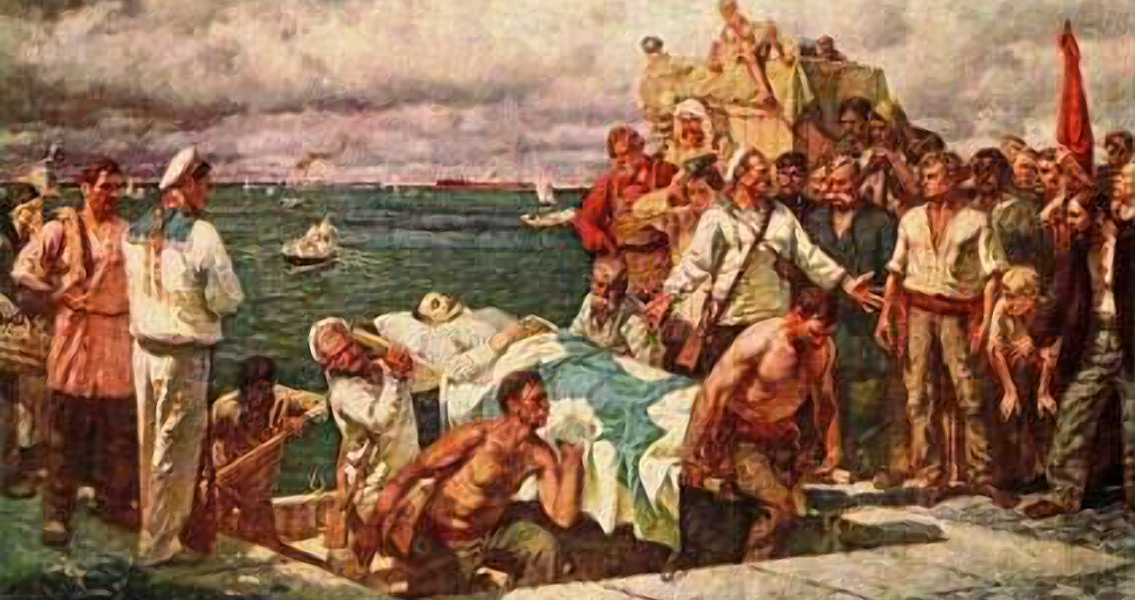
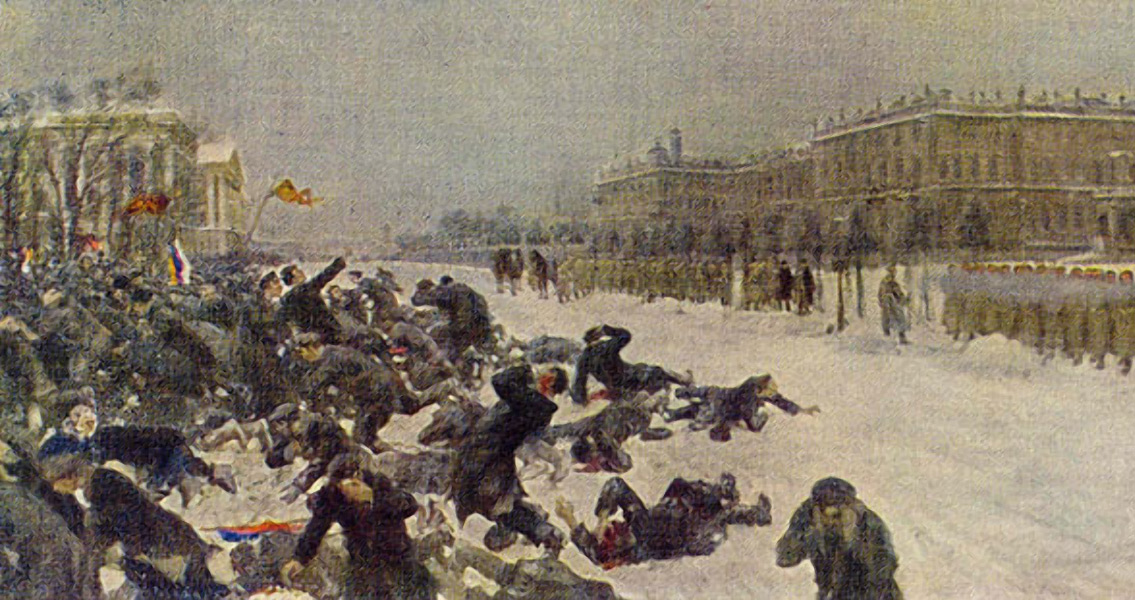
Potemkin surrendered to Romanian authorities at the port of Constantza, on the west coast of the Black Sea. Immortalised in Sergei Eisenstein’s 1925 movie, ‘Battleship Potemkin’, the Potemkin mutiny was one of the most shocking moments of a year of upheaval and unrest in Russia. The striking scenes of Eisenstein’s propaganda film ensured that events on the battleship Potemkin have been remembered more than others from the 1905 revolution as a symptom of the growing conflict between labour and capital which would ultimately split Russia and see the end of the Romanov monarchy. Commissioned in 1903, the Potemkin was one of the newest battleships in Russia’s Black Sea fleet. At sea on 27th June, the ship’s cooks complained that the meat they had been given to prepare was riddled with maggots. The ship’s doctor said that the meat was still fit to use, and instructed the cooks to continue serving it. Hours later a delegation from the crew went to the captain and complained that there were worms in the soup they had been served. Commander Gilarovsky, the ship’s commanding officer, inexplicably flew into a rage which some historians put down to the coarse language used by the crew members, and shot the group’s spokesman, a seaman named Valenchuk. Gilarovsky’s murderous response to the protest inevitably bred more violence. At once the crew members seized the commander and threw him over board. As he struggled in the water he was shot and killed. The refusal of the Potemkin‘s guard to fire on their own ship mates allowed the mutiny to rapidly escalate. A brawl ensued in which sailors were able to seize weapons from the ship’s armory. Several of the ship’s officers and the doctor were shot, while the rest of the officers were imprisoned in one of the Potemkin‘s cabins. A red flag was raised on the ship, and it set sail for Odessa. It was decided that the ship would be governed by a people’s committee, with one of the initial protest’s ringleaders, Matyushenko, elected its leader. At this point protests, riots and unrest were common throughout Russia’s southern cities as the Tsar’s grip on power began to look increasingly fragile. When the Potemkin arrived at Odessa on the 29th June, the unrest in the city quickly escalated as the population tried to deliver food and supplies to the ship’s crew. A violent clash erupted between rioters and government troops which saw huge swathes of the city burnt and over a thousand people killed. Tsar Nicholas II ordered the Russian army to Odessa to suppress the resistance and restore order. They indiscriminately attacked the crowd of protesters, and the Potemkin, powerless to assist the people of Odessa, fled the city. A squadron from the Russian navy was then dispatched to either capture or sink the Potemkin. The ships confronted the Potemkin in the Black Sea, but ultimately refused to open fire out of fear it could trigger mutiny among their own crews. The Potemkin then fled to the Constantza port in Romania to gain vital supplies, but was refused entry. Short on food, and lacking vital supplies to keep the ship running, the crew soon realised they had no choice but to surrender, and on 8th July they handed the ship over to the Romanian authorities. A large chunk of the crew returned to Russia, where they were imprisoned and trialed. Others stayed in Romania, and didn’t return to Russia until after the 1917 Bolshevik Revolution. The mutiny was the culmination of a variety of factors. The February 1905 Bloody Sunday Massacre had shocked the Russian people and galvanised resentment against the Tsarist regime. This led to growing acts of defiance and protest, of which the events on the Potemkin were just one example. In the longer term, Russia’s embarrassing failure in the recent war with Japan, combined with continued terrible conditions for its armed forces, had led to widespread dissatisfaction among all but the highest ranking members of the military. As Eisenstein’s movie about the Potemkin shows, the mutiny was later used by Soviet leaders as a heroic example of the history of the development of communist ideals in the country. Image courtesy of Wikimedia Commons user: HOBOPOCC]]>

New Historian last week, archaeologists have speculated that some of the artefacts in the site may be of Greek origin. Now, another use has been found for some of the golden objects excavated from this dig. The two bucket-shaped cups were found upside-down and covered with intricate carvings on the outside that depicted creatures from mythology; on one, winged griffons are seen attacking both a stag and a horse while another carving showcases an older man engaged in combat with a larger group of younger warriors. The interior of both cups were coated with a black residue that proved to be a mix of opium and cannabis after it was analyzed by forensics experts. The chamber where the golden bongs were discovered had been cleverly concealed beneath a layer of clay and stored within a chamber lined with broad, flat stones. In the end, nearly seven pounds of golden artifacts were excavated including two neck rings, a finger ring, a bracelet, and a collection of three cups in addition to the two cannabis cups. While the site was initially uncovered in 2013, the decision was made to keep the discovery a secret in order to discourage looters. Archaeologists say that there was already evidence that the burial mound had been scoured by looters sometime in the indeterminate past, prompting the secrecy and initially leading them to believe that any valuable artifacts had long since vanished. The site itself is known as a kurgan, one of the few pieces of permanent construction left behind by the Scythians; the largely itinerant civilisation constructed these burial mounds across their territory, which stretched from the Black Sea in the west to as far as Mongolia to the east over the close to a thousand years that the nomadic people ruled the region. Andrei Belinski, the archaeologist that led the excavation team that took over following the discovery of the site, says that the historical value of the find is noteworthy, especially since the bongs are in such excellent condition and the carvings on the cannabis cups harbor such minute details. “I’ve never seen such a detailed representation of the clothing and weaponry of the Scythians,” the archaeologist remarked, adding that “it’s so detailed you can see how the clothing was sewn.” Hopes are high that the cups, and the remainder of the gold uncovered from the kurgan, will help shed additional light on Scythian culture. It has long been thought that the Scythians used cannabis and opium in ceremonial or religious rites. Herodotus, the Greek historian living in the fifth century BCE, described Scythians as smoking a type of plant that affected the cognition of Scythian warriors prior to entering battle. Archaeologists believe the two golden cups uncovered in the Caucasus were likely the possessions of a tribal chief. ]]>

Jewish History. In the aftermath of the Revolution, new secular Jewish spaces began to emerge after the liberalisation policies of Tsar Nicholas II had slackened restrictions on the press and public gatherings. This new Jewish public sphere – comprised of the Yiddish press, coffeehouses and theatres – created an ‘ethno-linguistic’ community amongst Warsaw’s Jews, providing new collective bonds for the community. This new Jewish community provided a sense of order for new migrants to Warsaw, a place which could be very worrying. “The disorder, confusion, and possible dangers of urban life—from unfamiliar streetscapes to charlatans who preyed on those who were vulnerable—disoriented newcomers and other city residents, particularly women and children,” Auerbach notes. It is clear that scholarship has taken a clear shift in how Warsaw’s Jewish community is examined. The modern Jewish politics which arose in early-twentieth-century Warsaw was a reaction to a crisis of modernity and urbanisation. Jewish politics did not grow out of internal Jewish developments; they were a response to outside factors. “By shifting the focus away from ideologues, elite decision makers, and cultural figures and toward the broader public,” Auerbach notes, “[new research] complements and challenges the foundational historiography of modern Jewish politics in eastern Europe.” New cultural institutions expanded the Jewish public sphere and were instrumental in bringing Jews into political modernity. Coffeeshops, the press and theatres provided secular arenas where ideas could be shared and debated and Jews could form new bonds. “These spaces curbed the sense of isolation experienced by newcomers,” Auerbach concludes. For more information: www.link.springer.com Image courtesy of Wikimedia Commons user: Alex Bakharev ]]>