Categories
Breaking News

Ancient dirty dishes shed light on early climate change – and how farmers adapted

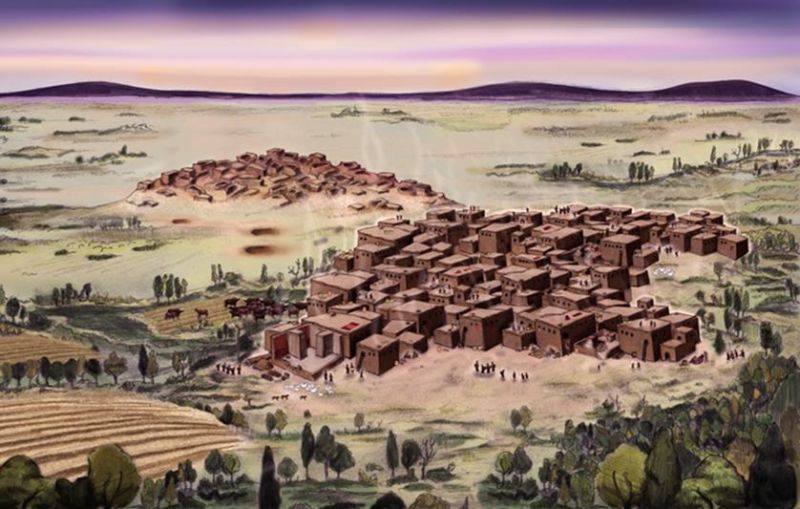
A major climate event Looking closely at the Neolithic and Chalcolithic city settlement of Çatalhöyük in southern Anatolia, Turkey, the study takes into account farming practices in the period spanning 7500 BC to 5700 BC. When the city was most intensely occupied around 8,200 years ago, there was a sudden decrease in global temperatures. It became a well-documented event in the history of climate change, and was caused by a huge amount of glacial meltwater from a massive freshwater lake in northern Canada.   [caption id="attachment_8875" align="aligncenter" width="800"] An artist’s reconstruction of the east and west mounds at Çatalhöyük. Image Credit: Çatalhöyük Research Project[/caption]

Pragmatic farming during drought

The research centres on animal bones found at the excavation site. Scientists have concluded that the herders of the city turned towards sheep and goats, as they fared better during times of drought than cattle. By looking at the cut marks on the animal bones, we can also find more information on butchery practices. They indicate desperation in the community: the high number of cut marks on the bones during the time of the temperature drop shows how the populace exploited any meat available as food would have been scarce.

Dirty dishes

Ancient cooking pots with traces of animal fats have also been analysed in the study, which makes this the first time compounds from animal fats found in pottery are shown to carry evidence for the climate event. [caption id="attachment_8874" align="aligncenter" width="500"] In situ pottery at the archaeological site of Çatalhöyük. The pottery has been at the centre of recent research shedding light on the ways ancient farming practices adapted to climate change. Image credit: Çatalhöyük Research Project.[/caption]

Inevitable impacts

The paper brings together researchers from the University of Bristol’s Organic Geochemistry Unit (School of Chemistry) and the Bristol Research Initiative for the Dynamic Global Environment (School of Geographical Sciences). Co-authors of the paper include archaeologists and archaeozoologists involved in the excavations and the study of the pottery and animal bones from the site. Dr Mélanie Roffet-Salque lead the research. She says: “Changes in precipitation patterns in the past are traditionally obtained using ocean or lake sediment cores. “This is the first time that such information is derived from cooking pots. We have used the signal carried by the hydrogen atoms from the animal fats trapped in the pottery vessels after cooking. “This opens up a completely new avenue of investigation – the reconstruction of past climate at the very location where people lived using pottery.” Co-author, Professor Richard Evershed, adds: “It is really significant that the climate models of the event are in complete agreement with the H signals we see in the animal fats preserved in the pots. “The models point to seasonal changes farmers would have had to adapt to – overall colder temperatures and drier summers – which would have had inevitable impacts on agriculture.”]]>

Categories
Breaking News

Roman-Era Coffin to be Repatriated to Turkey After Legal Battle

Categories
Breaking News

65 Byzantine Tombs Discovered in Ancient City in Turkey

Hurryiet Daily News. Located today in the western Turkish province of Mugla, in the center of the Yatagan district, the long-ruined ancient city is thought to have been one of the largest marble cities of antiquity from its founding during the Hellenistic era. Bilal Sogut, the Pamukkale University professor in charge of the excavation, recounted how the tombs, which contained the remains of both adults and children, were just some of the recent finds, which also included artifacts from varied time periods and evidence of a settlement that would have existed 3,500 years in the past. The researcher, who referred to Stratonikeia as “a living archaeological city”, called the site unique for is various characteristics, which included a high number of ancient structures surviving to the present day. The city, which would have at one time been home to the Carians of central Anatolia before the arrival of the Greeks, also holds ties to the Leleges, a pre-Hellenistic people that were said to have been allies of Troy during the Trojan War, the archaeologist said. One of the primary finds, according to Sogut, was the nearly four-foot-long skeleton found within a Byzantine-era tomb that had been undergoing cleaning and preservation works. The remains are thought to have belonged to a young woman who lived nearly 1,300 years in the past. There are high levels of historical continuity, according to the archaeologists, especially on one of the main areas currently under excavation and study. A thoroughfare being called “Western Street”, which was a field repurposed as a graveyard after a church on the site had collapsed, was the location of the 65 Byzantine tombs. Sogut remarked that the finds are currently undergoing conservation, with work continuing into 2017 at the very least. Even when archaeological finds are too far eroded or destroyed by time to be reconstructed, tourists to Stratonikeia will still be able to glimpse what life would have been like in the ancient city; there are plans to virtually reconstruct much of the structures unearthed through the use of 3D visualization technologies. Sogut says that once the excavation, analysis, and conservation efforts are concluded, visitors will be able to see many of the ancient city center’s structures, as they have been “revived” thanks to the use of the 3D technologies. Providing visual three-dimensional physical representations of ancient structures leads to higher levels of impact on visitors, the archaeologist stated, adding that it provides better opportunities for understanding. The 3D rendering, combined with gravure drawings, will be prepared in time to show visitors by the next season, Sogut said. Hopes are high that Stratonikeia, which has been classified as a “Tentative” UNESCO World Heritage Site, will soon be transitioned to full status. Archeological finds such as these, and those uncovered by research teams in the past, can help to expedite this process. ]]>

Categories
Breaking News

Ancient Statue of Goddess Kybele Unearthed in Turkey

Hurriyet Daily News, Mayor Enver Yilmaz said that the decision was made to support the dig after 2015’s initial one million Lira provision to begin excavations of Kurul Castle. Hopes are high that the restored, excavated castle will bolster tourism in the area, providing opportunities for visitors to observe archaeological artifacts such as the sculpture in an open-air museum. Researchers working on site say that the new statue is one of the most significant finds discovered within Turkey so far in 2016. Besides its historical significance, the Kybele sculpture is the first of its kind to have been discovered in situ – an extremely rare event. This is made even more noteworthy because of the state of Kurul Castle, as the main gate’s walls collapsed during an early occupation by Roman forces. Thought to be constructed during the reign of Mithridates the Sixth, king of Pontus and Armenia Minor from circa 120 BCE to 63 BCE, Kurul Castle may not have been the original home of the Kybele statue. The sculpture likely belonged to the Hellenistic Pontus Kingdom, and could have been transported to Kurul from a more western province, most likely that of Afyon. Located on a mountain ridge outside the village of Bayadi, a close suburb of the city of Ordu, Kurul Castle stands at an elevation of some 1800 feet (571 meters). The site once consisted of an open-air temple, surrounded by a pair of curtain walls. The interior of the castle also held a gallery, a water cistern, and at least four living spaces unearthed by recent excavations. Archaeologists plan to leave the statue in place for now until it can be secured for transport and conservation to a suitable museum in Ordu. Images of the statue can be found here ]]>

Categories
Breaking News

First-Ever Hittite Human Remains Discovered in Turkey

Categories
Breaking News

Yiddish May Have Roots in Turkey, Not Germany

Genome Biology, can be found online at www.oxfordjournals.org]]>

Categories
Breaking News

Burial With Turtles – An Unusual Iron Age Interment

here.]]>

Categories
News

Armenian Reform Plan Lays Path to War and Genocide

Categories
Breaking News

Church Discovered in Turkey Features Unique Art

Categories
News

From Turkey to Coca Cola – The History of Santa Claus