
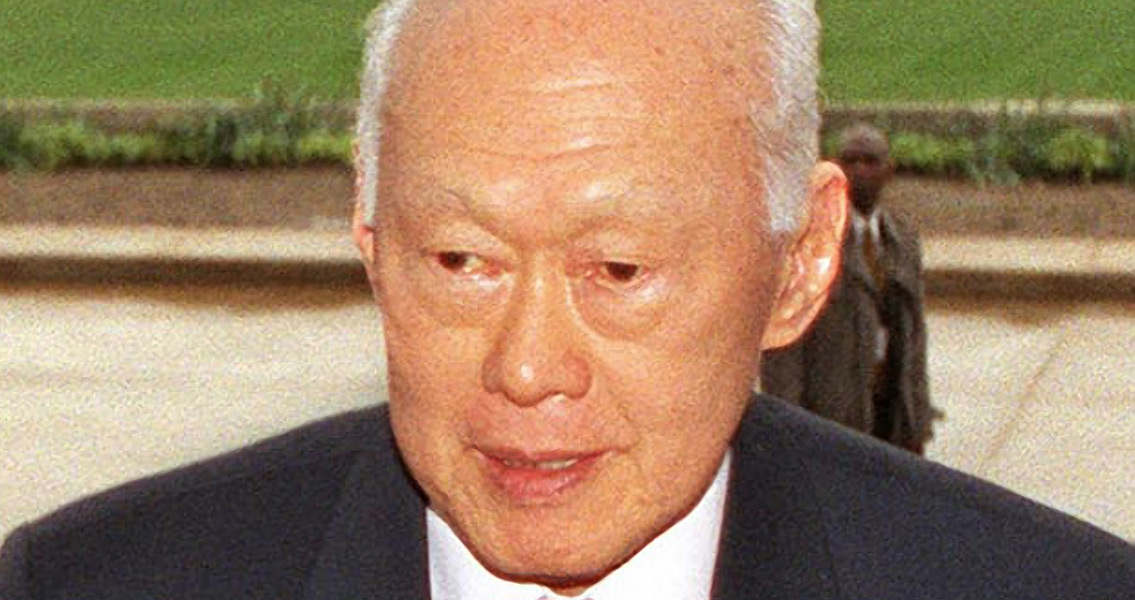
New York Times in 2007, where he described his government as, “We are ideology free”. He went on to explain that the only criterion for developing new policy was, “Does it work? If it works, let’s try it. If it’s fine, let’s continue it. If it doesn’t work, toss it out, try another one.” In 1959, Lee won election with the left-wing party he had co-founded, ‘People’s Action’, and Singapore gained self-government. For the next thirty years, Lee’s tenure as Prime Minister would define a huge chunk of the country’s history and identity. In 1963 he organised a referendum on whether Singapore should move for complete independence from the United Kingdom, so it could form a new federation with Malaysia. Mr. Lee’s campaign was successful, and in August 1963, he declared Singapore’s independence from Britain. The merger with Malaysia proved to be short lived. Violent clashes as a result of tensions between different ethnic groups meant that by 1965 the situation was no longer viable, and Singapore declared independence again, this time from Malaysia. In the following decades Mr. Lee oversaw a period of dramatic economic development in Singapore. In the twenty years between 1960 and 1980 the Gross National Product per Capita increased by fifteen times. At present, the International Monetary Fund ranks Singapore’s citizens as the third richest in the world. Mr. Lee’s model for Singapore was one of centralised government, economic liberalisation and transparency. These features combined to make Singapore one of the most prosperous countries in Asia. On the other hand, Mr. Lee’s rule was often accused of being authoritarian, and he himself admitted that prisoners had been detained without trial. Political rivals were jailed on dubious grounds, sometimes for decades, while opposition parties were sued into bankruptcy. He repeatedly justified these actions on the basis that they were the only way to maintain peace in Singapore’s multicultural society. Such was the length of his reign, that it is difficult to evaluate the benefits of any alternative. Mr. Lee oversaw economic modernisation, dramatic urban development and the creation of an internationally respected education system in Singapore, while at the same time installing mechanisms of government and authority which were at times excessive. Gun and drug crime perhaps best encapsulate the Singapore created by Mr. Lee. Due to incredibly strict punishments for both offences Singapore has some of the fewest instances of gun and drug crime in the world, however, it also has one of the world’s highest rates of execution per capita. Tributes to Mr. Lee from the likes of Angela Merkel, Barack Obama and Vladimir Putin, as well as a host of other statesmen, gives an insight into just how widely respected he was. Many of his policies were deeply controversial but it cannot be denied that perhaps more than other recent politician, he played a pivotal role in shaping the identity of the country he governed. ]]>



PLOS ONE, provides the first direct evidence of Palaeolithic humans having used stone tools in preparing animal carcasses and hides. It is known that early humans developed Acheulian technology around 1.5 million years ago. Acheulian technology is a sophisticated method of making tools, where two faces of hand axes or scrapers are flaked off to form a blade. These Acheulian tools have often been found alongside animal bones, but the evidence that humans had used these tools specifically to butcher animals was circumstantial. “At the Revadim quarry, a wonderfully preserved site a half-million years old, we found butchered animal remains, including an elephant rib bone which had been neatly cut by a stone tool, alongside flint handaxes and scrapers still retaining animal fat,” said Prof. Barkai. “It became clear from further analyses that butchering and carcass processing indeed took place at this site.” By examining the surfaces and edges of the tools to determine their function, (a technique known as ‘use-wear analysis’) and using Fourier Transform InfraRed (FTIR) residue analysis to identify prehistoric organic compounds, researchers were able to show direct proof of flint tools being used in butchering animals. The team also undertook some experimental archaeology, creating replicas of the blades to determine how they may have been used. They found that the hand axe made a very useful multipurpose tool; a prehistoric ‘Swiss army knife’ good for cutting bones, tough sinews and hide. The scraper, however, was a much more specialised tool. With its slimmer and more fragile blade, it was much better suited to separating fur, fat and muscle, the team found. Prof. Barkai believes that these tools come from a very important part of human development. “There are three parts to this puzzle: the expansion of the human brain, the shift to meat consumption, and the ability to develop sophisticated technology to meet the new biological demands. The invention of stone technology was a major breakthrough in human evolution,” Prof. Barkai said. “Fracturing rocks in order to butcher and cut animal meat represents a key biological and cultural milestone.” For more information: www.journals.plos.org Image courtesy of Wikimedia Commons user: Fæ ]]>


www.historians.org Image courtesy of Wikimedia Commons user: Takabeg ]]>
