Archaeometry Image courtesy of Nicolas Poussin]]>

Archaeometry Image courtesy of Nicolas Poussin]]>

Seven Pillars of Wisdom. In a Bristol University press release one of the project leads, Professor Nicholas Saunders, said, “The bullet we found came from a Colt automatic pistol, the type of gun known to be carried by Lawrence and almost certainly not used by any of the ambush’s other participants.” Over the years the integrity of Lawrence’s portrayal of the rebel skirmishes and his role in them has been questioned, with many believing he had taken some dramatic license in Seven Pillars of Wisdom. However, archaeologists have found nothing at any of the excavation sites to debunk his story. Another project participant, Dr. Neil Faulkner, is quoted in the Bristol press release as saying “Lawrence has something of a reputation as a teller of tall tales, but this bullet – and the other archaeological evidence we unearthed during ten years of fieldwork – indicates how reliable his account of the Arab Revolt in Seven Pillars of Wisdom is.” Only two months previously another item related to the Hallat Ammar ambush, a nameplate from a Hejaz Railway engine, reappeared after being lost for nearly 80 years. In 1933, Lawrence gave the nameplate to his friend Vyvyan Richards’ family for safekeeping, and it remained with them after his death in 1935. The nameplate is inscribed in Ottoman Turkish and translates as “iron road”, that is “Hejaz Railway”. The Richards’ family tradition claims that Lawrence “souvenired” the nameplate from a train he attacked. The ambush of the Hallat Ammar train was a rare opportunity for such a souvenir to be acquired given the Turkish train actually had two locomotives instead of just one, and there would have been ample time to pry off a nameplate. In fact, the ambush was so stunningly successful it likely held more meaning to Lawrence than other attacks, and would have merited taking a souvenir. “It is extraordinary,” Professor Saunders added in the Bristol press release, “that after 100 years new discoveries like this are still being made, casting new light on a guerrilla war which helped reshape the Middle East after 1918 – the consequences of which we are still living with today.”]]>

here]]>


Homo floresiensis, aka the ‘Hobbit’ people, were first discovered on the island of Flores in Indonesia and ever since researchers have wondered how they were able to co-exist with early humans when no other group had. The answer? They didn’t. New excavations and dating have concluded that the Hobbit people died away 50,000 years ago, tens of thousands of years earlier than previous testing indicated. In fact, the new data suggests that instead of living alongside them, modern humans may have driven H.floresiensis to extinction. In hindsight though, the error is clear to see. The first Hobbit fossils were considered too precious and fragile to undergo radiocarbon analysis. In lieu of testing the bones, researchers gathered charcoal found nearby under the assumption it had accumulated at the same time as the fossils. The charcoal was tested and dated to 11,000 years old. Modern humans spread throughout Australia and Asia around 50,000 years ago. “Somehow these tiny people had survived on this island 30,000 years after modern humans arrived”, Richard Roberts, with the University of Wollongong, told Nature “We were scratching our heads. It couldn’t add up.” Previous research shows the Neanderthals disappeared shortly after the arrival of modern humans in Africa and Europe. So the team continued excavations in Liang Bua (the limestone cave where the original fossils were found), primarily to search for more remains, and to gain a better understanding of the enormous cave and its geology. Freshly excavated rock and dirt (removed from the same layer of sediment as the Hobbit bones) was tested using several different methods and the results showed the samples were 100,000 to 60,000 years old. Tom Higham, with the University of Oxford, UK, considers the recent dating results compelling, telling Nature “These results are tantalizingly close to the earliest evidence for modern humans in the region, which might suggest a causal link to the subsequent disappearance of H. floresiensis.” Homo floresiensis (which translates as Flores Man) would have been around 3.5 feet (1.1 meters) tall. A total of nine partial skeletons were recovered in 2003, and included one with a complete skull, which is referred to as “LB1”. It’s been determined that LB1 is the skeleton of a 30-year-old female (nicknamed the Little Lady of Flores or “Flo”). Her height has been estimated to be 3 feet and 6 inches (1.06 meters). There has been intense and continuous research since their first discovery just to determine whether or not the Hobbit people represent a species separate from modern humans. Some experts have posited that the historical H. floresiensis could be connected to the Ebu Gogo myths which were prevalent on the island of Flores. Although the new research answers the co-existence question, others remain. For example; what is the Hobbit people’s evolutionary connection to other primitive humans and did they mate with modern humans? It’s also been noted that Liang Bua’s unusual geology would have made it easy for researchers to make the mistake of connecting the charcoal remains to the Hobbit remains over ten years ago. Image courtesy of Wikimedia Commons user Avandergeer]]>


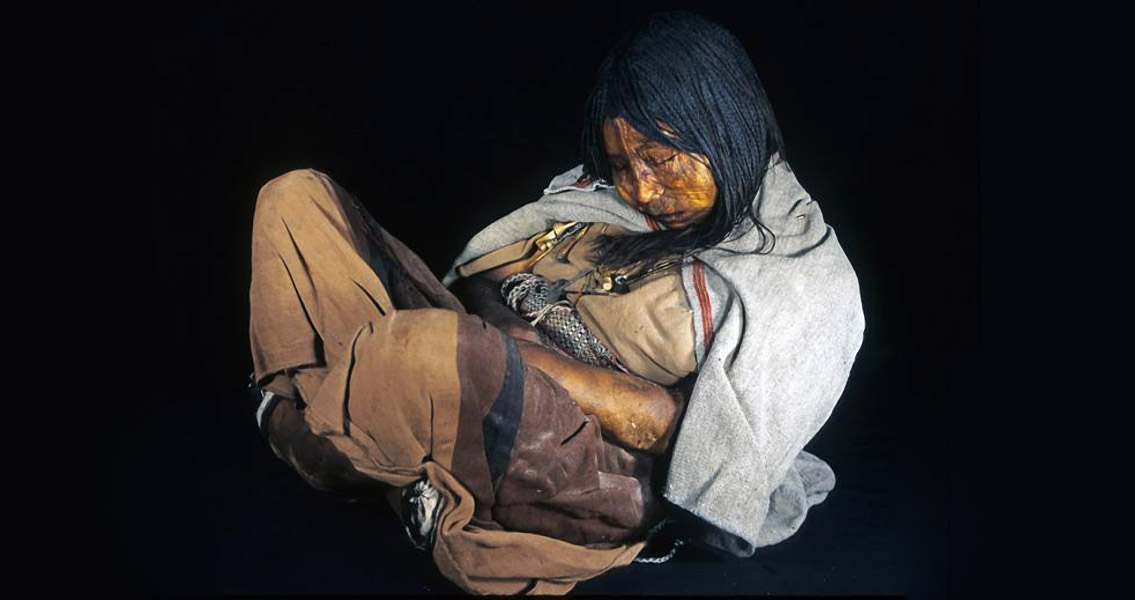
Science Advances, the study marks the first large scale investigation of indigenous DNA and its presence in modern Americans. The researchers analysed directly the DNA of 92 pre-Columbian skeletons, ranging from 500 to 8600 years old. Maternal genetic lineages were charted for the study by extracting and sequencing whole mitochondrial genomes from the teeth and bones of the 92 pre-Columbian skeletons. The team’s findings were shocking. “Surprisingly, none of the genetic lineages we found in almost 100 ancient humans were present, or showed evidence of descendants, in today’s Indigenous populations,” explained Dr Bastien Llamas, a Senior Research Associate with ACAD and joint lead author of the study. “This separation appears to have been established as early as 9000 years ago and was completely unexpected, so we examined many demographic scenarios to try and explain the pattern.” How such an extreme population decline could take place is a mystery, but Llamas suggests it is directly tied in with the pattern of colonisation. “The only scenario that fit our observations was that shortly after the initial colonisation, populations were established that subsequently stayed geographically isolated from one another, and that a major portion of these populations later became extinct following European contact.” he said, in a press release. “This closely matches the historical reports of a major demographic collapse immediately after the Spaniards arrived in the late 1400s.” Just last month, a genetic analysis of Panamanian men found that even though most Panamanians are from female indigenous ancestry, only 22% of the men studied had Y-chromosomes of native origin. Published in the journal PLOS ONE, the study led by Viola Grugni revealed the signature of the strong male genetic impact of European invaders. Beyond highlighting the dramatic consequences of European colonisation, the data collected by the researchers behind the latest study offers insight into the timing of the very first population of the Americas. “Our genetic reconstruction confirms that the first Americans entered around 16,000 years ago via the Pacific coast, skirting around the massive ice sheets that blocked an inland corridor route which only opened much later,” said ACAD’s director, Professor Alan Cooper. “They spread southward remarkably swiftly, reaching southern Chile by 14,600 years ago.” These earliest Americans were distinguished by their limited genetic diversity, a consequence of their population being isolated on the Bering Land Bridge for thousands of years during the last Ice Age. “This long isolation of a small group of people brewed the unique genetic diversity observed in the early Americans.” remarked Dr Lars Fehren-Schmitz, from UCSC, the other lead author. The new study charts both the formation of a unique early American identity, and its disappearance as a result of European colonisation. Image courtesy of Johan Reinhard]]>