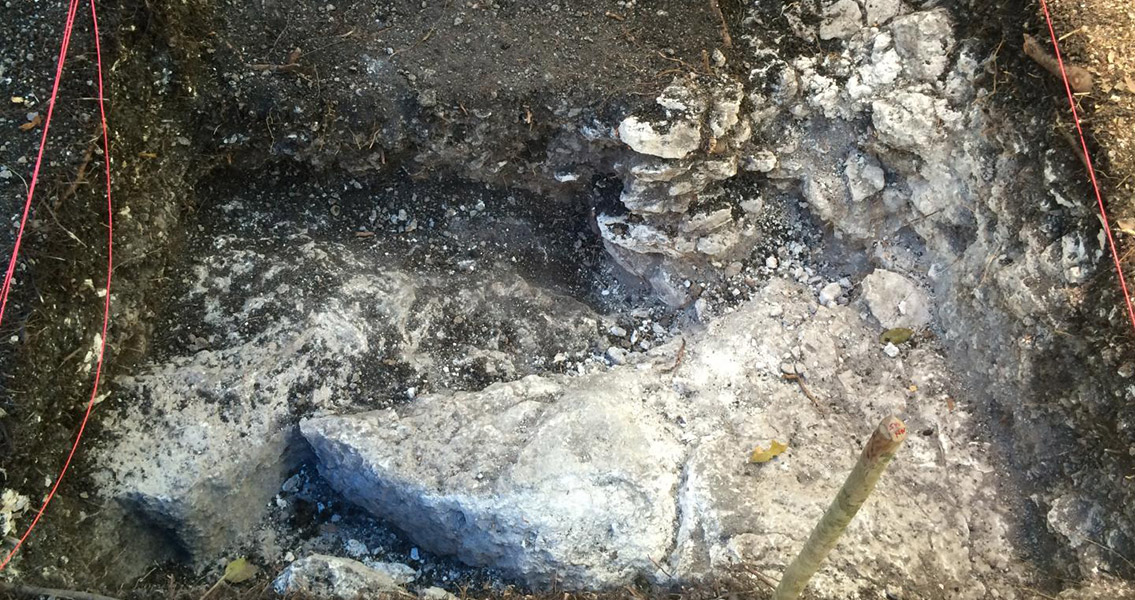



here Image courtesy of Michael Cordonsky (photographer), Tel Aviv University and the Israel Antiquities Authority]]>

Scientific American, the astrophysicist explained that the study focused on the 1,200-light year region of space surrounding the Earth known as the Local Bubble, which incorporates the region of the Milky Way that the Earth inhabits. Breitschwerdt and his team used a combination of existing supernova data and computer modeling to determine if the deep-sea deposits of iron-60 were from local supernovas that occurred around 2.2 million years in the past. The results led to the team pinpointing two supernovas that would have ejected their radioactive mass on trajectories that hit Earth – two stars that were around 290 light years and 325 light years from our own planetary system. Both of these supernovas, the first occurring 2.3 million years ago when a star almost 10 times the mass of our own sun exploded; the second 1.5 million years in the past when another star nearly as large exploded, occurred well within the window of human evolution. In fact, the oldest known member of the Homo genus – of which Homo sapiens is a member – has been dated to around 2.8 million years old. These explosions were two of the 14 to 20 supernovas that supplied the hot plasma making up the Local Bubble, researchers said. The other supernovas likely showered iron-60 onto Earth as well, albeit to a smaller extent because they happened farther away and longer ago. When the radiation from these two explosions reached earth, it could have triggered genetic mutations on Earth’s early life, Breitschwerdt remarked. In fact, mutations such as increase in brain size – one of the hallmarks of human evolutionary development – could have been jumpstarted by the supernova radiation. ]]>

Indian Times that many of these structures were concealed with a thick layer of aquatic growth, making them difficult to identify. “Some of them are badly damaged due to strong underwater currents and swells. However, we could make out that they were part of a building complex,” Nigam is quoted as saying. Archaeologists believe that the structures may be between 1,100 and 1,500 years old. From previous experiences and as a result of studies on the historical patterns of the sea level in this region, researchers have determined the sea-level approximately 3,500 years ago was lower than it is now, but 6,000 years ago it was actually higher. Archaeologist, T. Sathyamurthy, with the Archaeological Survey of India (ASI), Chennai Circle, told the Indian Times that explorations of this type were gradually providing evidence that myths are often facts. Using sonar technology, researchers with ASI began exploring the coastline of Mahabalipuram and discovered the row of stones seen by people immediately before the tsunami on 2004 and determined they were part of a larger 70-meter-long, six-foot-high wall. They also found the remains of three additional temples; two of which were submerged, and a cave temple within 500 meters of the coast. Historians believe a majority of these structures, as well as the port, may have become submerged as a result of a past tsunami-like occurrence which took place around 952 CE. Geophysical data from previous surveys and explorations also point to a large building complex, possibly a township, being submerged in the sea. A global rise in sea levels of even 1mm to 2mm annually could easily inundate several hundred meters of shoreline over a 2,000-year time period. Another explanation for the structures being under water is tectonic movement or soil erosion.]]>

American Journal of Physical Anthropology, challenges the prevailing view that infectious disease outbreaks exploded with the dawn of agriculture, when humans started to live in dense, sedantary populations alongside their livestock. In particular, their results bring into question the idea that diseases such as tuberculosis were initially spread to humans from livestock such as pigs. “We are beginning to see evidence that environmental bacteria were the likely ancestors of many pathogens that caused disease during the advent of agriculture, and that they initially passed from humans into their animals,” said Houldcroft in a Cambridge University press release. Although there is no definitive evidence humans transmitted African diseases to Neanderthals, Houldcroft and Underdown’s paper provides several candidates for diseases that could have been spread in such a way. One is Helicobacter pylori, a stomach ulcer causing bacterium. It is estimated to have initially infected humans in Africa between 116 and 88 thousand years ago. It arrived in Europe 52,000 years ago, while the most recent studies suggest Neanderthals had gone extinct by 40,000 years ago. Herpes simplex 2, the virus which causes genital herpes, is another candidate suggested by the paper. The genome of the disease suggests it was transmitted to humans through chimpanzees, via another as yet unknown hominin species, around 1.6 million years ago. “The ‘intermediate’ hominin that bridged the virus between chimps and humans shows that diseases could leap between hominin species. The herpes virus is transmitted sexually and through saliva. As we now know that humans bred with Neanderthals, and we all carry 2-5% of Neanderthal DNA as a result, it makes sense to assume that, along with bodily fluids, humans and Neanderthals transferred diseases,” said Houldcroft. Neanderthals lived in relatively small, isolated communities, meaning that rather than a rapid epidemic, their decline due to disease was probably quite gradual. “… it is unlikely to have been similar to Columbus bringing disease into America and decimating native populations. It’s more likely that small bands of Neanderthals each had their own infection disasters, weakening the group and tipping the balance against survival,” Other causes may have contributed to the extinction of the Neanderthals, but Houldcroft and Undertown’s work shows that humans spreading disease must be considered as a factor in the species’ decline. For more information: www.onlinelibrary.wiley.com]]>