Categories
Editorial

Nazi Germany and its curious treatment of lesbians

Memorial “to the gay and lesbian victims of National Socialism” in Cologne: The inscription on the left side of the monument (to the viewer’s right from the angle depicted) reads “Totgeschlagen – Totgeschwiegen” (“Struck Dead – Hushed Up”). Credit: Jörg Lenk via Wikimedia Commons[/caption]

Female oppression as a cause for the tolerance of lesbians?

Some have argued that lesbians weren’t as harshly persecuted as gay men, simply because female sexuality wasn’t taken seriously. Others have said that the regime’s policy of pronatalism, which encouraged reproduction and the nuclear family, didn’t face as much of a threat from lesbians as it did gay men. Further still, the Nazis believed women were inferior to men and thus dependent on them. Under this theory, a lesbian would still rely on the men in her community, and is hardly a threat to male dominance. The Nazis also dismissed lesbianism as they believed lesbians could still occupy a German woman’s primary role: to mother as many German babies as possible. Sexuality, they believed, did not interfere with a woman serving the Nazi state as a wife and mother. There is another prominent narrative, which has gained attention over the past year. Samuel Clowes Huneke from Stanford University posits that Nazi officials didn’t see lesbians as a strong political threat, due to the fact that women were barred from politics and public life. “In light of both the fearsome persecution of homosexual men and scholarship that places it in the context of National Socialist pronatalism, the regime’s seeming lack of interest in female homosexuality is startling, for in other respects the government placed considerable burdens on women,” says Huneke.  

Four couples betrayed

Specialising in homosexuality in the Third Reich, Huneke has examined 4 cases of investigation by the Kriminalpolizei, or the German criminal police. Discovered at the Landesarchiv Berlin in 2015, the files shed light on the investigation of 8 women. They show us signed statements from witnesses and the women themselves. In all 4 of the cases, the women were accused by a person they knew and trusted: whether that was a neighbour, co-worker or even a parent. “That these eight women were denounced to the Berlin criminal police in the early 1940s is striking on its own, given the archival silence when it comes to female homosexuality,” Huneke says. Astonishingly, there is no evidence that any of the 8 women were punished as a result. All 4 cases tell us that the women could not be prosecuted for same-sex relations under the criminal code, in the way that gay men would have been. Huneke was fascinated: “To scholars accustomed to seeing in the Nazi state a jungle of overlapping jurisdictions, personal initiative and law based solely on the Führer’s wish, this is a curious portrait of the Nazi justice system, one marked by an unexpected concern for the strict interpretation of statute.” One case stands out as particularly peculiar. Margot Liu née Holzmann was a Jewish lesbian living in Berlin. In 1941, she married a male Chinese waiter and received Chinese citizenship, which protected her from being deported to a concentration camp. However, when her husband discovered she was in a lesbian relationship, he filed for divorce and reported her to the police. Curiously, the police did not intervene. Moreover, they insisted, in multiple documents, that she was protected because of her Chinese citizenship – despite being a German Jewish lesbian. At this point, it is worth noting that in all 4 of these cases, including Margot Holzmann, we are looking at the judgment of one single officer. That particular officer may have just been less inclined to pursue homophobic policy than other officers. However, the rules were very closely followed, which has led some historians to consider this to be an indication of relative tolerance for lesbians.  

“Open – but not enviable – lives”

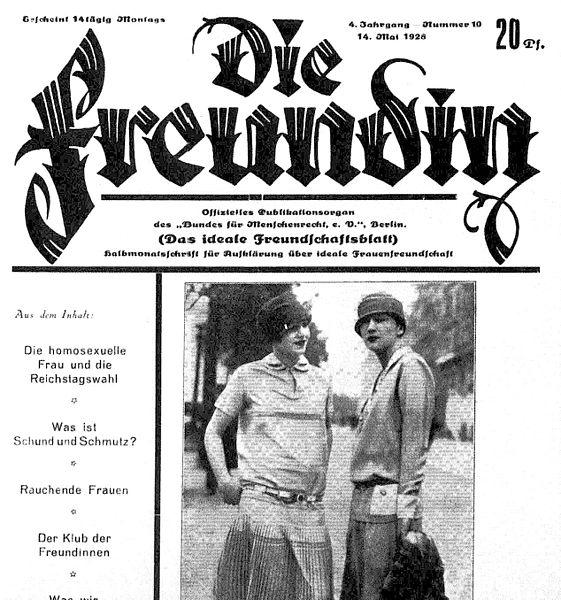
The files show that the 8 women had led relatively open – though certainly not enviable – lives as lesbians before being denounced to the authorities. Ordinary German citizens would have been aware of their female friends, co-workers and acquaintances in same-sex relationships, but were less likely to report them to the police. A patronising understanding of female sexuality comes into play: “Gender is perhaps why lesbians weren’t persecuted in the same ways… [but] these files throw into sharper relief the duplicity of tolerance that has characterised societies’ views of female sexuality for centuries,” says Huneke. By no means was life as a lesbian in Nazi Germany easy, though. In 1928, for example, the police banned popular lesbian journals such as Die Freundin (Girlfriend) based on the Protection of Youth from Obscene Publications Act.   [caption id="attachment_8709" align="aligncenter" width="561"] Credit: Bund für Menschenrecht/Wikimedia Commons[/caption] Many conservatives are documented as demanding the enactment of criminal statutes against lesbian sexual acts. Pamphlets with messages against homosexuals, feminists, Republicans and Jews were everywhere, usually bringing with them the ideas of a conspiracy from marginalised peoples to destroy Germany. These pamphlets denounced the movement for women’s rights, saying that feminism was nothing more than a seduction into lesbianism. Culturally, it seems there was a war against lesbians; and yet there appears to be at least some level of tolerance when it came to prosecution.  
Tolerance and the nature of dictatorships

The case of lesbian life in Nazi Germany is considered to demonstrate that dictatorships often rely not purely on overt oppression; but on limited tolerance of certain groups. Huneke calls it the ‘divide-and-conquer approach’. “One of the most important takeaways from this research, to my mind, is to break the popular idea that authoritarian governments maintain their power only through repression.” Moreover, Huneke says: “the experiences of lesbians in Nazi Germany can help shed light not only on how gender operates in multivalent ways, but also the complex negotiation of both repression and toleration on which authoritarian regimes depend.”]]>

Categories
Breaking News

Why does science say there was only 1 man for every 17 women in 3000 BC?

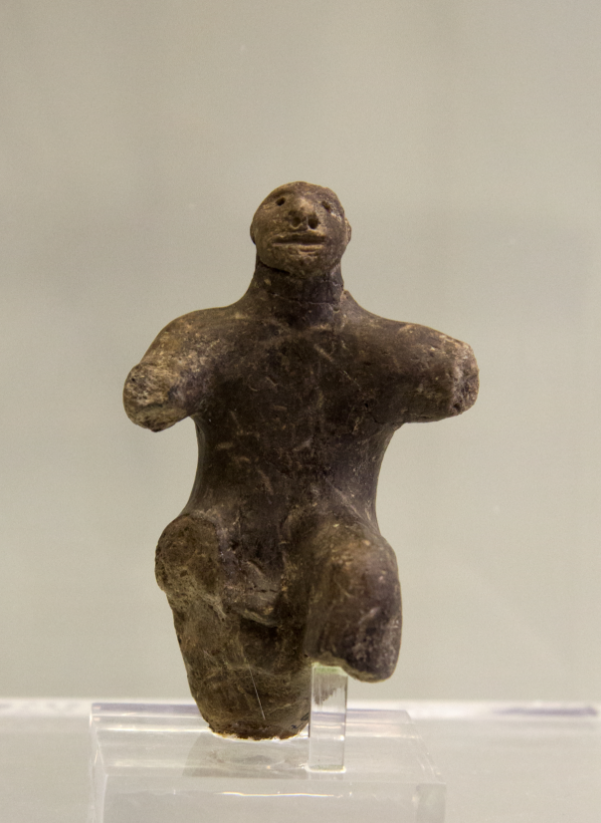
Male figurine, pottery. Neolithic, 5000 – 3000 BC. Credit: Archaeological Museum of Heraklion.[/caption]

The Y Chromosome Bottleneck

Known as the Y chromosome bottleneck, this research was first proposed in 2015 by Monika Karmin, a population geneticist at the University of Tartu in Estonia. Since then, academics have been trying to understand how this could have happened. Some research has told us that the drop-off in the male population was the result of ecological factors mainly affecting male babies. Stanford University students Alan Aw and Tian Cheng Zeng thought there must be another explanation. They took their theories to Marcus Feldman, a population geneticist at the University, who said that the imbalance “struck us as being very extreme.”  

A new explanation?

On 25th May 2018, the team published a new paper in the journal Nature Communications. It posits that humans who were living in patrilineal clans, which consisted of males from the same lineage, could have entered a particularly violent age; with inter-clan wars happening particularly frequently. If true, this had the potential to wipe out entire lines of male descent at a time. In his research, Feldman suggests that rather than the male population taking an apparent nosedive, the diversity of the Y chromosome decreased due to the ways people were living and fighting with one another. Or, to put it another way, there weren’t actually fewer males. There was just far, far less diversity.  

A quick recap of our chromosomes

As humans, most of our genes are carried in 23 pairs of chromosomes. The 23rd pair determines our sex: females have two X chromosomes, whereas males have one X and one Y chromosome. A baby’s sex is determined by the chromosomes it inherits from its parents. This allows genes to get shuffled around, which increases the overall diversity in the species. But the Y chromosome, which has no female counterpart, stays almost the same from grandfather to father to son, and so on. Of course, mutations occur, which explains why the Y chromosome does in fact differ among males.  

How were people living at the time?

After the advent of farming around 12,000 years ago, societies were increasingly organising themselves around extended kinship groups, ultimately manifesting as patrilineal clans. As we know from this study, this was a cultural fact with poignant biological consequences. Women may have married into a clan, but the men in the clan were all related through male ancestors. “From the point of view of those chromosomes at least, it’s almost as if everyone in a clan has the same father,” says Nathan Collins from Stanford University. This study, which looks at genetic occurrences between 5,000 and 7,000 years ago, considers people living in a transitional period. Soon after, people moved into larger societies and built towns. At that point, humans because less intent on maintaining the Y chromosome lineage and perhaps unsurprisingly, the diversity of the Y chromosome bounced back. [caption id="attachment_8716" align="aligncenter" width="500"] Marcus Feldman with fellow researchers Tian Cheng Zeng and Alan Aw. Credit: Marcus Feldman, Stanford University[/caption]

Simulating the possibilities

Feldman, Zeng and Aw conducted 18 different simulations, each representing different scenarios that could explain the bottleneck. This included situations reflecting Y chromosome mutations; competition between different tribes, and natural death. Crucially, the bottleneck did not occur in the simulation in which patrilineal clans did not exist. We can then assume that the most likely reason for the bottleneck was patrilineal clans going to war. If one clan was wiped out, so was its shared Y chromosome. Monika Karmin, lead author of the original study, weighs in: “fighting clans are indeed likely to cause a drastic drop in male genetic diversity… However, we do have to keep in mind that there is very little information on the actual societal organisation from that time.”  

No XX bottleneck

Incidentally, there was no such bottleneck in females. Feldman was able to deduce this by analysing mitochondrial DNA, which is only passed down from the mother. “In that same group, the women could have come from anywhere,” Feldman says. “They would’ve been brought into the group from either the victories that they had over other groups, or they could’ve been females who were residing in that area before.” He added that colonisation tends to see the men killed, and the women kept alive.  

A cultural influence on genetic variation

Academic research often focuses on behaviours that have a genetic basis; but not necessarily on behaviours that influence genes. The new research is, in Feldman’s words: “an example of what a cultural preference can do in changing the level of genetic variation.”]]>

Categories
Breaking News

Could this 2,800 year old sculpture show us the face of a biblical king?

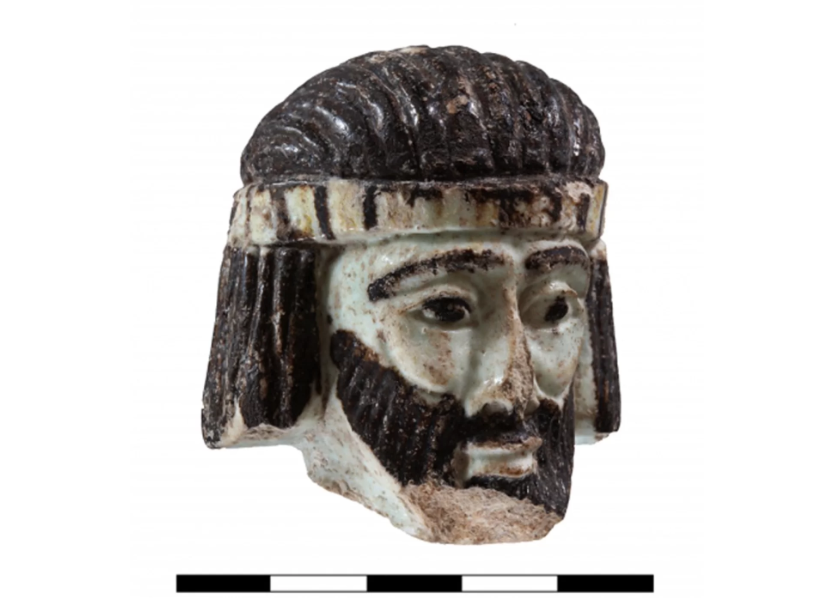
Credit: Gabi Laron[/caption]

A tiny representation of a momentous past

The glazed ceramic sculpture is of a man with long, black hair and a beard. He is wearing a yellow and black headband, which pulls the hair away from his dark, almond-shaped eyes. At only 5.1 cm x 5.6 cm, this tiny head is thought to have been part of a small statuette, according to archaeologists. At full size, the statuette would have been around 20 cm x 25 cm. Professor Robert Mullins from Azusa Pacific University’s Department of Biblical and Religious Studies is also co-director of excavations in the ancient city. He said: “Despite the head’s small and innocuous appearance, it provides us with a unique opportunity to gaze into the eyes of a famous person from the past — a past enshrined in the Book of Ages [the Hebrew Bible].”  

Whom does the sculpture depict?

Given that it was found inside what is thought to be an administrative building at the city’s peak, it is likely that the sculpture is of an elite person. The first assumptions have been that it was a biblical king; though Mullins and his team have yet to undertake the necessary research to prove or disprove this theory. So if it is indeed a king, whom would it have been? [caption id="attachment_8706" align="aligncenter" width="500"] Credit: Gabi Laron[/caption]  

Power struggles in Abel Beth Maacah

In the early stages of research, the team performed radiocarbon dating on the organic materials that were found in the same room as the sculpture. According to the findings, the object would have been constructed some time between 902 BC and 806 BC. The control of Abel Beth Maacah fluctuated greatly during this period. This is down to the fact that it sat at the border of 3 separate kingdoms: Israel, Tyre and Aram-Damascus. Borders were changing continually, leaving Abel Beth Maacah to be under the jurisdiction of different nations. Taking likelihood into account, Mullins thinks the sculpture could depict one of 3 possibilities: King Ahab of Israel, King Hazael of Aram-Damascus, and King Ethbaal of Tyre. However, there are many other candidates, he has said.  

Future research to confirm identity

The sculpture will be displayed at the Israel Museum in Jerusalem, while the scientists are publishing a paper on the discovery for the journal Near Eastern Archaeology. Excavations at Abel Beth Maacah are undertaken by Azusa Pacific University and the Hebrew University of Jerusalem. Joining Professor Mullins are Naama Yahalom-Mack and Nava Panitz-Cohen, both from the Hebrew University of Jerusalem. They will continue to arrange excavations of the large building into summer 2018. Archaeologists are hopeful that new information will arise to determine the identity of this miniature sculpture.]]>

Categories
Breaking News

Historian lifts the veil on cross-dressing in the English Civil War

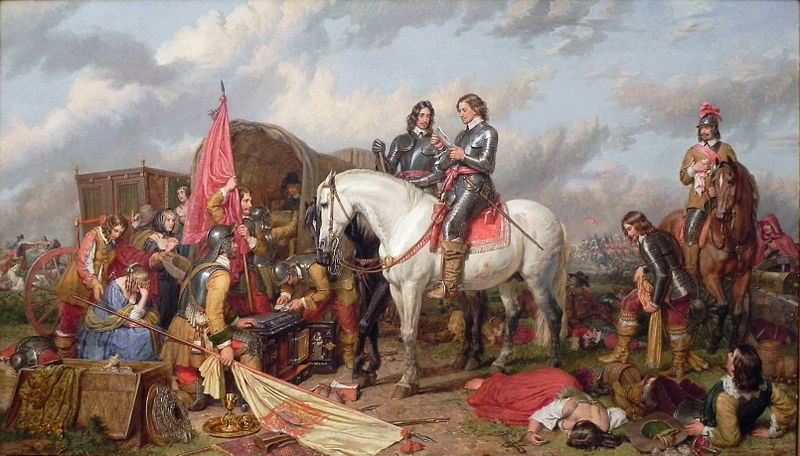
Battle of Naseby, by an unknown artist. The victory of the Parliamentarian New Model Army, under Sir Thomas Fairfax and Oliver Cromwell, over the Royalist army, commanded by Prince Rupert, at the Battle of Naseby (June 14, 1645) marked the decisive turning point in the English Civil War. Credit: Encyclopaedia Britannica Online[/caption]

Clothes maketh the man

After exploring hundreds of original manuscripts and printed works, a handful of fascinating cases were revealed. Wives, unmarried partners, would-be female soldiers and even prostitutes were present. Some women were motivated by a desire to fight; others wanted to remain close to their husbands. For example, the mistress of captured royalist Lord Henry Percy is documented to have been dressed in men’s clothing to hide her identity. To ridicule her, Oliver Cromwell got the woman to sing, so as to confirm his suspicions of the would-be man as a ‘damsel’.

A prince intervenes

One anonymous letter from 1642 describes a woman named Nan Ball, who was “taken in mans cloathes, waiting upon her beloved Lieutenant” while he served in the king’s army near York. It was later published in a pro-royalist news pamphlet, sparking an investigation. The Lieutenant was sacked, and there were suggestions that Nan Ball ought to be shamed by either public whipping or pillory. However, after an intriguing letter from the king’s son, which saw him beg for her reprieve, she was simply expelled from the camp. Exactly why her punishment was lifted is unclear; but it is possible that the initial threats were simply a warning.

“The severest punishment”

The following year, a draft proclamation set out the required standards of behaviour for the army of King Charles I. In the margin, the king hand-wrote: “lett no woman presume to counterfeit her sex by wearing mans apparall under payne of the severest punishment”. Professor Stoyle was fascinated by this statement: “These words suggest the king believed female cross-dressing was quite widespread in his army and show a willingness on his part to take a much firmer line on the practice – particularly in relation to prostitutes. Curiously though, when the proclamation was finally published it contained no reference to cross-dressing.” [caption id="attachment_8701" align="aligncenter" width="500"] Cromwell in the Battle of Naseby in 1645 by Charles Landseer. Credit: Wikimedia Commons[/caption]

Dressed to kill: female bravery during the English Civil War

A pamphlet published in 1645 details the account of a young soldier who spent a year in the parliamentary garrison of Gloucester. Eventually, she was discovered to be a woman after visiting a tailor to order a petticoat and waistcoat ‘for my sister’. The suspicious tailor raised the alert with the military authorities. In their investigation, they found that the solider had bravely disguised herself in order to first escape the royalists, and then fight against them. These pioneering women represent just one example of how female bravery was forced into disguise as they navigated a society rocked by war. Stoyle finishes: “Above all, though, the subject of female cross‐dressing during the Civil War is surely worthy of detailed study in its own right because it helps to illuminate one small corner of a much larger story: that of how ‘the crisis in English affairs’ during the 1640s made space for some bold women fleetingly to test the boundaries of patriarchy.” Read the full paper here.]]>

Categories
Breaking News

Only 15 people required to lift 12-ton hats onto Easter Island statues, research shows

Credit: Wikimedia Commons[/caption]

Early transportation technologies on Easter Island

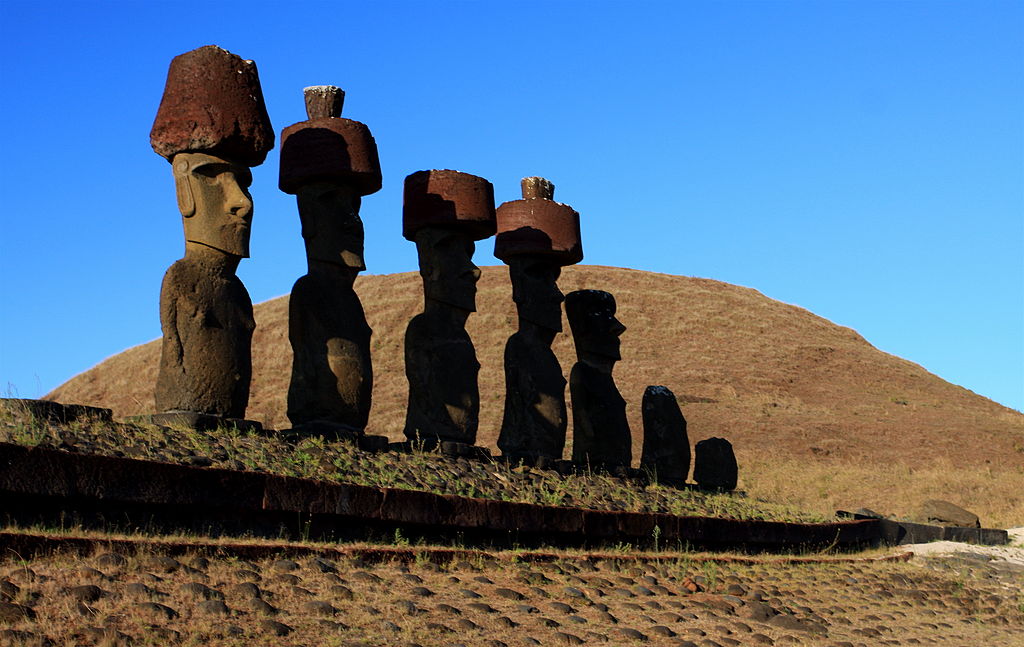
Easter Island sits in the Southern Pacific Ocean and is more than 2,000 miles from Chile in South America. It is about 15 miles long and 7.6 miles wide, with an area of roughly 63 square miles. The famous statues, the moai, were carved from volcanic tuff; while the hats were made of red scoria. Each part came from a different quarry on the island, sparking numerous studies about the technologies used by ancient peoples to transport such heavy goods across many miles. The moai statues, which can be up to 33 feet tall and weigh around 81 tons, are considered to have been moved into place along well-prepared roads using a walking or rocking motion, quite like the way we might move a refrigerator. “We’ve learned they moved the statues in a walking fashion using simple, physics-based processes, in a way that was elegant and remarkably effective,” said Carl Lipo, Professor of Anthropology at Binghamton University. As might be expected, not all of the statues made it to their final locations. Fallen and broken parts of statues show that the statues were originally carved so they leaned forward, for ease of transportation. They were then levelled off once they had reached their destination and were ready for the pukao to be lifted onto them. [caption id="attachment_8696" align="aligncenter" width="500"] Credit: Bjørn Christian Tørrissen via Wikimedia Commons[/caption]

Lifting the pukao of Easter Island: A perplexing concept

Often weighing up to 12 metric tons, pukao are huge cylinders made of red scoria. Despite having relatively few people and a limitation of resources, these heavy carvings were moved across the island. Once they had arrived at the site of the moai, however, they still had to be lifted onto the statues’ heads. It is likely that the islanders then carved the hats, as chips of red scoria are found in the platform of some of the statues. Sean Hixon, lead author of the project and graduate student at Penn State University, says: “Examples of past ideas for pukao transport include sliding the pukao up a wooden ramp or gradually building a pile of stones beneath the pukao. The challenge is to move beyond merely possible transport methods and to identify a transport scenario that is consistent with variation in the archaeological record.”  

Photogrammetry research

Lipo continues: “Our latest study now tackles the issue of the hats, or pukao. These multi-ton stone objects were carved at a separate quarry, transported across the island and somehow raised to the top of the heads of the statues.” Previous researchers have suggested that the statues and hats would have been united before being lifted into place. However, the remnants of broken or abandoned statues indicates that the hats were more likely to have been raised to the top of the already-standing statues. By photographing various pukao and generating 3D models, the research team were able to identify the most likely method of transport for these great statues. “We assumed they were all transported and placed in the same way,” said Hixon. “So we looked for features that were the same on all the hats and all the statues.”  

Parbuckling: highly effective work methods for small groups

The project showed that it is likely for the pukao to have been rolled from the quarry to the site of the moai. The Rapa Nui would have rolled them up large ramps, employing a parbuckling technique. Often used to right ships that have capsized, parbuckling is a simple and efficient technique for rolling objects. The centre of a long rope is fixed to the top of a ramp, and the two ends are wrapped around the cylinder that needs to be moved: in this case, the pukao. “In parbuckling, a line would have been wrapped around the pukao cylinder, and then people would have pulled the rope from the top of the platform,” said Lipo. “This approach minimises the effort needed to roll the statue up the ramp. Like the way in which the statues were transported, parbuckling was a simple and elegant solution that required minimum resources and effort.” As well as reducing the force required to move the hats, this technique also makes it easier to stabilise the hat on its journey up, because typically, it will not roll back down the slope. In fact, the researchers report that 15 or fewer workers could move even the largest of the Easter Island pukao.  

The ingenuity of the ancient people of Easter Island

The research shows the innovative thought processes displayed by the Rapa Nui, helping to challenge some pre-formed ideas about the people. “Easter Island is often treated as a place where prehistoric people acted irrationally, and that this behaviour led to a catastrophic ecological collapse,” said Lipo. “The archaeological evidence, however, shows us that this picture is deeply flawed and badly misrepresents what people did on the island, and how they were able to succeed on a tiny and remote place for over 500 years.” “The answer, like that of our findings with the moai, show that Rapa Nui people were remarkably ingenious and found solutions that required the fewest resources and smallest effort to achieve their goals.” “While the social systems of Rapa Nui do not look much like the way our contemporary society functions, these were quite sophisticated people who were well-tuned to the requirements of living on this island and used their resources wisely to maximize their achievements and provide long-term stability.” Lipo’s team will continue researching the Rapa Nui people and their relationship with their environment and community.]]>

Categories
Breaking News

Iceland genealogy study to cure rare diseases

Image credit: Amy Smith[/caption]

A unique genetic history

Iceland’s first settlers arrived from Norway, Britain and Ireland between 870 and 930 AD. In just over 1,000 years, its population has grown modestly to 330,000. Opportunities to directly study the founding of a human population and its subsequent evolutionary history are rare. With such a small, isolated population with some inbreeding, it is often considered a particularly interesting subject for genetic studies. CSIC researcher Carles Lalueza-Fox from the Institute of Evolutionary Biology explains: “This work takes an in-depth look at the process which makes small, isolated populations go through random changes in their genetic variability over time. Present-day Icelanders have been affected by 1,100 years of profound genetic drift. This means they are more similar to each other, yet different to modern populations of continental Europe.”

Gender bias in Iceland

deCODE Genetics, a Reykjavik biotechnology firm, contributed seven centuries’ worth of genelogical records to the study. The information confirms a gender bias in the population of Iceland. “The settlers of Celtic origin had fewer offspring compared with those of Norwegian origin. This is probably because there were more men of Scandinavian origin compared to more women – who would probably have come to the country as slaves and servants – from Scotland and the rest of Britain,” explains Lalueza-Fox. Sunna Ebeneserdóttir, a researcher from deCODE Genetics, continues: “We have always known that Icelanders descended from Norwegians and Celts, and the analysis of the ancient genomes from the first colonists allows us to see what they were like, both before mixing started, as well as throughout the whole process.” [caption id="attachment_8691" align="aligncenter" width="500"] Image credit: Amy Smith[/caption]

A medically-significant study

In providing a detailed impression of the origin of Iceland’s human population, the scientists have found a key to making advances in medical treatment. Finding ways to diagnose, treat and even prevent diseases is now within the realms of possibility. For instance, as the study includes the discovery of an ancient person with Klinefelter syndrome, there can now be deeper research into the disease. “Iceland is big enough for the diseases that affect Europeans to be represented, yet small enough to easily carry out genetic studies which lead to discovering the roots of these complex pathologies. In the not too distant future, we will be able to study the actual individuals who had a certain mutation 1,000 years ago and make a comparison with current patients,” finishes Lalueza-Fox.]]>

Categories
Breaking News

New research: How did the first people come to the Americas?

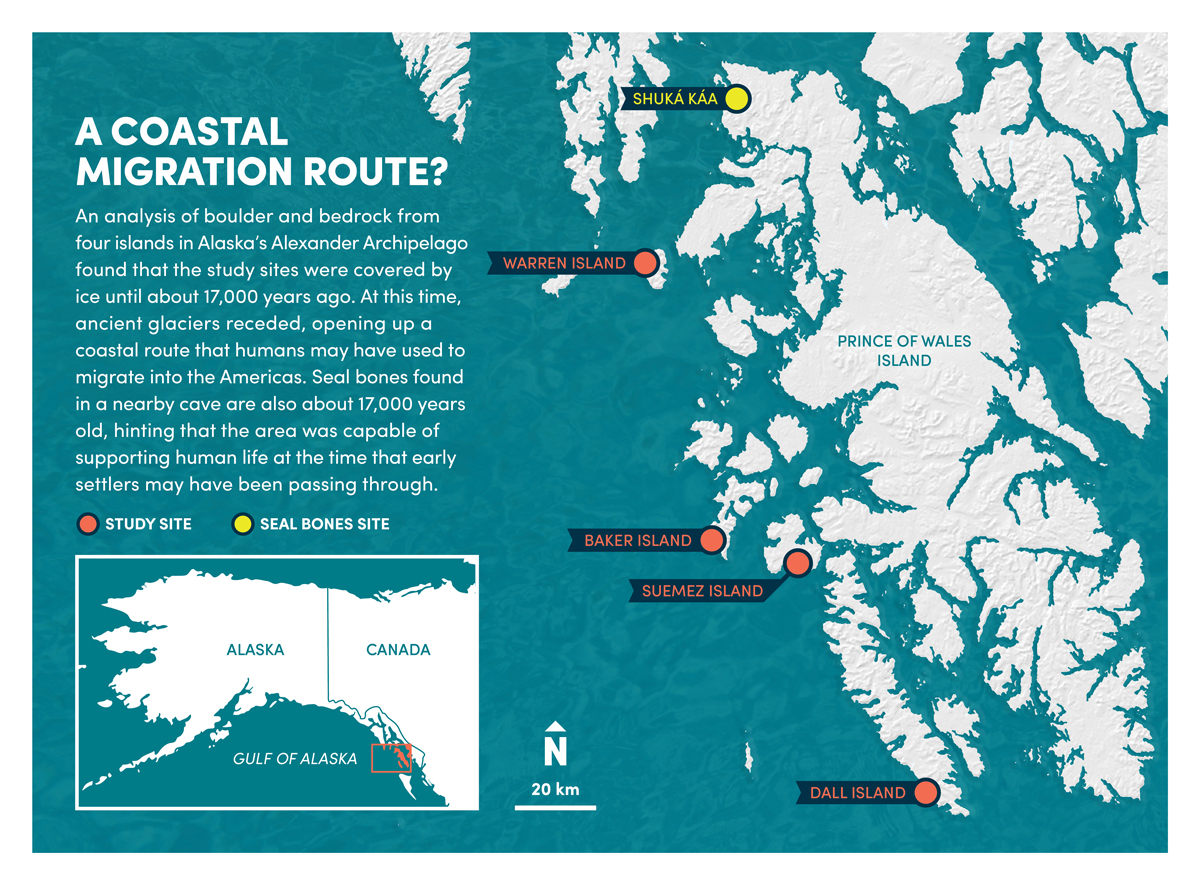
part of a coastal migration route appeared in Alaska around 17,000 years ago. At the same time, ancient glaciers began to recede, which exposed southern Alaskan islands to the potential for human migration. Supporting the hypothesis, recent genetic and archaeological findings show that settlers are likely to have begun travelling further into the Americas around 16,000 years ago; just 1,000 years after the coastal gateway became accessible. While the findings aren’t definitive proof that early settlers traversed Alaska’s southern coast, it is thought that it may spark off deeper research into the hypothesis, with further sections of the coastline being analysed in the future. [caption id="attachment_8683" align="aligncenter" width="500"] Credit: Buffalo University research team[/caption]

Updating American ancestry

Jason Briner, PhD, professor of geology in University of Buffalo’s College of Arts and Sciences, says: “Our research contributes to the debate about how humans came to the Americas. It’s potentially adding to what we know about our ancestry and how we colonized our planet.” Prior to this research, the bones of an ancient seal were discovered in a nearby cave. As part of the new study, these bones are shown to be about 17,000 years old. The presence of this ringed seal indicates that after the depletion of the glaciers, resources including food were becoming available to humans. In short, the area had the capacity to support human life at the time when settlers may have been following this route into the Americas. “Our study provides some of the first geologic evidence that a coastal migration route was available for early humans as they colonized the New World. There was a coastal route available and the appearance of this newly ice-free terrain may have spurred early humans to migrate southward,” adds UB geology PhD candidate, Alia Lesnek. “Where we looked at it, the coastal route was not only open — it opened at just the right time,” says Charlotte Lindqvist, PhD, an associate professor of biological sciences at UB and a visiting associate professor at Nanyang Technological University. “The timing coincides almost exactly with the time in human history that the migration into the Americas is thought to have occurred.” [caption id="attachment_8686" align="aligncenter" width="500"] The investigation was in challenging terrain. Photo: Jason Briner[/caption]

A possible new narrative

This evidence could further debunk the theory that humans populated North America via Canada. In order to have done this, they would have needed to walk through a path that opened up around 14,000 years ago. However, the route did not have the biological diversity to support human life until about 13,000 years ago. As humans were already living in Chile 15,000 years ago, and in Florida 14,500 years ago, there must have been another route in. This coastal migration theory could well start to fill in the blanks of what we now know about the American migration story.]]>