Ancient Mesoamerica, can be found here]]>

International Business Times, local road work had been planned for nearby the ancient ruins, which prompted local authorities to contact the French National Institute for Preventative Archaeological Research (INRAP) to clear the construction. INRAP conducted excavations to ensure the new road wouldn’t inadvertently demolish any significant archaeological remains, only to discover the statue during their investigations. Led by archaeologist Philippe Chapon, the INRAP team began work in Mariana in November of 2016. The small Roman town, thought to have reached its primacy in the third and fourth centuries CE, would have been most well-known for its moderately successful commercial harbor thanks to its location next to the Mediterranean. After several months of work on site, the INRAP team has revealed that they have excavated the remains of a religious sanctuary dedicated to Mithra. The entire find consists of a worship room and an antechamber devoted to the Indo-Iranian deity. Chapon characterized the find as “very rare and exciting”, adding that it’s the first time evidence of worshiping Mithra has been found on Corsica. Throughout the rest of France, there are only around a dozen similar sites, the archaeologist said, with the most recent one being found in 2010 near the city of Angers. Several relics were found in the ruined sanctuary, including a trio of oil lamps and a fragmented marble structure that would have depicted Mithra. Pieced back together, the marble depicts Mithra sacrificing a bull, a scene from the pre-Christian god’s mythology. One of the pieces showcases the spilled blood of the bull as both a snake and a dog lap at it. The same fragment adds insult to injury to the bull, as a scorpion is depicted pinching its testes as well. Other finds, such as pottery, bronze bells and a partial marble statue depicting a female head, were also found. While Mithra is likely to have pre-dated Christianity in its place of origin, when worship of the deity spread west it probably found itself battling for followers. There are indications that Roman soldiers and merchants returning to Rome from the east brought the religion with them, and that there was a fierce competition for new followers between Mithraism and Christianity. There’s no written record of the religion, but archaeologists have pieced together information from finding and analyzing things worshipers left behind. This includes relics and ritual representations depicted on walls of sanctuaries. The resultant knowledge paints a picture of a primitive monotheistic religion likely open exclusively to men, one that spread through the elite echelons of society before expanding outward and downward. Mithras worshipers came under fire directly in 392 CE as emperor Theodosius I forbade the religion, instead proclaiming Christianity the Empire’s official religion. This may be the source of some of the damage the artifacts at the Corsican site sustained, with the altar being broken sometime in the past. A large Christian structure being built in Mariana at around 400 CE, one of the earliest occurrences of Christianity on the island, may have been built in the wake of Mithra’s expulsion. ]]>



Nature, scientists say that DNA recovered from Mexican burials – specifically stomach bacterium – can be linked to the pestilence that wiped out four fifths of the native population in the 1540s. Before the first Spanish conquistadors arrived in Mexico in 1519, estimations put the native population at approximately 25 million; just 100 years later, that figure had plummeted to around 1 million, driven by Spanish conquest and multiple disease epidemics. These epidemics, called “cocoliztli” in the Aztec language of Nahuatl, raged between approximately 1546 and 1576. Two of the largest cocoliztli are thought to be responsible for the deaths of anywhere between 7 million and 18 million indigenous people in the highlands of Mexico alone. The causes of these cocoliztli have long been debated, as other diseases such as typhus, smallpox, and measles have all been ruled out by previous scholarship. A recent theory, from a 2002 research study from the National Autonomous University of Mexico, proposed a combination of catastrophic drought and viral hemorrhagic fever as the culprit. Two new studies have tried a different tack. Researchers from the Max Planck Institute in Germany, led by evolutionary geneticist Johannes Krause, examined the teeth of nearly 30 individuals who are thought to have died during the 1545 cocoliztli. Scientists extracted teeth from the remains and sequenced their DNA, recovering traces of ancient bacteria from several samples. This ancient DNA was found to be a match with the genome of salmonella. Additional work led the team to pinpoint the specific strain of the bacterium, revealing that Paratyphi C, a type of salmonella that causes an illness similar to typhus, was the likely culprit. The strain is an active one, mostly seen in developing countries today, with a 10% to 15% mortality rate if left untreated. Meanwhile, a second study from the University of Warwick in the UK and spearheaded by microbiologist Mark Achtman, dovetails with this first piece of research. The remains of a woman from Trondheim, Norway, interred around 1200 CE, were found to also hold traces of Paratyphi C. The discovery not only shows the salmonella strain was active in Europe, it’s also the earliest evidence of the bacterium to date. This doesn’t in and of itself link the Norwegian instance of Paratyphi C to its appearance in Mexico of course, nor could it be proof positive that the infection was spread to native Aztecs by European imperialists. However, it’s not out of the question, especially since there are some who can become carriers of Paratyphi C without becoming sick. In other words, a Spanish conquistador who looked otherwise healthy could have infected native populations. Without natural resistances to the bacterium, indigenous peoples would have been ravaged by the infection. The two research studies, both which have been published on the BioRxiv servers, are available here and here]]>


Proceedings of the National Academy of Sciences is available here]]>
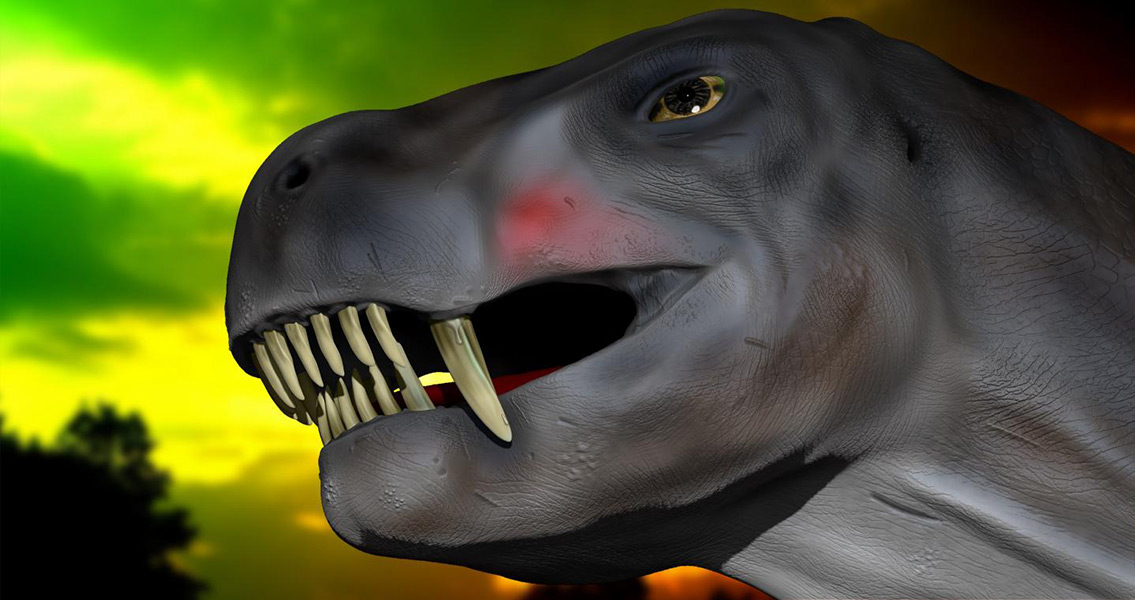
Euchambersia, a therapsid which was one of the evolutionary precursors to mammals. Euchambersia pre-dates the rise of even the first dinosaur by millions of years. While technically a reptile, it is inextricably tied to the rise of countless mammalian species, including our own. Euchambersia lived around 260 million years in the past. The small, dog-sized proto-mammal developed a unique biology in order to better protect itself from larger, more aggressive predators of the era, and also to aid it in hunting prey of its own. Living in South Africa near Colesberg in a region known as the Karoo, the therapsid evolved to develop a circular and deep fossa in its upper jaw behind its canine teeth. Venom would be produced in this hollow to be delivered in a bite through a complex series of canals and grooves in the Euchambersia’s bones and teeth. Today, the most well-known venomous animals are of course snakes, but Dr. Benoit pointed out that their fossil record only stretches back around 167 million years. Proving that Euchambersia even had venom glands was problematic, as the glands don’t fossilize. Benoit and his fellow Wits University researchers, along with the aid of London’s Natural History Museum, employed 3D imagery and CT scanning techniques to analyze the only pair of fossilized Euchambersia skulls found to date. The results of this analysis were described as “stunning”, as the therapsid was found to have had anatomical adaptions that indicated venom production. These adaptations included the fossa and a network of canals and grooves, as well as additional, previously undiscovered teeth that had sharp ridges which would have aided in injecting venom through the Euchambersia’s bite. The therapsid’s venom would have been passively introduced through its bite, unlike modern snakes with their needle-like grooved fangs that act to inject venom directly into their prey. In fact, the venom of the Euchambersia flowed freely into its mouth and through the ridges on the outside of its canines into whatever it had bitten. Dr. Benoit said that Euchambersia could have used its venomous bite for hunting or protection. With the majority of modern venomous species using their bite for hunting, the researcher feels that the therapsid would have likely followed the same route. Additionally, Dr. Benoit pointed out that animals from that time period, specifically therapsids, were not all insectivores but instead had a diverse diet. The new research paper, published in the journal PLOS ONE, can be found online here Image courtesy of Wits University]]>