

Seeker, researchers say that the mysterious man had died wearing the shackles and had been interred with a shroud around his body. University of Milan archaeology professor Giorgio Baratti, one of the scientists involved in the excavation, added that the remains of what might have been a wooden object were found under the nape of the man’s neck and may have been connected to the collar. There may have been more to the man’s shackles, as an iron ring was found near the remains of his left hand. The object was likely part of a connecting apparatus from the head to the feet, made possible through the use of leather thongs, rope or some other organic material that has not survived the ravages of time. The end result of the device would have been to limit the man’s mobility even further. Professor Baratti suspects the deceased individual had committed some definitive crime in order to be fitted with such a distinctive device. The man may have also been a slave, as Populonia was both a maritime settlement and in close proximity to local iron mines. Between 500 and 300 BCE, the region was a popular Mediterranean destination for the processing of iron ore, much of it coming from the nearby island of Elba. There was little in the grave that could be used to pinpoint its age. However, based on the fact that there was a burial directly above this one that had been definitively dated to the fourth century BCE, Baratti felt comfortable in placing the shackled man’s time of death in the fifth century BCE, with at least a century passing between one burial and the other. The new findings raise some dark questions about the Etruscans, who have been characterized as rather benign in their contributions to early civilizations. Rising to power by around 900 BCE, the Etruscans were the primary power on the Italian peninsula for around half a millennium, only to be absorbed into Roman culture by around 300 BCE. While there is little known for sure about the Etruscans, the research data we do have paints a picture of a carefree people interested in commerce, metalworking, agriculture and art. Credited with pioneering wine-making, road-building, and writing, the Etruscans don’t seem to have been the type of people to bury a still-shackled man. However, Baratti said that there was plenty of cruelty within the Etruscan civilization. He pointed out several instances of what looked like the victims of ritual human sacrifices at other Etruscan archaeological digs throughout Tuscany. ]]>
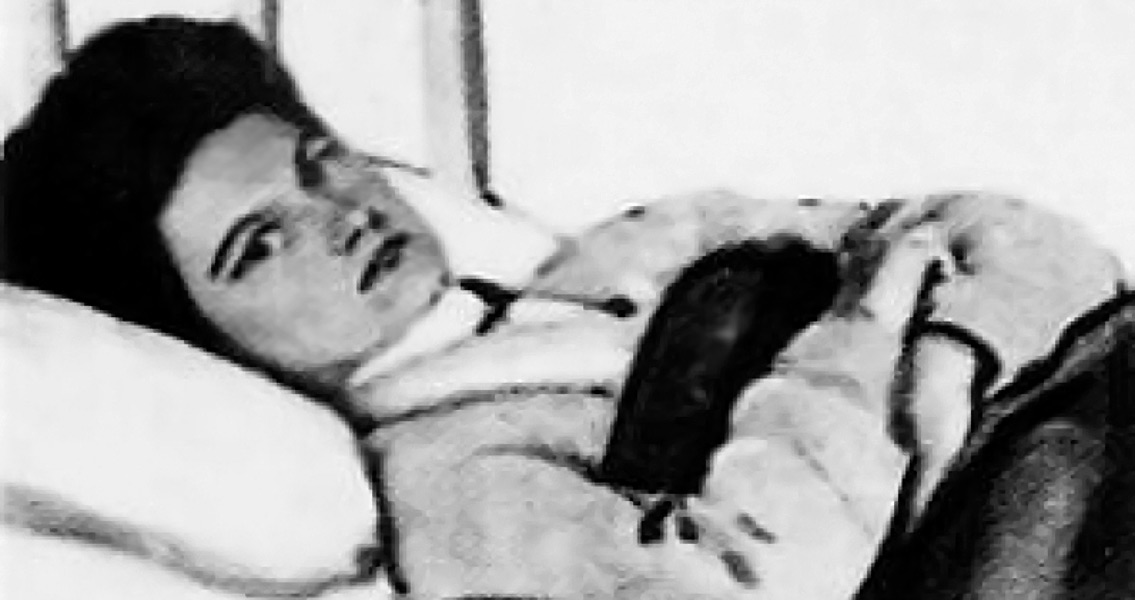
Salmonella typhi. Between 1900 and 1907 over twenty people fell sick with typhoid fever in houses where Mary worked in New York City and Long Island. Often, the disease would appear shortly after Mary had started working at a house, but she would leave before its source could be traced. Typhoid was one of the most devastating diseases of the twentieth century. Infection spread though households quickly, often meaning multiple members of a family could be infected before anyone realised what they were dealing with. The symptoms in the first week of infection are barely distinguishable from a common case of flu; by the third week it triggers inflammation of the brain and intestinal hemorrhaging. In the early nineteenth century typhoid fever was associated with the poor sanitation in deprived slums. The disease’s appearance in the home of wealthy New Yorkers left epidemiologists flummoxed. In 1907, New York City Department of Health sanitary engineer George Soper; a specialist in typhoid fever epidemics, was called to investigate an outbreak at a house in Manhattan. Soper met with Mallon, who’d also worked at a household hit with the disease he’d investigated the previous year. He soon realised that all 22 cases of the disease that had recently hit New York and Long Island could be traced back to the woman the press would soon dub Typhoid Mary. Mary fled, but the authorities caught her and had her committed to an isolation centre on North Brother Island. She was finally released in 1910, on the condition she’d never again work in a job that involved handling food. Within four years, two more epidemics broke out, one at a sanatorium in New Jersey, the other at a hospital in Manhattan. Soper was immediately suspicious, and eventually found that Mary had worked at both under an alias. In 1914 she was captured by the authorities, and sent to North Brother Island once more. Through it all and up until her death, Mary refused to accept she was responsible for the typhoid fever that had followed her for at least fourteen years, questioning how she could spread a disease she didn’t seem to be suffering from herself. Some are cynical about this: asking why, if she was so convinced she wasn’t spreading the disease, she fled after each outbreak. However aware Mary really was of her condition, hers is a challenging case. She was vilified by the press and afforded no anonymity, spending a quarter of her life confined to a quarantine facility. Even now, it provides a difficult case study in the balance authorities need to seek in protecting the public interest while also maintaining an individual’s civil rights. ]]>

journal PLOS Genetics, can be found at http://journals.plos.org/plosgenetics/article?id=10.1371/journal.pgen.1006340 Image courtesy of Jaysmark, Flickr, CC BY]]>

Live Science, senior researcher Evgeny Ermolov said that Schatzgraber was completely free of any snow and ice this year, making it possible to conduct a full exploration of the area. Researchers discovered several Second World War-era artifacts, including pieces of uniforms from the German army and navy, as well as arms and armaments such as hand grenades, land mines, and ammunition for rifles and machine guns. The weather station was active for approximately a year, with around 10 German laborers and meteorologists constructing the site in 1943 as part of an initiative to create an early-warning weather detection network across the Arctic. The artifacts discovered by the team were left behind when the base was evacuated in 1944 via German submarine. More than 600 individual objects have been recovered from the base station building remains, an emergency landing strip for aircraft and a nearby emergency supply depot, Ermolov said. Researchers sent these artifacts to Arkhangelsk’s Arctic National Park Museum for further study. Many of the artifacts were remarkably well-preserved, remarked the researcher, something he attributed to Alexandra Land’s lack of humidity and low microbe population. This allowed many organic components such as cloth, leather and wood, as well as paper documents like astronomical tables and meteorology textbooks, to survive. Additional finds include a copy of Mark Twain’s “Tom Sawyer”, as well as several magazines. Life at the research station was hellish even from the start, according to historical records. The German weather researchers were sustained by canned food, but several supply boats sank after becoming icebound in the bay alongside the weather station, prompting the researchers to hunt polar bears to supplement their diet. However, improper cooking methods left nearly the entire base sick with trichinosis from tainted polar bear meat. The Germans dispatched a plane to the base in July of 1944 bearing medical personnel, only for it to damage a wheel when landing on the emergency airstrip. This prompted a second plane to airdrop replacement parts, which allowed the plane to evacuate those in critical condition. Shortly after the incident, the rest of the base was evacuated by U-boat. In the intervening years, Schatzgraber Base was used briefly after the war by the Russian military, though it sat largely abandoned until the 1980s, when German military experts visited the site to disarm several land mines left behind by Nazi forces to protect the base from an attack that never came. ]]>

journal Evolution & Human Behavior, can be found online at http://www.ehbonline.org/article/S1090-5138(16)30307-5/abstract]]>

Harry Houdini over the validity of spiritualism; became embroiled in solving a real life murder mystery, and was until recently believed to have been involved in one of the great archaeological hoaxes of the twentieth century. Conan Doyle was born in Edinburgh, Scotland on 22nd May, 1859. Doyle’s family were affluent, strict Irish Catholics. His father was a respected artist whose achievements had ultimately been thwarted time and again by alcoholism. His mother was a well educated woman with a passion for reading. She would prove hugely influential in Conan Doyle’s life, as he wrote in his biography: “In my early childhood, as far as I can remember anything at all, the vivid stories she would tell me stand out so clearly that they obscure the real facts of my life.” In 1876 Doyle embarked on a medical degree at the University of Edinburgh. It was here that the youngster wrote and had published his first short stories, in many ways reflecting a balance between practical scientific study and fantasy that would come to define his work. The Sherlock Holmes character first appeared in 1887’s A Study in Scarlet, published in Beeton’s Christmas Annual. Holmes was partly based on Dr. Joseph Bell, one of Doyle’s lecturers who impressed him with his intense attention to detail, a trait clearly reflected in the character. Beyond Holmes however, Doyle’s medical background is also reflected in Round the Red Lamp and the Stark-Munro Letters; the latter a novel depicting the live of a young medical graduate in nineteenth century England, the former a collection of short stories on the trials and traumas of the medical profession. Alongside fiction, Doyle engaged with highly controversial issues of the day. Inspired by “a burning indignation”, he wrote the The Crime of the Congo in just eight days in 1909. Dealing with the atrocities taking place in the Congo on behalf of Belgian King Leopold II, the powerful book included graphic portrayals of violence and is littered with horrific photos of mutilated victims. Not satisfied with the publication of his written description of the horrors in the Congo, Doyle used his fame to lobby world leaders such as Kaiser Wilhelm and Theodore Roosevelt. Doyle’s work straddles the line between the factual and the fantastical. His groundbreaking science fiction novel The Lost World tells the story of a group of explorers discovering a South American plateau where prehistoric animals survive. Although an adventure story, it is littered with references to real prehistoric creatures such as dinosaurs and hominids. It’s a book which engages with the idea of evolution at a time it was still considered cutting edge, and shows Doyle’s own interest in the sciences. Towards the end of his life Doyle became fascinated with the mystical and the occult, unveiling another, perhaps totally unexpected facet to this complicated individual. He fell out with Houdini following the illusionist’s campaign to debunk Spiritualism, Doyle having spent much of the 1920s writing books championing Spiritualist beliefs. In 1922, Doyle wrote The Coming of the Fairies, a book which promoted the Cottingley Fairies photographs. Opinion was divided at the time as to whether the images of two girls playing with fairies were a hoax (the girls finally admitted in the 1980s that the images had indeed been faked), and for many, Doyle’s passionate championing of the fairies did long term damage to his literary reputation. Sir Arthur Conan Doyle will likely always be best remembered for his most recognised character, the deerstalker and pipe bearing Sherlock Holmes. By looking at his other works however, an image of a deeply complicated, fascinating individual emerges. ]]>
