Categories
Breaking News

World's Oldest Axe Found in Australia

Australian Archaeology. Dating of the piece of polished axe suggests it was created shortly after the first humans arrived in Australia. No bigger than a thumbnail, the Stone Age axe fragment was found in the remote Kimberley region of Western Australia. Dated to between 45,000 and 49,000 years ago, the axe is at least ten millenia older than previous discoveries of ground-edge axes. “This is the earliest evidence of hafted axes in the world. Nowhere else in the world do you get axes at this date,” said Professor Sue O’Connor, an archaeologist from the Australian National University who worked on the project. Hafted axes are those axes which have a handle attached. “In Japan such axes appear about 35,000 years ago. But in most countries in the world they arrive with agriculture after 10,000 years ago.” O’Connor explained, in a ANU press release. The remarkable discovery points to the innovation of Australia’s earliest human inhabitants, showing they were capable of a greater technological sophistication than is often believed. Professor Peter Hiscock from the University of Sydney was responsible for analysing the fragments unearthed in Western Australia. “Since there are no known axes in Southeast Asia during the Ice Age, this discovery shows us that when humans arrived in Australia they began to experiment with new technologies, inventing ways to exploit the resources they encountered in the new Australian landscape,” Hiscock explained, in a press release from the University of Sydney. Analyses of the fragment have revealed it came from a hafted axe made from basalt; the fine grained rock shaped and polished by grinding it against a softer rock such as sandstone. The axe could have been useful for any number of tasks, from chopping down trees to stripping the bark off wood, even as a tool for shaping wood into spears. The fragment was initially excavated by O’Connor in the 1990s, among a host of other artefacts from Carpenter’s Gap, a large rock shelter known to be one of the first sites occupied by modern humans. In 2014, further study was carried out on the objects, including food scraps, tools and artwork, that had been extracted two decades earlier. It was then that Hiscock noticed the fragment of polished axe. Surprisingly, it seems that the axes developed in the region surrounding Carpenter’s Gap did not migrate with humans through the rest of Australia. “Axes were only made in the tropical north. These differences between northern Australia, where axes were always used, and southern Australia, where they were not, originated around the time of colonisation and persisted until the last few thousand years when axes began to be made in most southern parts of mainland Australia,” Prof. Hiscock explained. The dating of the axe fragment has shed fascinating new light on the development of Stone Age hunter-gatherer societies, and the chronology and geography of the development of certain tools. “Polished stone axes were crucial tools in hunter-gatherer societies and were once the defining characteristic of the Neolithic phase of human life. But when were axes invented? This question has been pursued for decades, since archaeologists discovered that in Australia axes were older than in many other places. Now we have a discovery that appears to answer the question,” said Hiscock. Image courtesy of ANU ]]>

Categories
Breaking News

Bubbles Show Early Earth's Atmosphere Was Half The Weight

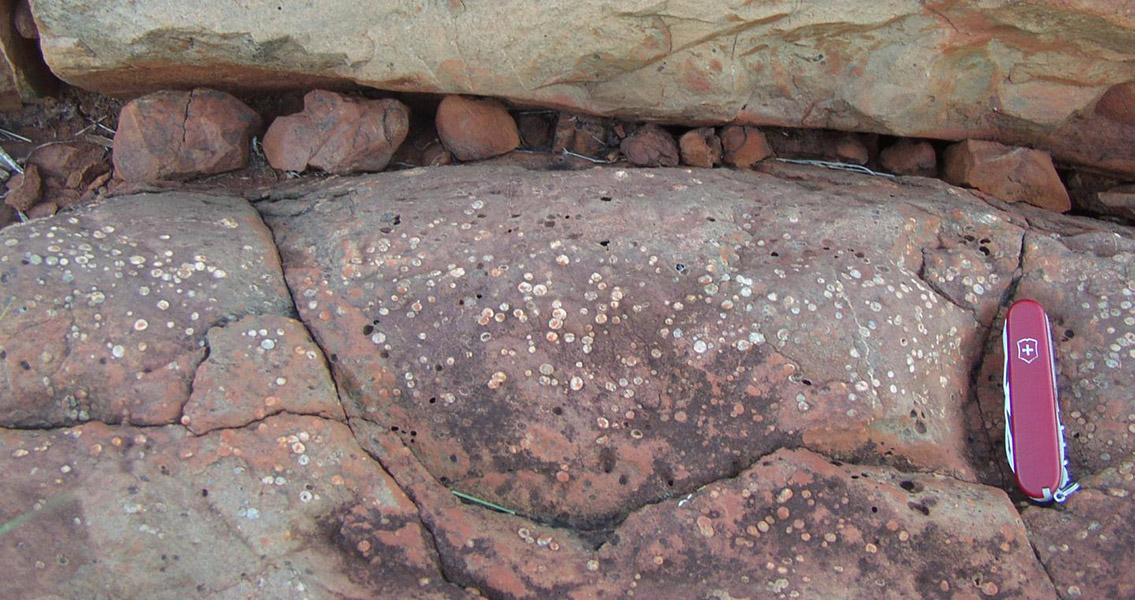
Geosciences. “It’s going to take us a while to digest all the possible consequences.” A lighter atmosphere could have affected the Earth in a number of ways, changing climatic conditions, wind levels, even the boiling points of liquids. Other geological evidence has shown that water was present on earth at this time, so the atmosphere must have contained heat trapping greenhouse gases, such as carbon dioxide and methane. Scientists have used air bubbles before, as a means to measure the elevation of lavas millions of years old – the trapped air providing insights into the height at which the lava solidified. The team behind the latest study, led by Sanjoy Som, a post doctoral student from the University of Washington, flipped this process; taking a site where lava had indisputably formed at sea level and using it to determine the air pressure billions of years ago. “For the longest time, people have been thinking the atmospheric pressure might have been higher back then, because the sun was fainter,” said Som, in a press release from the University of Washington, “Our result is the opposite of what we were expecting.” The key to the researchers’ study is the fact that streams of molten rock quickly cool from the top and bottom. Bubbles trapped at the bottom are therefore smaller than those at the top, the difference in size reflecting the air pressure pressing down on the lava as it cooled. Study co-author Tim Blake from the University of Western Australia discovered the site used in the research: basalt lava exposed by the Beasley River, in Australia. By drilling into the overlying lava flows, the team were able to examine the size of the bubbles. Rough estimates taken at the time suggested the atmosphere 2.7 billion years ago was lighter than expected, and subsequent, thorough x-ray examinations of several different lava flows confirmed that the atmospheric pressure was less than half of what it is today. The next step for the researchers is to search for other rocks that confirm their findings, hopefully allowing them to gain a better understanding of how atmospheric pressure might have changed through time. For more information: www.nature.com Image courtesy of Sanjoy Som/University of Washington]]>

Categories
News

Aboriginals Killed at Pinjarra

The Pinjarra Massacre took place on 28th October, 1834. The event is remembered as one of the most horrendous massacres of Aboriginal peoples in Australia’s history.

Battle or Massacre?

Even now, close to two centuries later, the event in Western Australia is cause for significant controversy. Referred to as the Battle of Pinjarra in some histories – suggesting that the Aboriginal people’s deaths were part of a conflict involving mutual aggression, others argue that the term massacre is the only one capable of truly capturing the events that took place in Pinjarra. Ultimately, a case can be made for both explanations. The Aboriginal people in the region had shown aggression to the European Settlers there, although one could argue this was an inevitable consequence of Europeans moving into their territory. Just as significantly for those who call the event a massacre, among the Aboriginal people killed were a substantial amount of women and children.

Tensions Before Violence

[caption id="attachment_8723" align="aligncenter" width="800"] Panorama of the Swan River Settlement, 1831[/caption] The origins of the tragic events at Pinjarra came in the arrival of the first European settlers to Western Australia, in 1829. Led by Captain James Stirling, the Swan River Colony was quickly established in what is now known as the Peel region of Australia. This was a region which had been inhabited for thousands of years by the Bindjareb tribe, an indigenous people particularly renowned for their spear making ability. Tensions quickly started to form between the white, European settlers and the Bindjareb tribe. While the Aboriginal people initially placed the Europeans into their folk traditions, interpreting them as the returning ghosts of their ancestors, Stirling declared the region a territory of England, arguing that the Bindjareb should be accountable to English law. As the settlers expanded their territory, taking up more land as they established farms, settlements, and ultimately towns, conflict started to brew. One key issue was a fundamental difference in agricultural practices. The Bindjareb people practiced firestick farming, a method where parts of the bush were torched to enable hunting and encourage regrowth of the land. For the white settlers, with little understanding of the firestick tradition, it seemed like an attack, especially on the occasions when the fires spread into the land they had started to cultivate.

The Flash Point

Signs of discontent continued to mount in the region over the next few years, as the settlers desire for land increasingly put pressure on the Aboriginal population. In 1834, with the colonists struggling to feed themselves, Governor Stirling ordered the flour rations given to the Bindjareb as a means of keeping the peace to be cancelled. On 24th April a group of Bindjareb launched a raid on the mill at South Perth, stealing 445kg of flour, possibly as a result of a misunderstanding that saw them believe that the flour rations were payment for the land the settlers had taken from them. Eventually, three Bindjareb believed to have been involved in the incident were captured by the settlers, and publicly flogged. Several days later, in response to their humiliating punishment, the Bindjareb men formed a group and lead a retaliation against the settlers, killing one soldier and seriously injuring another. With tensions high, Governor Stirling set off on an expedition with a group of soldiers and police on 26th October. Taking a surveyor with them, they intended to expand the area of settlement to Pinjarra, a region with fertile land. It was also an area at the heart of the Bindjareb community. At some point on 28th October, Stirling’s party encountered members of the Binjareb tribe. His group divided into two, taking up strategically advantageous positions around the Bindjareb camp. Exact details of which side was the first to show aggression are not clear, with some sources arguing that the Bindjareb hurled their spears at Stirling’s men, while others claim Stirling’s forces opened fire first. Either way, after roughly an hour of fighting, the outnumbered colonists were forced into retreat. Only one settler had been killed in the fighting, although several, including Stirling, were injured. Even now, it is unclear how many Aboriginal people were killed, but estimates range from around fifteen into the hundreds.]]>

Categories
Breaking News

Female Aboriginal Hunters Worked With Dingoes

Canis lupus dingo as the species is known in scientific circles, began to forge relationships with Aboriginal people shortly after their arrival in Australia around 4,000 years ago, according to a joint study conducted by the Australian National University (ANU) and the University of Western Australia (UWA). The alliance between female Aboriginals and dingoes could have been instrumental in the women being able to provide higher amounts of hunted food, the research says. According to Jane Balme, the UWA archaeologist that spearheaded the research, the first dingoes accompanied a wave of immigrants from South East Asia on watercraft, indicating that they were likely domesticated before stepping foot – or paw, as it were – on a boat. However, Dr. Balme added in an interview with Western Australia’s Science Network that once these animals made it to mainland Australia, they reverted to a wilder state. Referring to DNA evidence collected in the past, the archaeologist said that dingoes likely made landfall in a pair of locations, one being in the north-east of the Australian continent and the other in the Kimberley, the sparsely-settled northern regions of Western Australia. The likelihood of Aboriginal having formed close bonds with dingoes quickly is high, Dr. Balme added, remarking that European colonists noted that the dogs were used quite often by the native population as watch dogs and bed-mates at night to keep warm. This is analogous to how dogs in modern society are often used in similar roles, with the addition of being trained to act as service animals or therapy companions as well. In the case of women being more likely to use dingoes than men, Dr. Balme said that the research suggested Aboriginal males were unlikely to take dingoes out with them while hunting because the dogs would startle larger animals, causing them to flee. However, the archeaological record suggests that the number of small animals hunted by Aboriginal people increased after the arrival of dingoes, which was likely due to women going off to hunt, dogs at their sides, to bring down this smaller game. The archaeologist said that dig sites in locations in South West Australia such as Tunnel Cave yielded evidence that dingoes had been used as hunting companions specifically for the smaller prey animals that were traditionally hunted by female Aboriginals. The middle of the Holocene era, which dates to around 4,000 to 5,000 years in our past, has long been noted for the difference in the type of animal remains found in Aboriginal sites, as they yield a much higher percentage of small animal bones than they did prior to this time. For more information: www.sciencedirect.com]]>

Categories
Breaking News

Humans and Giant Lizards Co-Existed in Australia

factsheet on the Capricorn Caves website. The manager of the cave complex commented in the UQ press release that “This study also begs the question — what else is entombed in our caves and what else can we learn?” For more information: Temporal overlap of humans and giant lizards (Varanidae; Squamata) in Pleistocene Australia ]]>

Categories
Breaking News

Aboriginal Oral Traditions Go Back More than 7,000 years

www.tandfonline.com Image courtesy of Wikimedia Commons user: Google Cultural Institute]]>

Categories
Breaking News

Trenches for Australian Soldiers Discovered in Canberra

Categories
Breaking News

400-km Meteorite Impact Zone Found in Australia

Categories
Breaking News

Aboriginal Rock Art Discovered in Suburban Sydney

Categories
Breaking News

Prehistoric Kangaroos Were Too Large to Hop