Categories
Breaking News

Did Our Dark Side Push Late Pleistocene Dispersal?

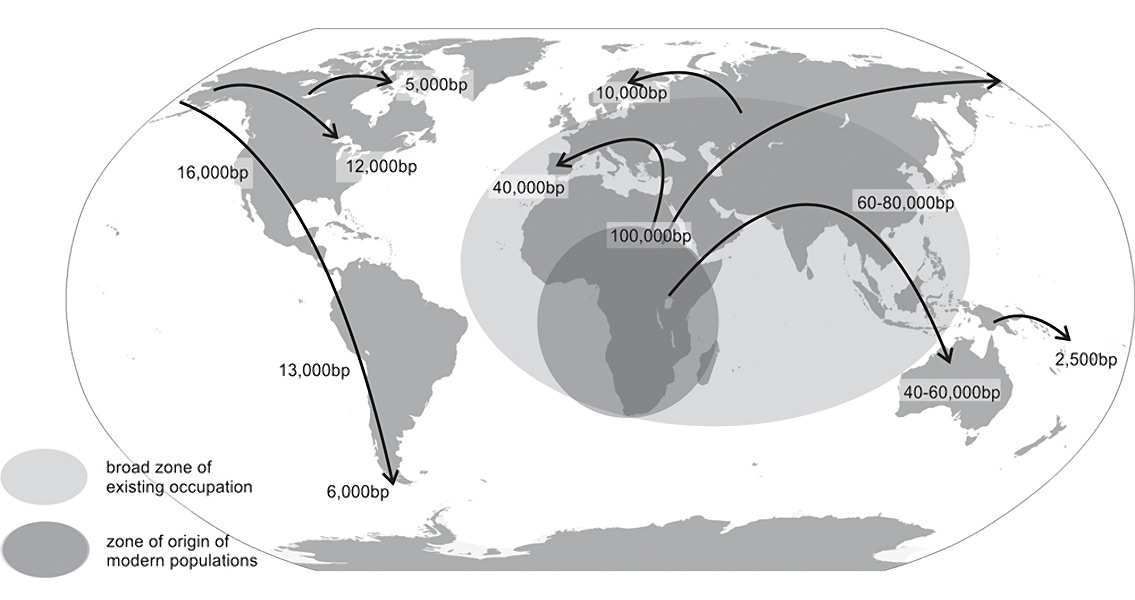
Open Quaternary, offers a social explanation for the sudden change. “Here it is argued that the structural dynamics of emotionally complex collaboration and in depth moral commitments generates regular expulsion events of founding populations. These expulsion events provide an explanation for the as yet elusive element to dispersal. Alongside cognitive and cultural complexity we should recognise the influence of emerging emotional complexity on significant behavioral changes in the Palaeolithic. ” In essence, the new study argues that as human relationships became more complicated, so the potential causes of conflict increased. This in turn became a force which could force humans to live further away from each other. The social bonds which were increasingly responsible for keeping our initial communities together had a darker side in that they increased the level of repulsion one felt after a perceived betrayal of trust. At the same time, as humans became more reliant on social bonds for their survival, they became more determined to identify and punish those who had ‘cheated’ them. Dr. Spilkins argues that the enormous pressure put on those who had betrayed a trust, including a fear of physical reprisals from wronged former friends, drove human dispersal into hostile environments, increasing the space between communities. In a press release from York University, she explained the ramifications of the study. “Active colonisations of and through hazardous terrain are difficult to explain through immediate pragmatic choices. But they become easier to explain through the rise of the strong motivations to harm others even at one’s own expense which widespread emotional commitments bring. “Moral conflicts provoke substantial mobility — the furious ex ally, mate or whole group, with a poisoned spear or projectile intent on seeking revenge or justice, are a strong motivation to get away, and to take almost any risk to do so.” This strong emotional response to a betrayal of trust is something which we still experience today. Exactly why this would have become an issue 100,000 years ago to the extent that it drove our dispersal across continents and seas is unclear, but the study offers some possible explanations. “The precise factors influencing the post 100,000 year transition to collaborative morality may be complex. We may be tempted to infer that modern humans as a species, emerging in Africa, were simply more emotionally complex than other species, and that this alone allowed them to pass a transition point where widespread egalitarianism based on complex moral emotions and commitments was the norm.” Exactly why our species came to spread around the globe is one of the most fascinating mysteries of archaeology. Dr. Sipkins’ study has provided a unique insight into this development, ominously highlighting a darker side of humanity as a driving force of its history. For more information: www.openquaternary.com Image courtesy of University of York]]>
Categories
Breaking News

Herbivore Extinction Triggered Environment Change

Categories
Breaking News

Humans and Giant Lizards Co-Existed in Australia

factsheet on the Capricorn Caves website. The manager of the cave complex commented in the UQ press release that “This study also begs the question — what else is entombed in our caves and what else can we learn?” For more information: Temporal overlap of humans and giant lizards (Varanidae; Squamata) in Pleistocene Australia ]]>

Categories
Breaking News

50,000-Year-Old Bones Found in Altai

Categories
Breaking News

Warmer Climate May Have Contributed to Mammoth Extinction

www.sciencemag.org Image courtesy of Wikimedia Commons user: Mauricio Anton]]>

Categories
Breaking News

Oldest Murder Victim Discovered

PLOS ONE journal. What makes the find particularly interesting is the fact that it is the earliest known example of murder, taking place much earlier than the appearance of the Homo genus on the world scene. The proof that the Neanderthal’s death was the result of deliberate injury can be seen in the presence of two nearly identical fractures to the frontal skull bone of the individual. Examination of the fractures revealed that they had been inflicted with one weapon and the trajectory that could be inferred from their shape and size told scientists that this weapon had been used in a close, face-to-face, conflict. Moreover, the authors say, the fact that there is more than one fracture, given that the severity of each of them would have been lethal, suggests “an intention to kill.” The major conclusion of the analysis was that intentional killings were part of our ancestors’ lives, something for which there has not been abundant evidence from this period of pre-human history. According to the authors, any insight into early hominin violence is of interest because it sheds light on the relations within communities and between different communities with regard to resources and their distribution, the density of the population, and the distribution of land. The authors also note in their paper that up until now there has been no evidence of “direct traumatic injury” in hominins from the Middle Pleistocene, although there has been previous evidence of non-fatal injuries and cannibalism. There is also abundant evidence from the Middle and Upper Pleistocene of skull trauma, although the sufferers survived in the majority of cases. In fact, only two fossils have been discovered that could be said to have belonged to people who died violent deaths, but not with a high degree of certainty, the PLOS ONE paper authors write. One of these two fossils has a lesion on one of the ribs but the shape of the bone actually suggests he lived for a few weeks after the injury was inflicted, so it cannot be established whether the lesion was the real, or only, cause of death. The other fossil shows signs of severe trauma to the first thoracic vertebra, which has been taken as the cause of this individual’s death, but it is unclear whether this trauma was caused by the deliberate actions of another hominin or was the result of an accident, while hunting, for example. It is the scarcity of fossils bearing the clear marks of an intentional death that makes the Spanish find so precious for the scientific community. It might also provide clues as to why there were so many people in this cave, which, at the time, could only be accessed through a 13-metre high chimney. Two of the hypothesis put forward so far have been ruled out, namely predators or geological activity dragging the bodies there. The two remaining hypotheses have to do with accidental falls and intentional killings. These latest findings could support the latter hypothesis. For more information: www.journals.plos.org Image courtesy of Wikimedia Commons user: Jose-Manuel Benito]]>