Categories
Breaking News Editorial

How did Christianity spread?

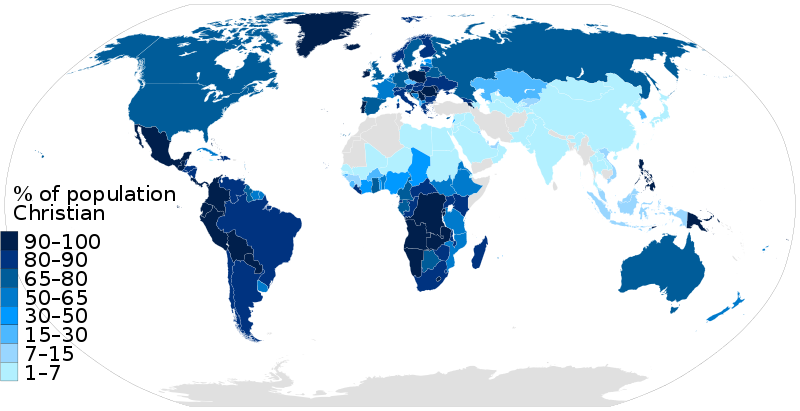
Christian populations across the world. Credit: M Tracy Hunter[/caption]

70 Christian communities analysed

A new paper delves into research from 70 Austronesian Christian societies, where political hierarchies, social inequality and population size were all analysed. Austronesian societies shared a common ancestral language and are located across Southeast Asia, East Africa and the South Pacific. Despite some similarities, they have a great variation of societal make ups; with some forming small, egalitarian, family-based communities and others following the concept of a large, politically complex society. Hawaii is an example of the latter. The communities were converted in the 18th and 19th Centuries. Some took under a year to convert; the longest took 205 years. With such a range of social structures and reactions to conversion, these Austronesian societies were ideal for exploring theories on cultural change.

Win the chief and you win the tribe

The researchers have revealed that cultures with political leadership structures already in place were usually more easily converted to Christianity. They call it a ‘top down’ process of conversion: chiefs and elite leaders were the first to be converted by missionaries. Due to their existing influence over their people, the spread of Christian doctrine followed naturally. Jesus Christ Interestingly, social inequality was not related to conversion times. This debunks the theory that Christianity spread from the bottom up, by empowering the impoverished and promising an improved experience in the afterlife. There was a distinct correlation between small populations and the fast spread of Christianity, proving the importance of population size during processes of cultural change.

“A smaller populace is more open to innovation”

Lead author Dr Joseph Watts undertook the research at the University of Auckland’s School of Psychology and the Max Planck Institute for the Science of Human History in Germany. The research team also includes doctoral candidate Oliver Sheehan, Professor Joseph Bulbulia, and Professor Russell Gray. Dr Watts says: “While people often think of big societies as sources of innovation, our findings show that bigger societies can also be slow to pick up on new ideas… In a small population, it becomes more likely that beliefs will be transmitted relatively quickly, particularly if they are being driven by leaders and other powerful figures.”

Cultural change

Looking beyond Christianity and even religion, Dr Watts says this is indicative of cultural change at large. “If you look at our contemporary world, some things spread incredibly quickly while others take a very long time so here we provide evidence of why that might be.” University of Auckland Professor Quentin Atkinson adds: “This research can help us understand how both the size and the structure of populations influence the diffusion and adoption of new institutions, ideologies or technologies.”]]>

Categories
Breaking News

Church of the Holy Sepulchre at Risk of Collapse

National Geographic, the Edicule housed within the Sepulchre and thought by the faithful to be the final resting place of Jesus Christ, is at “very real risk” of collapse because of the church’s crumbling foundation. To make matters worse, the Edicule itself rests on a mix of rubble, mortar, and warren-like passageways and tunnels, all of which have compromised the integrity of the ground beneath it. Ironically, the discovery of the damaged floor was made during a $4 million project to restore and renovate the church itself to protect it for future generations of visitors. In some cases, more than four feet of unconsolidated rubble lie beneath the floor, which is doing its best to support the stone pillars that in turn hold the rotunda of the Church’s roof above the Edicule; each of these pillars is thought to weigh more than 20 tons. NTUA’s chief scientific supervisor Antonia Moropoulou spoke in dire terms of the foundation of the Edicule failing. Saying it’s a matter of when, not if, it occurs, Moropoulou remarked that the process will be slow but catastrophic. Such an event is unlikely to occur, however, considering the deep religious significance of the church to the world’s Christians. A newly-proposed project, drafted by the NTUA, calls for a $6.5 million excavation to shore up the foundation, which would take nearly a year and involve replacing rotted mortar and ancient rainwater and sewage drain systems around the holy site. The history of the site itself is inextricably tied with the state of the Edicule’s foundation, researchers say. In the time of Christ, the site was likely an old limestone quarry that had been repurposed as a burial ground for influential Israelites. Additional tombs discovered on the grounds lend credence to this theory. During the Roman occupation of Judea, a temple was built over the site sometime after it had become the supposed resting place of Christ. This temple was razed to the ground in 324 CE, revealing what the first Christian Emperor assumed to be the tomb of Jesus. Constantine built a shrine around the tomb, which stood until the seventh century CE when Persian invaders partially destroyed it. It was again razed by the Fatimids in the early eleventh century before being rebuilt once again. Periods of rebuilding punctuated the site’s history after this, from attempts by Europeans during the Crusades to later reconstruction efforts in the sixteenth and nineteenth centuries. Many of these construction phases are encompassed by the Church’s existing edifice. The dome of the rotunda, held up by those massive pillars on the Edicule’s crumbling foundation, is thought to mark the foundation of the original shrine erected by Constantine. Researchers hope that the new restoration work will provide opportunities for archaeologists to learn more about the church and its shrine, though there are fears that the cadre of religious authorities that oversee the site will not permit the activity. ]]>

Categories
Breaking News

A Menorah and Cross Etched Side-by-Side Hundreds of Years Apart

here ]]>

Categories
News

A History of the Christmas Tree From Paganism to Shopping Centres

Categories
News

Constantine Receives Divine Vision

Categories
Breaking News

Tomb of the Maccabees Found, Maybe

Categories
Breaking News

Kremlin Declares Chersonesus National Heritage Site

Categories
News

The Boxer Rebellion

Categories
Breaking News

Archaeologists Find First Moravian Settlement in Nazareth

Categories
Book Reviews

City of God

Related Books


The City of God book

The City of God
De Civitate Dei Vol. 2Vol. 2
by Saint Augustine

[gap height=”20″]]]>