

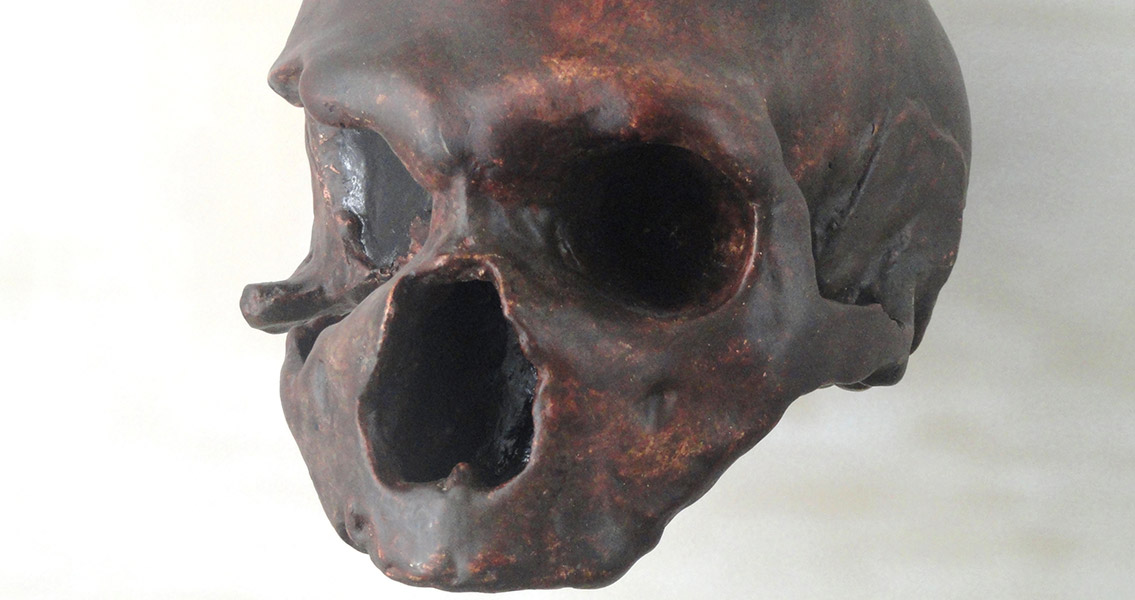

Timurlengia euotica, were discovered over the course of nine years during international expeditions to the Kyzylkum Desert of Uzbekistan. The creature lived around 90 millions years ago, and slots into a 20 million year gap in the fossil record of tyrannosaurs. Although a fellow tyrannosaur, T.eutoica is not the ancestor of T-Rex. About the size of a horse, Timurleniga could have weighed up to six hundred pounds. Its long legs mean it was likely a fast runner. “Timurlengia was a nimble pursuit hunter with slender, blade-like teeth suitable for slicing through meat,” explained Hans Sues, chair of the Department of Paleobiology at the Smithsonian’s National Museum of Natural History, in a press release. “It probably preyed on the various large plant-eaters, especially early duck-billed dinosaurs, which shared its world. Clues from the life of Timurlengia allow us to fill in gaps and better understand the life and evolution of other related dinosaurs, like T. rex.” Perhaps surprisingly, the study, published in the Proceedings of the National Academy of Sciences, suggests that brains came before brawn in the evolution of Tyrannosaurs. Prior to the development of their giant size and strength, Tyrannosaurs developed keen senses and cognitive abilities. These heightened abilities allowed them to reach the top of the food chain after other large meat eating dinosaurs had gone extinct, 80 – 90 million years ago. Although typically associated with North America, T.rex’s and other Cretaceous dinosaurs mostly had their routes in Central Asia. “The discoveries from the Kyzylkum Desert of Uzbekistan are now helping us to trace the early history of these animals, many of which later flourished in our own backyard in North America.” Sues said in the press release. The new species was discovered while Sues and a team of paleontologists led by Steve Brusatte at the University of Edinburgh were sorting through the bones brought back from the Kyzylkum Desert. CT scans of the brain case allowed the team to reconstruct Timurlengia’s brain and gather insights into the development of its abilities. “The ancestors of T. rex would have looked a whole lot like Timurlengia, a horse-sized hunter with a big brain and keen hearing that would put us to shame,” explained Brusatte. Tyrannosaurs originated in the Jurassic Period around 170 million years ago, but they were barely the size of a human. 100 million years later, in the Cretaceous Period, they had evolved into animals like T-rex, which weighed up to 7 tons. The fact Timurlengia was so small, despite living some 80 million years after tyrannosaurs had first appeared, indicates the group’s terrifying size only occurred relatively late in their evolutionary history. For more information: www.pnas.org Image courtesy of © Proceedings of the National Academy of Sciences]]>

here Image courtesy of Wikimedia Commons user: AA]]>


the Sun newspaper as saying the find is “as good as it gets”. Hepworth and David Kierzek first came across a well-preserved chisel as well as several other objects. Archaeologists were contacted by Hepworth, following procedures outlined by the Portable Antiquities Scheme which encourages voluntary notification of archaeological finds by the public in Wales and England. Archaeologists investigating the site found the barrow (a stone and earth mound built over a grave). Early exploration has dated the burial site to 2500 BCE. The very rare find is extraordinary because most burial sites from the bronze age have typically been ploughed over or looted. Additionally, the Morecambe Bay site is significant because of its size, which initial investigations have put at 35 meters by 25 meters. It’s likely that the site was overlooked for millennia because, according to what project director Brendon Wilkins told the Sun, it “looks like any other field”, adding that barrows are “the best windows” into a time period. Ben Roberts, from Durham University and a former curator of bronze age collections at the British Museum, told the Sun, “The potential is huge because untouched, undiscovered sites are very rare indeed. What’s really special about our site is that no one knew about it before … The barrow appears to be intact and its pretty substantial”. Morecambe Bay, despite what the name suggests, isn’t a bay at all but rather a huge multiple estuary, located in northwest England, south of the Lake District National Park and east of the Isle of Man. Covering an area of 310 square kilometers (120 square miles) it’s the largest expanse of sand and intertidal mudflats in the United Kingdom. Both Hepworth, who had also found Viking silver in the same area, and Kierzek have been invited to work alongside archaeologists at the site when excavations scheduled for July begin. The work will also involve the rest of the community. The local council has agreed to provide a so-called incident room where finds can be put up for display immediately following their discovery and where footage of the dig will be broadcast. In addition to support from the Heritage Lottery Fund, excavation at the Morecambe Bay site is also partially financed as a crowdfunding project called DigVentures. DigVentures is a social enterprise headquartered in London that was founded by three archaeologists – of which Wilkins is one– to address the severe budget cuts made by local authorities and the decrease in research archaeology funded by universities. DigVentures has supporters from around the world, from ordinary people to professional archaeologists who donate money to various archaeological projects in return for the opportunity to participate in some capacity at the actual excavation site. According to their website, the enterprise is designed to put ‘archaeology in your hands”. Image courtesy of Ordnance Survey ]]>

www.efeo.fr ]]>