Categories
Breaking News

700-Year-Old Casino Found in Utah

Discovery News that they most probably came south from the subarctic territories of Canada and thrived in Utah in the second half of the thirteenth century, a time when other indigenous peoples in the region were having trouble simply surviving because of environmental and social factors. While their neighbours were struggling to survive, the Promontories had enough resources to live in relative comfort and entertain themselves with various games. One of these probably involved shooting darts through a hoop, another was a hand guessing game in which players had to guess what object another player held in his or her hand, and some were possibly board games in which dice were used. It seems most of the dice games, however, were played by the women in the tribe: most of the dice were found near the entrance of the cave, dubbed simply Cave 1, around a large hearth, where women likely gathered after their chores were done, Ives’ colleague Gabriel Yanicki related to Westerndigs. The stakes in these games tended to be small, including swapping chores and personal items. The dice were made of cane pieces, with burnt markings on their sides. The men of the tribe were less likely to take part in the dice games but they did bet on the outcome, Yanicki went on to say. At the same time, they partook in other leisure activities such as the dart-throwing game, where there were two participants who aimed to shoot their darts through a rolling hoop. In the men’s games, the researchers believe, the stake tended to be significantly higher. In fact, Yanicki suggests that these games were not played just for fun but may have replaced other, more hostile encounters between groups. This is likely to have strengthened the social ties between these neighbouring groups and hence their economic exchanges. The Promontory cave was discovered in the 1930s by University of Utah archaeologist Julian Steward. However, not much progress was made until recently as to understanding the real significance of the artefacts found in the cave. These include animal hides and bones, but also around 200 pairs of moccasins, a lot of them in children’s sizes. Analysis of the moccasins revealed that the style they were made in was typical of the people living in subarctic Canada, which led to the conclusion that the Promontory culture came from the north and settled in the southwest of North America. Native American cultures like the Apache and the Navajo may well have then sprung from the Promontory. The research team has speculated that the Promontories probably brought with them not just the moccasin style but their gambling habits as well, and these spread across the continent like the culture’s descendents. Image courtesy of Wikimedia Commons user: NASA]]>

Categories
Breaking News

Scientists Recreate Colosseum Lift for Animals

Categories
Breaking News

Renovation Works Reveal Medieval Hospital Remains in York

http://www.boydellandbrewer.com/store/viewItem.asp?idProduct=14539 Image courtesy of Wikimedia Commons user: W. Monkhouse/ Wellcome Trust]]>

Categories
Breaking News

North and South Korea Resume Work at Koryo Palace Dig

Categories
Breaking News

Cornwall Yielded 200 kg Gold in Bronze Age

Categories
Breaking News

First Artefacts from Franklin’s Arctic Shipwreck Go on Display

HMS Erebus, which sank in 1846, have been recovered to the surface. This is the second major discovery after the location of the ship itself, which only happened last year. The Erebus was one of two ships that carried Sir John Franklin’s expedition to the Arctic to find a Northwest Passage. The Erebus and its sister ship, the HMS Terror, became stranded in ice near the shores of King William island in the Queen Maud Gulf off the coast of Canada a year after they had left Britain. Both ships eventually sank, with 128 people dying. Franklin himself died on the island a year later, in 1847. The wreck site is at a very remote and climatically hostile location. After the Erebus’ remains were discovered in 2014, the divers sent to examine them had a difficult time, to put it mildly: just to reach the wreck they had to overcome sea ice with a thickness of two metres. The work on the ship was led by underwater archaeologist Ryan Harris, from the Parks Canada Agency, who told LiveScience that just getting all the equipment and professionals needed for the job to the Queen Maud Gulf had been a challenging task. Thankfully, the team could count on logistics support from several government agencies, including the Department of National Defense, the Canadian Royal Navy, and the New York Air National Guard. The first divers went underwater last September and cleared the kelp and other marine flora colonies on the ship, which rests five meters from the seafloor. This April, the divers returned to scan the site with lasers to catalogue what was there. It was during this diving session that they retrieved the artefacts that have now been put on display at the Canadian Museum of History. The objects include three plates, some buttons, a bottle of medicine still holding some of its contents, pieces from the ship’s rigging, and a huge, 300-kg canon. According to Harris, the two ships must have sailed under “a flag of scientific neutrality” but nevertheless thought it wise to be prepared for any eventuality. All of these, however, are nothing but scratching the surface, LiveScience writer Stephanie Pappas notes. There is a huge amount of work yet to be done on the ship’s remains if there is any hope of identifying at least some of the victims of the wreck, establishing what they were doing in those last days, and determining whether they died on the ship or elsewhere. The buttons could be some help, as they may tell the researchers the rank of their owner. The team also hope to find out what caused the wreck or what factors contributed to it, given that both ships were equipped for sailing in the ice-packed Arctic waters. The Erebus wreck features ice channels on the port side, as well as metal plating and a system allowing the propeller to be hoisted onto the deck. The whereabouts of the second ship in the expedition, the Terror, remains unknown. Image courtesy of Wikimedia Commons user: Piotrus]]>

Categories
Breaking News

Fossils Support Human’s Levant Route into Europe

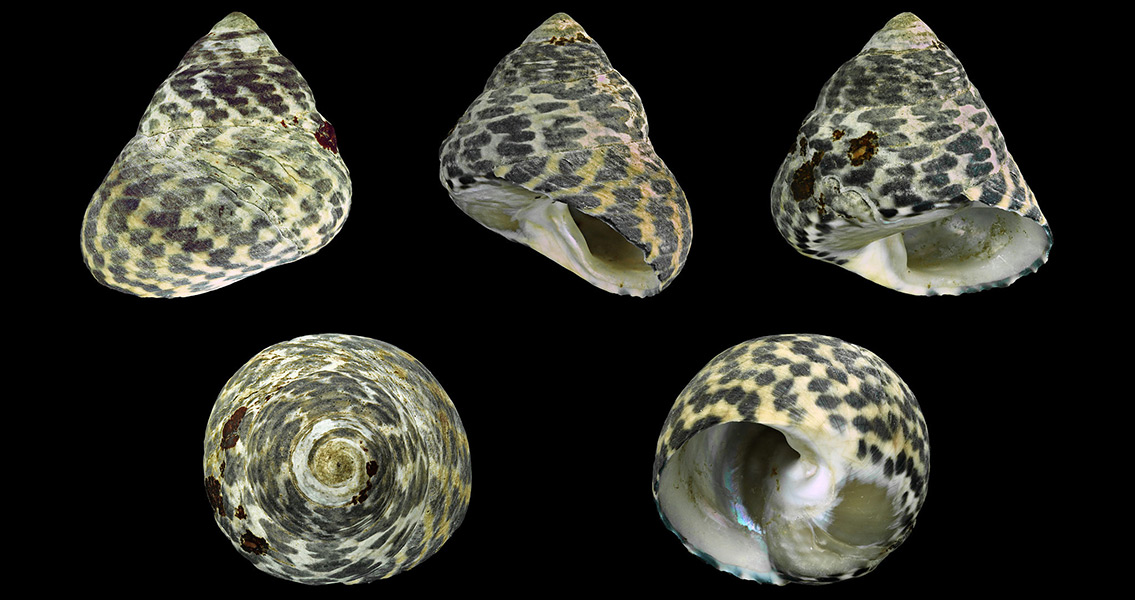
Phorcus turbinatus, an edible mollusc that early humans ate, as evidenced by the broken upper shells of the animals. The fossils were uncovered at the Ksar ‘Akil site, where two sets of human remains from the Upper Paleolithic had been discovered previously. Combining the age of the mollusc fossils with that of the human remains, the researchers concluded that modern people lived in the Levant as early as 45,900 years ago, according to a press release by the Max Planck Institute. This is before the time modern humans settled in Europe, so the suggestion that they spread across the continent from the Near East was, according to the researchers, the only logical one. Another important suggestion from the study is the timing of this spread. This has also been subject of debate for a long time, mainly because there is scarce human fossil evidence from the early Upper Paleolithic period, Jean-Jacques Hublin, co-author of the study, said in the press release. Two human fossils, however, were found at the Ksar ‘Akil and have now been dated more accurately. One of the fossils, a man nicknamed Egbert by the team who discovered him, lived in the region around 43,000 years ago, during the early Upper Paleolithic. The other fossil, of a woman dubbed Ethelruda, was older, dated back to 45,900 years ago, a period that researchers call the initial Upper Paleolithic. Both fossils were associated by researchers with tools typical for the Upper Paleolithic and both were older than any Paleolithic human fossils from European archaeological sites. This, says co-author Johannes van der Plicht from the University of Groningen, suggests that modern human’s entry into Europe took place some time between 55,000 and 40,000 years ago. The conclusions of the scientists about the route of dispersal into Europe were supported by radiocarbon dating of the molluscs, an endeavour usually extremely difficult on shell remains. The team, however, used a new approach, as explained by Van der Plicht and another co-author, Marcello Mannino. They combined radiocarbon dating with biochemical datasets for more accurate results, including a technique examining the state of amino acids contained in the shells. What these revealed was a confirmation of the dating of the human fossils: modern humans lived in what is today Lebanon before they ventured northwest into Europe and spread across it, displacing the continent’s former masters, the Neanderthals. Image courtesy of Wikimedia Commons user: H. Zell]]>

Categories
Breaking News

Medical Marijuana Smoking Linked to Parasite Prevention

Categories
Breaking News

Study Finds Evidence of Opening of the Mouth in Mummies

Categories
Breaking News

Epigenetics Provides Glimpse Into Ancient Lifestyles