Categories
Breaking News

Ancient Monkey Fossil Could Be First Modern Baboon

A. sediba remains, has confirmed previous research that the species it belongs to, known as Papio angusticeps, has a close relationship to modern baboon species living today. In fact, P. angusticeps might actually be one of the very first members of Papio hamadryas, the modern monkey species known as the hamadryas baboon. Modern baboon populations are routinely divided into several different groups, most commonly referred to as separate species or subspecies, throughout large swathes of sub-Saharan Africa. These modern baboons have also spread into the Arabian Peninsula, easily making them one of the biggest evolutionary success stories of the primate world. However, there are plenty of questions about the origins of modern baboon species when it comes to examples in the fossil record. Dr. Gilbert says that modern baboons had been thought to have diverged from their closest evolutionary relatives between 1.8 million and 2.2 million years in the past, but evidence in the form of fossil specimens had been rare to nonexistent until this latest find. The scientist added that the Malapa specimen, in conjunction with the analysis conducted by the research team, lends credence to the possibility that early P. hamadrayas fossils might have been incorrectly categorized by earlier researchers as P. angusticeps – especially in light of how modern baboon anatomy seems to be consistent with that of P. angusticeps – to the point where experts would be hard-pressed to differentiate ancient specimens from the bones of modern baboons hailing from South and East Africa. For more information: www.journals.plos.org Image courtesy of Wikimedia Commons user: RADION Imaginery / Kamil Wence]]>

Categories
Breaking News

Finger Bone Find Pushes Back Origins of Modern Human Hand

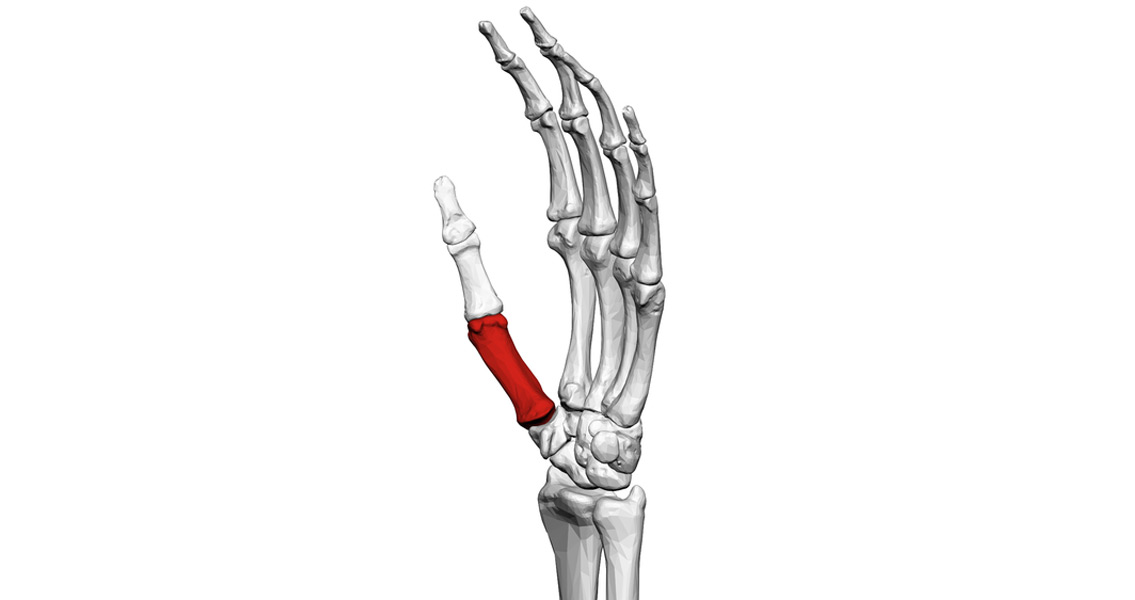
Homo habilis and Paranthropus boisei, the researchers say, but was more modern human-like than them. In fact, this species could be a “missing link” between Homo habilis and Homo sapiens. The bone was discovered in Olduvai Gorge, northern Tanzania, at a rich palaeontological site called Philip Tobias Korongo, or PTK, and, according to UPI, moves forward the point at which hominins climbed down the trees and evolved hands suitable for holding tools by as many as 400,000 years. In their paper, the researchers who discovered the bone note that there has been ongoing debate about the cause and effect relationship between the evolution of a hand capable of manipulating tools and the invention of these tools, a debate in which the discovery represents a valuable input. For one thing, it brings the evolution of the modern human-like hand closer to the oldest stone tools, discovered earlier this year in Kenya. Still, the tools predate the finger fossil by more than a million years, suggesting there could be even older fossils of modern human-like hands. The lead author of the study, Manuel Dominguez-Rodrigo from the Institute of Evolution in Africa, told New Scientist that the bone “belongs to somebody who’s not spending any time in the trees at all”. It is straighter than the phalangeal bones of tree-dwelling hominins who used their hands as modern-day primates do, to move in trees by hanging from branches and swinging between them. Speaking to the Christian Science Monitor, Dominguez-Rodrigo also said that this species was already capable of using tools and it was larger than its contemporaries. Based on the size of the fossil, the hominin it belonged to must have stood about five foot nine, which is quite a bit more than Homo habilis, (the first hominin who left Africa), who has been estimated to have stood at around three feet tall. The authors of the study note that the evolution of the hand has been a major driver for the evolution of humans, because the more capable of manipulating objects it became, the more capable hominins got at using increasingly sophisticated tools. However, recent discoveries, including this one, are revealing a much more complex hand evolution picture. For instance, the researchers write, the hand bones of some Pliocene australopiths have proven to be much more modern human-like than the bones of hominins from a more recent era, the Pleistocene. This suggests that hands capable of manipulating tools evolved before the tools were invented, feeding more evidence into the debate about the causal link between hand evolution and tool invention. For more information: “Earliest modern human-like hand bone from a new >1.84-million-year-old site at Olduvai in Tanzania” ]]>

Categories
Breaking News

Compassion Helped Fuel Human Evolution

Complexity, Compassion and Self-Organisation: Human Evolution and the Vulnerable Ape Hypothesis ]]>

Categories
Breaking News

New Human Ancestor Raises Questions About Our Origins

Australopithecus deyiremeda, as the new human ancestor has been named, lived in the Afar region of Ethiopia some 3.3 million to 3.5 million years ago. This means it would have lived alongside Australopithecus afarensis, another hominin species from the Afar region whose most famous representative, “Lucy”, was discovered in 1974. A. afarensis lived in what is now Ethiopia, between 2.9 million and 3.8 million years ago. “The new species is yet another confirmation that Lucy’s species, Australopithecus afarensis, was not the only potential human ancestor species that roamed in what is now the Afar region of Ethiopia during the middle Pliocene”, said Dr. Yohannes Haile-Selassie, curator of physical anthropolgy at the Cleveland Museum of Natural History and the project team leader of the study, in a press release. The fossil specimens were found on 4th March, 2011, in the Woranso-Mille Paleontological Project study area, situated in the centre of the Afar region, about 325 miles north east of Ethiopia’s capital Addis Ababa, and just 22 miles north of the site where Lucy’s remains were unearthed. Differences in jaw bone mark the two species apart. A. deyiremeda had thick enamel teeth of a different shape and size to Lucy, and a more robust lower jaw. The anterior teeth were also comparatively smaller in A. deyiremeda, suggesting it had a different diet. A. deyiremeda‘s discovery adds to the increasing ambiguity about the process of human evolution. For much of the twentieth century the general consensus among scientists, based on available sources, was that during the Pliocene period only one human ancestor species existed at any time. In 1995, a hominin species called Australopithecus bahrelghazali was discovered in Chad, and in 1999 another called Kenyanthropus platyops was discovered in Kenya. Both of these species were reported to have lived at the same time as Lucy, although this assertion was met with skepticism from the scientific community over whether they really were separate species or simply another example of A. afarensis. Skeptics in the scientific community may still need to be convinced that A. deyiremeda is indeed a distinct species but its discovery adds further weight to the idea that the evolution of homo sapiens was not just a straight line from A. afarensis. “Some of our colleagues are going to be skeptical about this new species, which is not unusual. However, I think it is time that we look into the earlier phases of our evolution with an open mind and carefully examine the currently available fossil evidence rather than immediately dismissing the fossils that do not fit our long-held hypotheses”, said Haile-Selassie. For more information: www.cmnh.org Image courtesy of Wikimedia Commons user: Chartep]]>

Categories
Breaking News

2-Million-Year-Old Skin Found in South Africa

Australopithecus remains have announced that one of the fossils had skin on. The six fossils discovered so far have been dated to 2 million years ago and belong to the species Australopithecus sediba, which combined features of both the original Australopithecus, the first erect hominin species, and of modern Homo species. The find is all the more fascinating because, in addition to this being possibly the oldest hominin skin ever discovered, the fossils contain traces of organic matter from the food these ancient human ancestors ate. The initial discovery was made by chance: the lead researcher’s son stumbled across a human fossil in the Malapa Reserve near Johannesburg, in 2008. Until then, science did not even know this species had existed. Since then, excavation works have expanded significantly, and the team has even built an on-site laboratory where they can examine their finds in a secure environment. So far, the site has yielded bones belonging to six individuals, including an almost complete skull. Based on the evidence, the researchers have established that representatives of the Australopithecus species were much shorter than modern humans, standing at some 1.30 metres, and with a correspondingly smaller frame. While they walked on two legs, they also had more curved fingers than later hominins, suggesting they were also skilled climbers. Yet the most striking feature, according to Lee Berger, the leader of the research team, is the Australopithecus seiba’s head, which was disproportionately small, with the brain about the size of a modern man’s fist. The skin remains found on the fossils could tell the scientists a lot about those hominins’ lifestyle, while the organic substances between the teeth of some of the fossils could reveal something about their diet. This would be possible due to the kind of rock in which the fossils were found, which, unlike other sorts of rock, is capable of preserving organic substances. Two million years ago the site used to be a cave in the ground, Berger told the Naked Scientists podcast. It later collapsed in on itself, creating conditions he compared to a pool filled with liquid concrete, in which the bones were then thrown and preserved. The team has no way of knowing how these proto-humans got into the cave but suggest it may have been a trap they didn’t notice or contained something that lured them in. The team expects to unearth more human remains from the ancient cave and in order to protect them from environmental factors, has actually built a whole laboratory on the site. This will most likely turn the place into a tourist attraction and already the scientists are allowing visitors to look at the excavation site. The endeavour was challenging because the place is part of a nature reserve but, says Berger, the team came up with a structure that organically fits in its surroundings. This has made this site a unique one, where tourists will be able to witness the ongoing work of the researchers as they further their insight into the nature of this species and possibly establish where exactly they stand in relation to modern humans. Image courtesy of Wikimedia Commons user: Lee Berger]]>

Categories
Breaking News

Giant Human Jawbone Baffles Scientists

Categories
Breaking News

Early Hominin Hands Could Have Gripped Tools

Homo sapiens, the name for modern man). By studying the bone structures of a number of hominins – the group of species that split from the chimpanzee lineage and includes modern humans and their relatives – the team were able to see how dexterity had developed in human hands. The study focused specifically on fossils of Australopithecus africanus, as well as hominin bones from the Pleistocene Period. The results could challenge the traditional ideas about human evolution. The study suggests that Australopithecus africanus were capable of having a more powerful grip than previously suspected, even though their hands lacked the styloid process. The team found that the fine mesh network of bones (trabeculae) within the metacarpals of A. africanus was comparable to that of modern humans. The density of trabeculae reveals a great deal about what a species’ hands are predominantly used for. In chimps and gorillas the mesh is denser than in humans, as chimps and gorillas use their hands to support their bodies. Less dense trabeculae however, allow greater dexterity – crucial for the creation and manipulation of tools. Kivell told Livescience: “We are suggesting that even without the full suite of humanlike morphology, early hominins were capable of forceful precision and power grips.” Chimpanzees are capable of creating and using spear-like tools for hunting. It is possible that when hominins and chimpanzees diverged between four and seven million years ago, our ancestors were already capable of creating and using tools. The earliest known tools have been found in Ethiopia, and date from 2.6 million years ago. Kivell’s research indicates that A. africanus could have been capable of using tools, 500,000 years before they were first invented. Image courtesy of Wikimedia commons user: was a bee ]]>