Categories
Anniversary of Eisenhower's Death


Scientific Reports Image courtesy of Stephen Dornbos]]>

www.crossref.org Image courtesy of Marc Reichow, University of Leicester ]]>
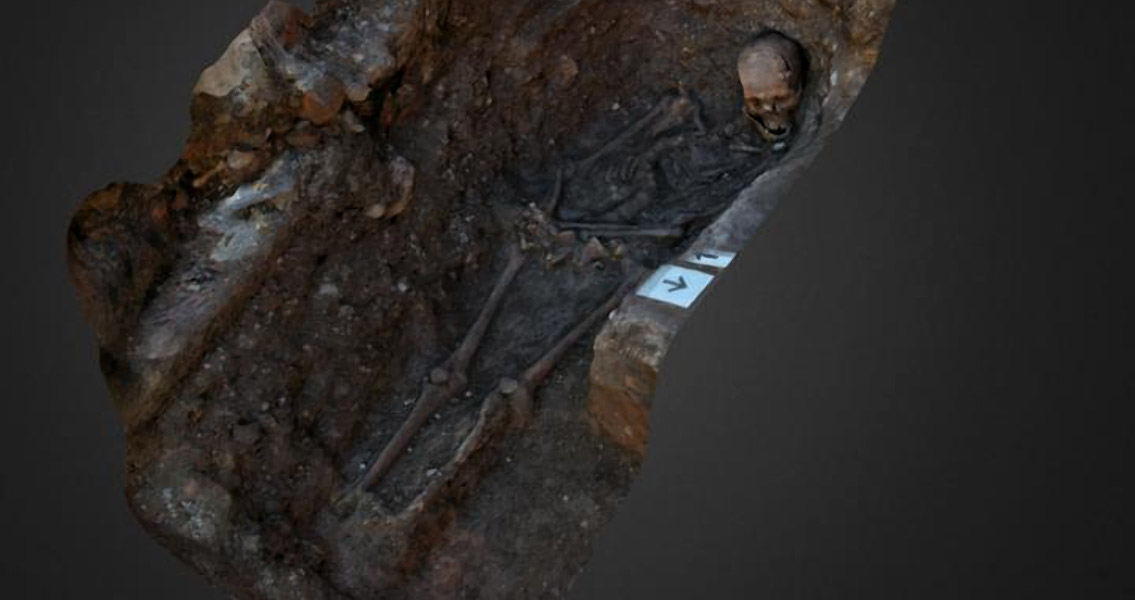
Sketchfab, a 3D sharing platform, the interactive model can be rotated and examined in order to provide an immersive pathway to study the king’s grave – and reveals the perfunctory, less-than-reverent nature in which his remains were interred. In fact, researchers discovered that the grave itself was dug poorly and seemingly in haste, as its sides sloped and its base was uneven. The grave was also too short to accommodate the king’s body properly, resulting in it being laid out slumped to one side with the head propped up – providing evidence that matches contemporary accounts that the monarch was buried unceremoniously. In a university press release, ULAS site supervisor Matthew Morris said that two-dimensional images of the burial, while having a drama all of their own, aren’t as arresting as a three-dimensional model is, especially when it comes to grasping the spatial relationships that are revealed. The first man to lay eyes on the remains of the king since his internment centuries ago added that the new 3D model of the grave affords researchers the ability to continue examining it long after the end of the excavation. Additionally, it allows scientists to examine the grave from angles that would have been impossible during the initial exhumation. The process used to create the digital reconstruction of the grave, known as photogrammetry, has seen widespread use not just in archaeology but in other industries as well, including the entertainment industry. The technique is both cost-effective and swift in building a three-dimensional model out of several two-dimensional images. The grave, along with other 3D imaged archaeological sites explored and documented by ULAS, can be explored on the Sketchfab website Image courtesy of University of Leicester ]]>

Australopithecus afarensis fossils unearthed in Kenya suggest that the early hominid lived across a much broader area than previously thought. Until the latest discovery, all A. afarensis fossils had been found on the floor of the Great Rift Valley, a trench which marks the separation of the Nubian and Somali plates. The latest find marks the first time that fossils of the species have been identified east of the valley, suggesting A. afarensis lived much farther eastward than hitherto believed – as far as the highlands of Kenya. Emma Mbua of Mount Kenya University and Masato Nakatsukasa of Kyoto University led the international team responsible for the findings. In their report, published in the Journal of Human Evolution, they detail the fossilised teeth and forearm bones from an adult male and two infant A.afarensis discovered in an exposure eroded by the Kantis River in Ongata-Rongai, a settlement in the outskirts of Nairobi. “So far, all other A. afarensis fossils had been identified from the center of the Rift Valley,” explained Nakatsukasa in a press release. “A previous Australopithecus bahrelghazali discovery in Chad confirmed that our hominid ancestor’s distribution covered central Africa, but this was the first time an Australopithecus fossil has been found east of the Rift Valley. This has important implications for what we understand about our ancestor’s distribution range, namely that Australopithecus could have covered a much greater area by this age.” A. afarensis is one of the most well studied early human species. Based on the fossil record available, which includes specimens from over 300 individuals, paleontologists estimate the species lived between 3.85 million and 2.95 million years ago, a 900,000 year period four times longer than modern humans have existed. First discovered in 1974, with the famous ‘Lucy’ fossil, the species has played a ground breaking part in developing our understanding of human evolution. A.afarensis exhibited characteristics of both humans and apes. Their face and brain case were very much reminiscent of primates, as were their long, curved arms which would have allowed them to climb trees with ease. On the other hand, their small canine teeth, and body which stood on two legs were very similar to other early humans. Significantly, the Kantis region where the latest remains were unearthed would have been different to environments usually assumed to have been the domain of A. afarensis. Stable isotope analysis of the surrounding area revealed that three million years ago Kantis was a humid, plain like environment with markedly fewer trees than the other sites where evidence of A.afarensis has been discovered. “The hominid must have discovered suitable habitats in the Kenyan highlands. It seems that A. afarensis was good at adapting to varying environments,” Nakatsukasa noted in the press release. Nakatsukasa and Mbua’s findings force a reevaluation of the geographic distribution of some of our oldest ancestors, while also suggesting A.afarensis was much more adaptable than previously believed. For more information: www.sciencediret.com Image courtesy of Masato Nakatsukasa / Kyoto University]]>

E. sibiricum, which was as big as a mammoth and was believed to have had a large horn on its forehead. The horn may have been used for defense – driving away competitors, attracting mates, digging for plant and water roots, and sweeping snow away from grass in the winter. Elasmotheres were herbivores, like all rhinoceroses. Unlike others however, its high-crowned molars were constantly growing and it had longer legs than those found on other rhinos, which had been adapted for galloping, giving it a gait similar to that of a horse. Presumed to have died off around 350,000 years ago the Elasmotherium rhinoceros roamed the vast territory between the Don River and east of what is now modern Kazakhstan. Residual Elasmotherium findings in Pavlodar Irtysh indicate a significant period of habitation by these rhinos in the southeast region of the West Siberian Plain. The researchers are now planning to complete mass radiocarbon studies of other mammalian remains which have previously been presumed to have gone extinct between 50,000 and 100,000 years ago. “Our research makes adjustments in the understanding of the environmental conditions in the geologic time in general. Understanding of the past allows us to make more accurate predictions about natural processes in the near future—it also concerns climate change,” Shpanski said in the American Journal of Applied Science ]]>


here ]]>