


K. newportensis and K. clallamensis. Originally thought to be related to the raccoon, modern paleobiologists say the genus is likely to be most closely related to the sea otter. However, a team of researchers from the American Museum of Natural History found that the pair of mystery predators had similar jaw construction that would have been ideal for anchoring a pair of long, saber-like teeth against prey encased in shells and using leverage to pry them open. Research paper co-author Camille Grohé, a postdoctoral fellow from the museum’s Paleontology division, said in a recent press release that the initial scope of the study was to see if the two Kolponomos species used techniques similar to those of sea otters to feed. These modern marine carnivores often pry mussels, clams, and other hard-shelled marine invertebrates off of surfaces by using rock tools or their bare hands. Sea otters then crush these hells open with their teeth or smash them open with a rock tool, and the researchers were looking for parallels. However, a curious parallel was discovered when Z. Jack Tseng, a fellow paleontologist and colleague of Grohé, found similarities between the jaws of the Smilodon and that of the Kolponomos specimens. Tseng, the lead author of the study, said that both the saber-toothed tiger and the marine bear had unique profiles featuring deep jawbones with a distinctive tapering towards the back. Additionally, both Kolponomos and Smilodon have expansions at the back surface of their skulls and at their mastoid process. This suggested to the researchers that both the tiger and the two marine bear species would have had a plenitude of muscles attached therein that would have made it easy for the animals to move their heads both with control and with considerable force. Nobody expected to involve a saber-toothed tiger into a study of clam-eating marine carnivores, Tseng added, but that is exactly what ended up happening in the end. Research into the skulls of the marine bear specimens was conducted at the museum’s Microscopy and Imaging Facility through the use of computed tomography (CT). CT scans of the skulls were compared to those of other carnivores, including leopards, brown bears, river and sea otters, grey wolves, and the Smilodon. The data gathered was applied to creating biomechanical models to determine which most closely matched those of the Kolponomos specimens. The team found that the saber-tooth tiger’s jaw mechanics and those of the marine bear bore the closest similarities out of all the other animals included in the study. The results indicate that Kolponomos might have fed by using its jaw to pry and dislodge marine prey before using the rest of its teeth, adapted to cracking the shells, to enjoy its meal. No, this doesn’t mean that Kolponomos was related to Smilodon like some sort of monstrous “manbearpig” creature as popularized by satirical American television. Instead, researchers say that this is clearly a case of convergent evolution between two completely unrelated species. For more information on the research article, visit the journal Proceedings of the Royal Society B, here Image courtesy of @ AMNH/J. Tseng, C. Grohé, J. Flynn]]>
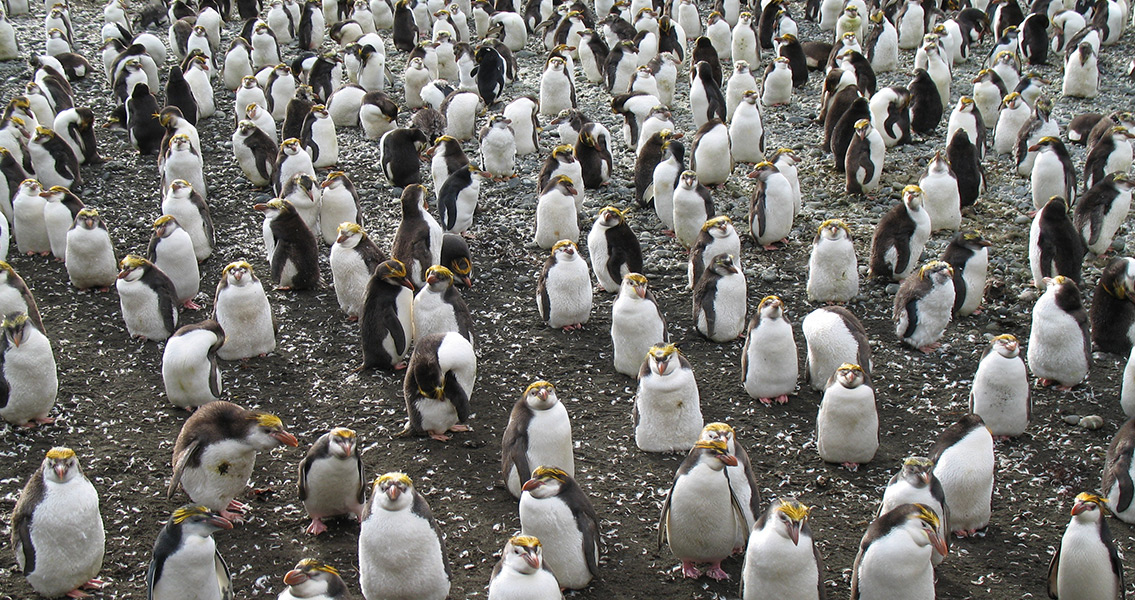
Journal of Anatomy. Researchers from the University of Texas at Austin argue that although the loss of flight was responsible for modern penguins’ unique way of walking, it didn’t cause any major changes in the animals’ brain structure. The conclusions have been reached following examination of the skull of the world’s oldest known penguin fossil, from the mid to late Paleocene era in New Zealand. “What this seems to indicate is that becoming larger, losing flight and becoming a wing-propelled diver does not necessarily change the [brain] anatomy quickly,” said James Proffitt, a graduate student at University of Texas’ Jackson School of Geosciences and the leader of the research, in a press release from the University of Texas. Despite modern penguins exhibiting a unique brain, one remarkably different from those of their ancestors, these changes didn’t take place until long after the birds had evolved away from flying. “The way the modern penguin brain looks doesn’t show up until millions and millions of years later.” Proffitt explained. The 60 million year old penguin whose remains were used in the study was likely to have lived a life very similar to modern penguins. Its age, and its position in the line of penguin evolution meant it provided invaluable insights for the study. “It’s the oldest [penguin] following pretty closely after the loss of flight and the evolution of flightless wing-propelled diving that we know of”, Proffitt said. Exactly why penguins evolved to not fly is a mystery that plagued scientists for centuries. It seems massively impractical, Emperor penguins for example, have to walk distances of up to 60km from their rookeries to the sea, a journey which takes several days but could be achieved in a matter of days if the birds flew. Similarly, many penguins are the target of predators such as leopard seals at the point they enter the ocean – a problem which could be avoided if they were able to fly. A 2013 study by scientists from the University of Aberdeen used comparisons with Guillemots to conclude that there is no way for a bird to develop wings which are good for both flying and swimming. According to the scientists, as penguin wings evolved to make them better swimmers, the amount of energy they needed for flying became too great. Proffitt and his partners on the latest study, Julia Clarke; a professor in the Jackson School’s Department of Geological Sciences, and Paul Scofield; the senior curator of Natural History at the Canterbury Museum in Christchurch, New Zealand, assumed that the loss of flight would have impacted brain structure, making the brains of ancient and modern penguins similar in certain regions. Due to the fact the shape of a bird’s skull is influenced by the structure of its brain, the team were able to use X-ray CT scanning to capture digitally the minute details of the penguin skull’s anatomy before applying computer modelling software to form a digital mold of the brain, called an endocast. Their results showed that in reality the ancient penguin’s brain anatomy had more in common with petrels and loons than modern penguins. If the peculiarities of penguin brain structure were a consequence of its initial loss of flight, the changes would have been apparent in the Paleocene skull. Similarities between the ancient penguin and modern diving birds suggest that the actual act of diving could be responsible for the differences in brain structure. “The question now is do the old fossil penguins’ brains look that way because that’s the way their ancestors looked, or does it have something maybe to do with diving?” Proffitt said, in the press release. For more information: www.wileyonlinelibrary.com]]>

PLOS ONE, can be found online here Image courtesy of Tel Aviv University.]]>


Raphus cucullatus, better known as the dodo, had a brain that was rather large for its size. The closest relative of the dodo, the simple and ubiquitous pigeon, has a brain-body size ratio roughly equivalent to that of its extinct cousin; pigeons can of course be trained, something that requires a modicum of intelligence. Dodos earned the reputation for being particularly dim thanks to the circumstances surrounding their extinction. The large-sized flightless bird was native to Mauritius, an island in the Indian Ocean, and was found there when sailors discovered the island at the end of the sixteenth century. With the birds having never encountered humanity before, they had no reason to fear the sailors that would coax them onto boats to be used as a source of fresh meat; by 1662 the last dodo had disappeared from the island. Invasive species introduced to Mauritius also contributed to the dodo’s decline and extinction, according to Stony Brook University’s Eugenia Gold, the lead author of the new research paper. In an interview with Heritage Daily, Gold recounted how she approached London’s Natural History Museum in her endeavor to learn more about the curious bird. The museum had a well-preserved dodo skull in its collection and permitted the researcher to scan it using high-resolution computed tomography (CT). Gold then compared the image to those she made of the skulls of several different pigeon species at the Microscopy and Imaging Facility at the American Museum of Natural History. Gold’s results were startling. She found that the size of the dodo’s skull, and therefore its brain, in relation to the rest of its body, was “right on the line” compared to the pigeon examples she scanned herself and those provided by collaborators from the National Museum of Scotland and the Natural History Museum of Denmark. While the researcher was quick to say that there’s more to relative intelligence than simple brain size, the results provide a basic measurement tool, one that may help dispel the myth that the dodo was an exceedingly stupid example of a bird. The research also unearthed an insight in the morphology of the dodo by revealing the bird had a much larger olfactory bulb than most bird species. Most birds have highly developed optic lobes, showing a preference for visual acuity over the ability to process smells, but as the dodo was flightless, Gold and her co-authors have made the suggestion that the species relied on scent to help it hunt and scavenge for food sources on the ground. While the diet of the dodo is still an unsolved mystery, it’s likely it would have fed on shellfish and other marine animals, smaller land vertebrates, and even fruit from trees on the island. As a final mystery, the semicircular canal of the dodo – the region of the bird’s ear where it would have derived its sense of balance – incorporated a curvature described by the researchers as “unusual”. There are currently no viable theories as to this atypical biological construction. Gold’s research, published in the Zoological Journal of the Linnean Society, can be found online here]]>

