Categories
Breaking News

Earliest Human Cancer Pushes its Origins Back Over a Million Years

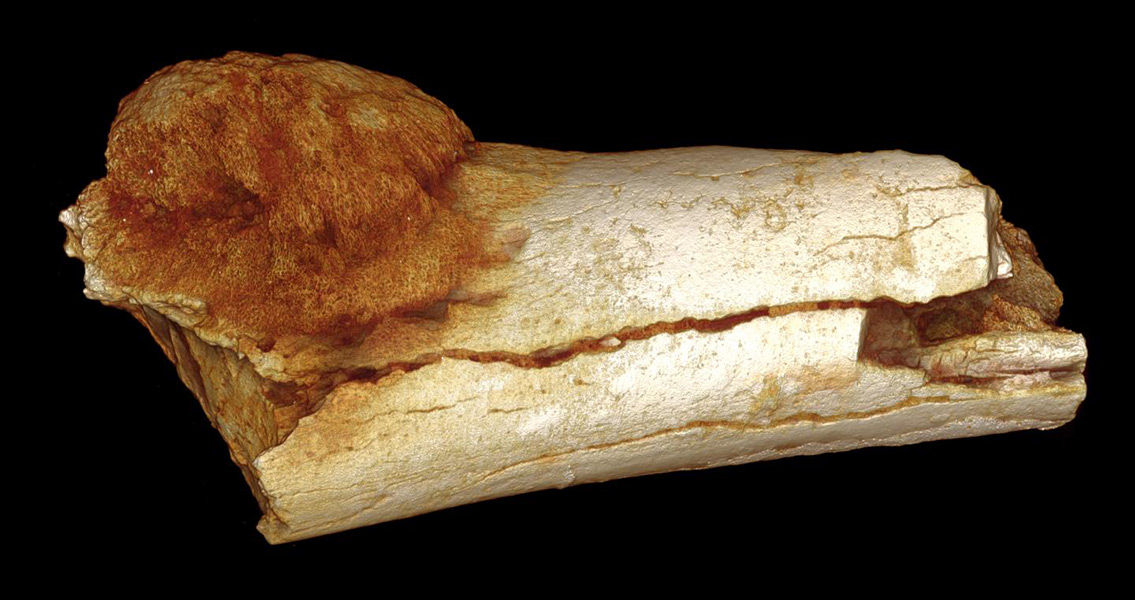
South African Journal of Science, an ancient cancer case and an ancient tumour case are detailed. Until now, the oldest documented incidence of a tumour had been discovered on the 120,000 year old remains of a Neanderthal. The two new studies suggest that cancer and tumours were in fact around well over a million years ago. A 1.7 million year old foot bone discovered in Swartrans, South Africa, bore definitive evidence of malignant cancer. Although the species to which the foot belongs remains unclear, the researchers behind the first paper say it is clearly that of a hominin or bipedal human relative. The accompanying paper identifies the oldest tumour ever found in the human fossil record. A benign neoplasm was found in the vertebrate of Karabo, the close to two million year old remains of an Australopithecus sediba child discovered at the site of Malapa. “Modern medicine tends to assume that cancers and tumours in humans are diseases caused by modern lifestyles and environments.” said Edward Odes, a Wits doctoral candidate and lead author of the cancer paper, and co-author on the tumour paper. “Our studies show the origins of these diseases occurred in our ancient relatives millions of years before modern industrial societies existed”. In the case of the foot bone, the cancer: an agressive osteosarcoma, was discovered on the metatarsal. It’s a form of cancer most commonly found in younger humans, which if left untreated proves fatal. “Due to its preservation, we don’t know whether the single cancerous foot bone belongs to an adult or child, nor whether the cancer caused the death of this individual, but we can tell this would have affected the individual’s ability to walk or run”, explained Dr Bernard Zipfel, a Wits Scientist and expert on the feet and movement of early human relatives. Both discoveries further complicate the picture we have of the causes and history of cancer and tumours. The diseases are typically linked to aspects of modern life, such as our diet, urban living and background radiation. Prevailing thought also suggests that the reason cancer and tumours seem to exhibit themselves more often now is due to increasing life expectancies. However, the tumour discovered on the child’s vertebrate is one associated with adulthood. Indeed, it is the first evidence of the disease in a young individual in the whole of the fossil record. Professor Lee Berger, the leader of the Malapa project and an author on both papers, highlighted just how much of a game changer in the study of oncology both discoveries could prove to be. “…not only has there been an assumption that these sorts of cancers and tumours are diseases of modernity, which these fossils clearly demonstrate they are not, but that we as modern humans exhibit them as a consequence of living longer, yet this rare tumour is found in a young child. The history of these types of tumours and cancers is clearly more complex than previously thought”. In both studies, cutting edge imaging technology was used to diagnose the incidences of disease. The results show the potential of modern technology to not only further our understanding of our ancient human relatives, but also the origin and development of modern diseases. “This is another good example of how the modern clinical sciences and the science of palaeoanthropology are working together in South Africa and with international collaborators to advance our understanding of diseases in both the past and the present.” said Dr Jacqueline Smilg, a radiologist based at Charlotte Maxeke Hospital, who is an author on both papers and was involved in the clinical diagnoses. Image courtesy of Patrick Randolph-Quinney (UCLAN)]]>

Categories
Breaking News

Origins of Farmed Rice Discovered in China

Scientific Reports, can be found online here]]>

Categories
Breaking News

800,000 Year Old Homo Erectus Footprints Found in Eritrea

Homo erectus, in the desert of the East African country of Eritrea. It’s believed the prints date back approximately 800,000 years, and although their age has yet to be verified, it’s anticipated they will provide a wealth of information about the movements and gait of this extinct species of hominid. Alfredo Coppa, an archaeologist with Sapienza University in Rome, along with his Italian research team and researchers with Eritrea’s National Museum discovered the 26 square meter stone slab that contained the footprints. Today, the region where they were found is in the middle of a desert, but 800,000 years ago the environment was very different. The fossilized footprints, which are practically indistinguishable from our own, were left in the sandy sediments on the shore of a lake, which archaeologists believe was part of the landscape at the time. The shapes of the footprints indicate they filled with water directly after they were formed and before they dried out and were eventually buried. The footprints suggest movement from the north to the south, and amazingly, there were also tracks from an animal similar to a gazelle around them, suggesting perhaps our early ancestors were on a hunting expedition. “Fossilized footprints are extremely rare,” Coppa explained to the Italian publication, The Local, “We need to carry out more digs in the area, which has so far turned up the fossilized remains of five or six different Homo erectus specimens.” Homo erectus (which means “upright man”) lived through most of the Pleistocene epoch which lasted from about 2,588,000 years ago up to 11,700 years ago. The earliest Homo erectus fossils date back 1.9 million years, and there are two schools of thought on how and where they evolved. The first theory has Homo erectus evolving from the Australopithecina, in East Africa, and migrating (around 2 million years ago) as a result of the desertifying conditions which were developing in northern and eastern Africa at the time. H.erectus joined other migrations travelling through the “Saharan Pump” and spread throughout much of Eurasia, getting as far as India, Georgia, Sri Lanka, Indonesia, and China. The second theory is that H.erectus evolved in Eurasia and then migrated to Africa, based largely on evidence which has been discovered at the Dmanisi site in Georgia which shows they inhabited the area around the same time or even slightly before the earliest evidence of H.erectus in Africa. What has been decided is that we, Homo sapiens, evolved from African Homo erectus approximately 200,000 years ago. Even if the footprints are found to be the oldest left by Homo erectus, they aren’t even close to being the oldest prints left by a hominid species; a team of researchers in Tanzania discovered the tracks of our first upright ancestor, Australopithecus, which were 3.8 million years old. ]]>

Categories
Breaking News

Letter Written By Charles Darwin Still Up for Grabs

Categories
Breaking News

Scientific Techniques Lead to Discovery of Ancient Marble's Origins

Categories
Editorial

May History News Round-up

The Americas Researchers from New York Queens College have found that the Ancient Maya city Nixtun-Ch’ich, in Northern Guatamala, was built with a grid pattern design, something not seen in other cities from that time and region. Thought to have thrived between 600 and 300 BCE, the city featured a ceremonial route lined with up to 15 flat top pyramids which were each up to 100 feet tall. Running from west to east, the route only had a 3-degree variation from true east. Other Maya cities tended to be much more ‘relaxed’ in design and the researchers, led by Timothy Pugh from Queens College, have suggested that Nixtun-Ch’ich’s strict design may have given a sense of being constantly controlled for the people living there. A study by Jack Williams and Samuel Munoz has looked at the largest pre-colonial settlement north of Mexico, the city of Cahokia, located on the flood plain of the Mississippi River. By studying 2000 years old sediment cores from the flood plain, Munoz and Williams have shown that major flood events could have been linked to the rise and fall of the city. Correlating the history of the city with the record of floods, it was found that the rise of Cahokia took place between 600 and 1200 CE, a relatively flood free period. A major flood hit the area after 1200 CE, around the same time that the city entered a period of decline culminating in its complete abandonment in 1400 CE. The study could be hugely important for other studies of early agricultural societies as it has highlighted the importance of flood as a possible cause of decline, as well as shedding new light on a rarely studied period of North American history. Human Origins and Development Several studies published in May about our prehistoric origins have the potential to cause a major rethink about our distant past. Grasping the connectivity of such developments can be difficult. Below, several of the most important news stories from this month are presented in chronological order of the periods of which they relate to. An international team of scientists has just announced the discovery of a new human ancestor species which they have called Australopithecus deyiremeda. The scientists believe that this species inhabited the Afar region of Ethiopia around 3.3 million to 3.5 million years ago. This is hugely significant as it means Australopithecus deyiremeda lived in the region at the same time as Australopithecus afarensis (whose most famous representative is Lucy). The study has the potential to question the hitherto dominant theory that only one human ancestor species inhabited the earth at any time during the Pliocene period. Jumping forward three million years, a study from the Wellcome Trust Sanger Institute and the University of Cambridge used genetic sequencing to understand the path of human migration through Africa. Based on a study of the DNA of 100 Egyptians and 125 Ethiopians, the team observed that the DNA of the Egyptians was closer to that of Eurasians. From this, they concluded that the divergence from Egyptians to Eurasians occurred around 10,000 years later than that from Ethiopians to Eurasians. Based on these conclusions, the team believes that the bulk of the human migration from Africa went through Egypt rather than Ethiopia. Other studies have looked at the development of early culture and societies. Genevieve von Petzinger, an anthropologist from the University of Victoria, has looked at the origins of written communication. It is generally believed that the use of written symbols as a source of communication first emerged in Sumer around 3,000 BCE. After examining 52 caves around Europe where ancient humans had lived, von Petzinger believes that written symbols were intentionally used as a way to convey information over 40,000 years ago. These written symbols are clearly not as sophisticated as a modern written language, but if von Petzinger is correct, they would suggest that human cultural development actually started much earlier than previously thought – possibly before the migration out of Africa. Finally, a study by Pontus Skoglund from Harvard Medical School and the Broad Institute, and Love Dalén from the Swedish Museum of Natural History, has suggested that the relationship between humans and dogs may have formed much earlier than previously thought. Scientists generally argue that the domestication of dogs occurred around 16,000 years ago, but this new study argues it actually took place as far back as 35,000 years ago. The conclusions are based on research into the dates that modern dogs diverged from wolves in Siberia (Scientists consider the divergence between dogs and wolves to have been a consequence of human domestication of the animals). ]]>

Categories
Breaking News

Enslaved Africans' Origins Traced

Proceedings of the National Academy of Sciences. Dr Schroeder and her colleagues performed genome analyses on the remains of three enslaved Africans, found buried in the Zoutsteeg area of Philipsburg on the Caribbean island of Saint Martin. It is understood from previous studies that the ‘Zoutsteeg Three,’ one adult female and two adult males, were buried in the seventeenth century and most likely came from Africa, rather than having been born in the New World. The new study enriched the poorly preserved DNA of the Zoutsteeg Three using a technique known as whole genome capture. “Those remains had essentially been lying on a Caribbean beach for hundreds of years so their preservation was really not good,” Dr Schroeder explained. “But by enriching the poorly preserved DNA in those samples we were able to obtain enough data to be able to dig deeper into the genetic origins of those three individuals we analyzed.” Dr Schroeder and her colleagues found that one of the Zoutsteeg Three had originated among Bantu-speaking groups in northern Cameroon. The other two came from a different area, most likely from non-Bantu speakers in the area which is now Nigeria and Ghana. “To our knowledge, these findings provide the first direct evidence for the ethnic origins of enslaved Africans,” writes Dr Schroeder in her study. “The data suggest that the Africans who reached Saint Martin were drawn from diverse cultures and societies.” The study has several major implications for the study of history. Most importantly, it clearly shows that it is possible to get extensive genome data from poorly-preserved archaeological remains; Dr Schroeder’s work clearly shows the value of her whole-genome capture method, which enables us to use samples which were previously thought to be too poorly degraded. This is particularly important in the Caribbean as artefacts deteriorate considerably in tropical settings. Genome-wide analyses are very useful for tracing the genetic origins of individuals, in this particular case victims of the transatlantic slave trade. Dr Schroeder’s work provides an alternative record which enhances our understanding of a long-standing historical problem, one where documentary sources can not tell us enough. For more information: www.pnas.org Image courtesy of Wikimedia commons user: Jgdc47B ]]>