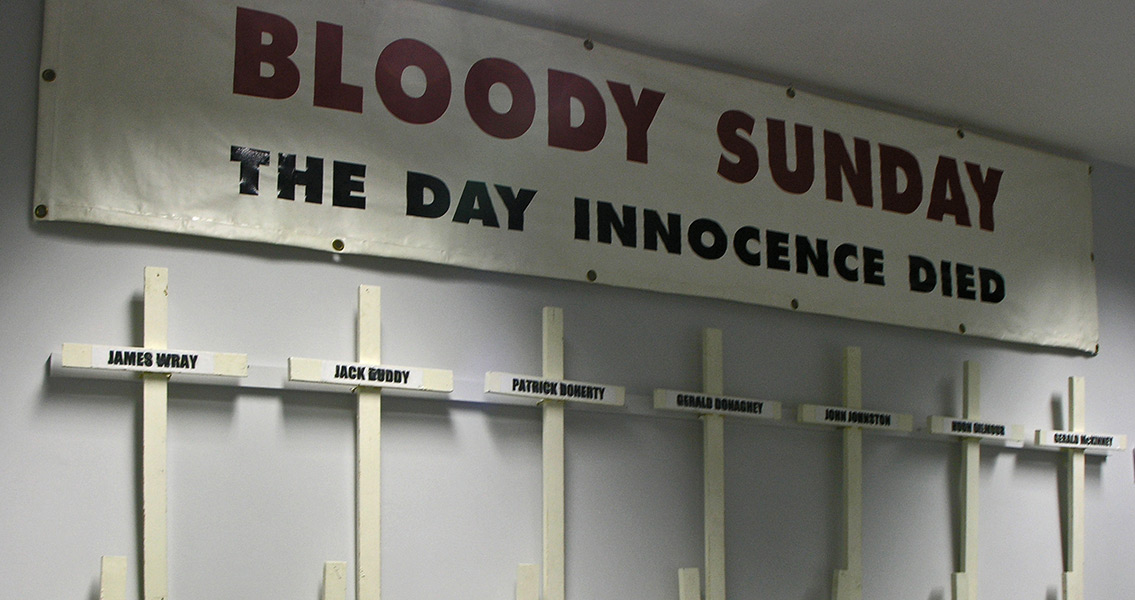
The Wolfe Tones – Go On Home British Soldiers Its depiction in Irish rebel songs such as ‘Go On Home British Soldiers’ shows that for many in Ireland the massacre was just another tragedy in a centuries old conflict between British imperialism and Irish nationalism. The Bloody Sunday massacre was absorbed into the tradition of rebel music which had for centuries railed against British interference in Ireland and Northern Ireland. It took decades for the British government to accept the responsibility of its military for the massacre. A controversial report, headed by High Court Justice Lord Widgery, was published in summer 1972. It exonerated the British troops, and suggested that the protesters had been carrying explosives and other weapons. It wasn’t until 2010 that a new report into the events was published, headed by Lord Savile it laid responsibility for the massacre with the British army and cleared all of the victims of any wrong doing. Among other crucial conclusions, it claimed the soldiers opened fire without warning and subsequently attempted to cover up their actions, and that the protesters were all unarmed. In November 2015 a former British soldier was arrested for questioning in regards to the shootings, showing that 44 years on, the Bloody Sunday massacre is yet to be truly resolved. Image courtesy of Wikimedia Commons user: SeanMack ]]>



Homo floresiensis from Flores, which is just south of Sulawesi. Similar to the island of Flores where the Homo floresiensis (sometimes called ‘Hobbit’) fossils were first found over a decade ago, Sulawesi may have been a natural lab for human evolution in an isolated condition. Initially, the age of the artifacts was unknown and the early attempts to date them failed to give researchers a definitive answer. At the CAS, colleagues of Dr van den Bergh used the latest technique of luminescence dating for feldspars minerals. Feldspar is a group of minerals distinguishable by the silica and alumina present in their chemistry, the most abundant group of minerals on the planet. Known as multiple elevated temperature post-infrared stimulated luminescence (MET-pIRIR) the technique analyzed the sediment layer the artifacts were discovered in. The research is part of a collaboration between the late professor Mike Morwood who led the team responsible for the ‘Hobbit’ find on Flores, and the Geological Agency of Indonesia. Dr van den Bergh was part of Professor Morwood’s research team at the time of H.floresiensis‘ discovery. The research is being supported by ARC grants and funds from the Geological Agency of Indonesia. Image courtesy of Wikimedia Commons user: Olaf Studt ]]>