Categories
Pirate Ship Found in the Black Sea

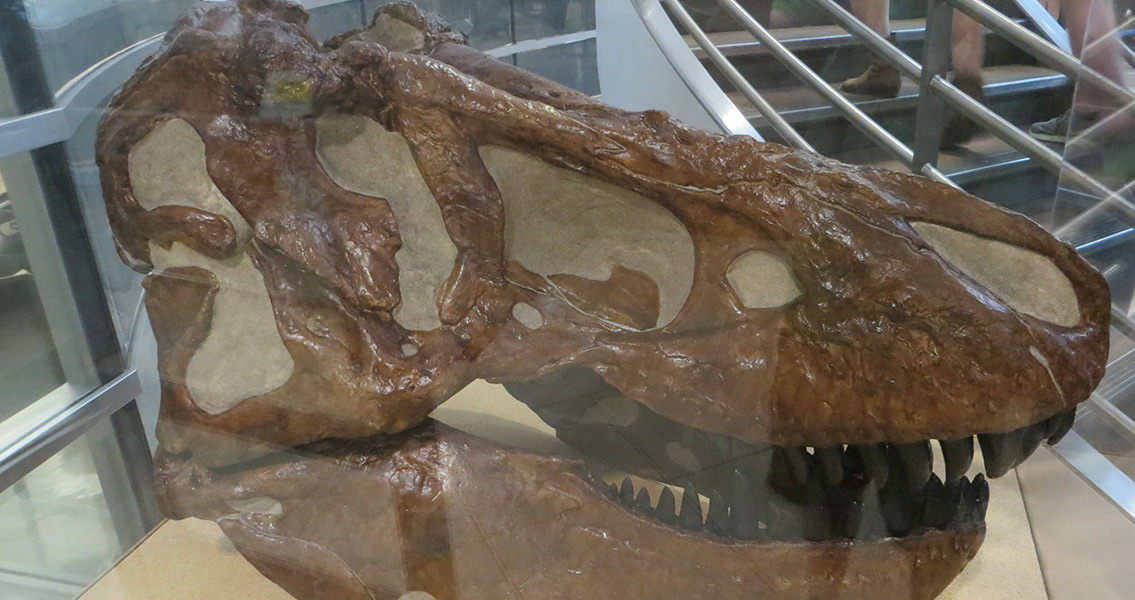
Allosaurus fragilis, and a third specimen – a herbivorous theropod known as Erlikosaurus andrewsi. The simulations were held up against several bird and crocodile species – the closest living relatives of dinosaurs – in order to have a comparison point for maximum jaw gape and muscle strain. According to the results of the study, carnivorous theropods like the Allosaur and the Tyrannosaur were capable of opening their mouths an impressive and perhaps terrifying 90 degrees at the maximum. Meanwhile the Erlikosaurus, the herbivorous relative of the meat-eating pair, could only open its mouth as wide as around 45 degrees. Additionally, the bite force that the Tyrannosaur could sustain over a wide variety of jaw angles was prodigious, a strong indication that the carnivore was easily capable of rending flesh and crushing bone in order to feed on its prey. The results were eye-opening but not necessarily unexpected, Dr. Lautenschlager said in the press release. The jaw gapes of modern herbivores is almost universally smaller than that of predatory animals living today, the scientist remarked; the fact that this trend was also apparently present in theropods millions of years ago shows commonalities in evolution and biology. Image courtesy of Wikimedia Commons user: WildFrogs]]>



giant lizard discovered in the Capricorn Caves had been carbon dated to 50,000 years ago. The date coincides with a time after humans had started to inhabit the Australian continent. Although the scientists were unable to determine exactly what species of giant lizard the fossilised bone came from, its discovery suggests that there was a period our ancestors shared Australia with giant reptiles. Louys and his team made their discovery as part of the ‘From Sunda to Sahul’ project which is analysing the first human dispersal through the islands of Southeast Asia. The project, according to Louys, aims to find out when humans first moved through the islands of the region, how they did so and the impact they had on the ecosystem. The disappearance of the large rats could well be tied in with human activity. “The funny thing is that they are co-existing up until about a thousand years ago.” said Louys. “The reason we think they became extinct is because that was when metal tools started to be introduced in Timor, people could start to clear forests at a much larger scale.” The reason why megafauna such as mammoths and ground sloths went extinct has long been a source of controversy. Exactly why these creatures disappeared is unclear, but many scientists have suggested that humans may have played a part. The theory of Louys and his team adds further weight to the idea that humans have long been able to affect ecosystems to such an extent as to cause these spectacular creatures to go extinct. ANU’s study in the region will continue, in the hope of not only charting past human impact on ecosystems, but also informing modern conservation efforts. “”Once we know what was there before humans got there, we see what type of impact they had.” Louys, who returned from East Timor in August, presented his findings at the Meetings of the Society of Vertebrate Palaeontology in Texas.]]>




45,000years ago. Exactly what caused our genetic cousins to disappear from the continent is a hotly contested issue. Theories range from the effects of humans, whether through increased competition for food and resources or by humanity inadvertently spreading fatal diseases to the Neanderthals, to climate change or even a major volcanic eruption. Prior to this study, the earliest Neanderthal specimen found in Italy was Altamura Man. Discovered embedded in a limestone cave in Southern Italy in 1993, an analysis of the calcium deposits on Altamura Man’s skeleton suggested he was between 128,000 to 187,000 years old. The skeleton is renowned for providing the oldest ever DNA sample extracted from a Neanderthal. Marra and his team were inspired to analyse the Saccopastore remains further by a mystery which has plagued scientists since the skulls were first discovered. Eleven stone artefacts found at Saccopastore seemed to be significantly older than the bones themselves. By re-dating the skulls, this inconsistency has been cleared up. The findings will be published in the journal Quaternary Science Reviews, later this month. Image courtesy of Wikimedia Commons user: 120]]>
