Categories
Rare Roman Mural Found in Arles

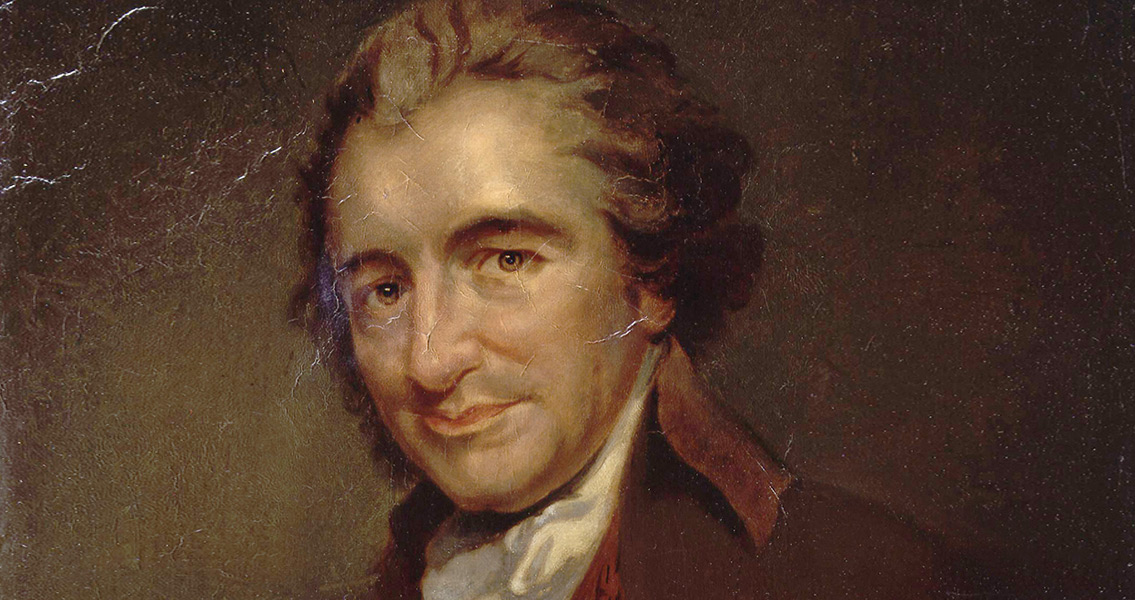
Common Sense was first published as a pamphlet in 1776. The hugely influential seventy-seven page work was one of the first to argue in clear, direct fashion that the future of the American colonies should be one independent from Great Britain. Along with general discussions on the nature of politics and society, Paine’s pamphlet also engages with what he perceived as fundamental flaws in the British political system and the defining injustice of monarchy. All of these factors are combined to form a justification for US independence. Paine was born in Thetford, England, in 1737. He finished his formal education at the age of thirteen and started to work for his father. Throughout his teens and twenties he took in a variety of jobs, ranging from corset maker to school teacher to tax collector. At the same time he used his spare time to pursue the education he hadn’t completed in his youth. He lost the tax collecting job in 1772, after he’d published an article arguing that an increase in tax collectors pay would lead to a reduction in corruption. In 1774, shortly before the American Revolution started, Paine left England for North America. He quickly became involved in American political life, editing the Pennsylvania Magazine and writing a host of articles. At this point relations between the North American colonists and the British were in a precarious state. Several protests against excessive British taxation of the colonies, most notably the Boston Tea Party of December 1773, had already taken place. As more British troops were sent to the colonies, a growing campaign formed among the colonists to break Britain’s interfering presence. Crucially, at this point most colonists viewed themselves as still holding some connection to Britain, and as such campaigned to break the aggressive British taxation rather than win complete independence. Commons Sense played a key role in changing the focus of the campaigns by making a clear argument for independence. At a time when the stirrings of the Revolutionary War had already started with a battle at Lexington and Concord in 1775, Commons Sense convinced many colonists that the only solution was to completely cut all connections to the British government. Pivotal was Paine’s highlighting of the fact that many of the colonists were not just from England, but had actually fled to North America from across Europe in search of liberty. “This new world hath been the asylum for the persecuted lovers of civil and religious liberty from every part of Europe. Hither they have fled, not from the tender embraces of the mother, but from the cruelty of the monster.” By framing the history of migration to the colonies as one from persecution to liberty, Common Sense provided a political justification to the campaign for freedom, and established a clear distinction between the colonists looking for liberty and the conservative politics of the Old World. At the same time, painting Britain as a monster ruled by a tyrannical monarchy and dominated by inequality made explicit the sense of a fundamental divide between the values of the colonists and their rulers across the Atlantic. The pamphlet also argues that when America won its freedom from Britain, its people would stop being rebels and instead become respected internationally. This in turn would allow the new country to make important alliances to further strengthen its position and gain support in its campaign for liberty and freedom. Paine’s Common Sense is a crucial work in understanding American history. Undoubtedly the movement towards the Revolutionary War was already well underway before he had even reached North America. However, the seventy-seven page pamphlet is vital for helping to develop an understanding of the ideological arguments used in the build up to the Declaration of Independence.

Common Sense
by Thomas Paine

Eocyathispongia qiania. The information provided through these methods was sufficient for the team to determine that the fossil had a number of characteristics in common with sponges from the Cambrian, characteristics that were until now thought to have only emerged during the explosion period. Bottjer told Phys.org that the sponge had already developed “fundamental sponge traits” 60 million years before the beginning of the Cambrian explosion, which meant that the majority of “developmental genes” for sponges were already present at the time. The obvious implication is that evolution was more gradual than believed, causing a rethink of the dating of early animal evolution. What’s perhaps even more fascinating is that the genes in the sponge fossil are present to this day in a variety of animals up to and including us humans. Bottjer added that in the future, the relatively new discipline of palaeogenomics will come to play an increasingly prominent role in research thanks to modern technology. Palaeogenomics focuses on the evolution of genes, determining when this or that gene first appeared in an organism. Until now, the fossil record came from bigger animals, but with SEM and synchrotron microscopy, it is likely that a host of previously unknown stages in evolution will be revealed. For more information: “Sponge grade body fossil with cellular resolution dating 60 Myr before the Cambrian” ]]>






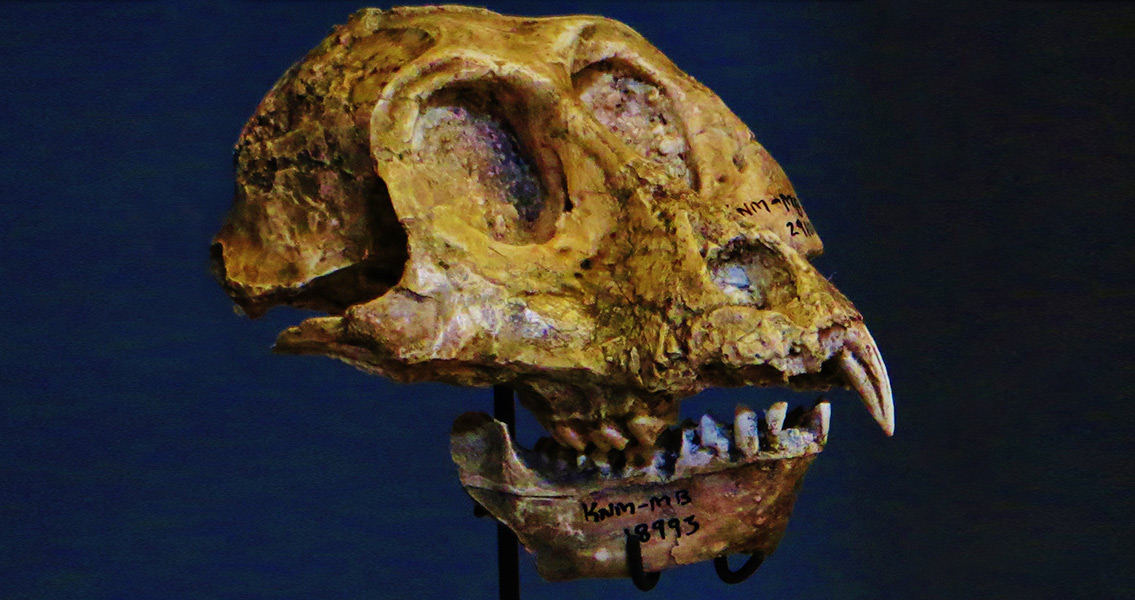
Victoriapithecus, an ancient monkey species that has evolutionary links to macaques, baboons, and other smaller primates in the family, once roamed Africa at a time when humanity was still spreading across the globe in tribes of hunter-gatherers. The skull of this particular monkey was discovered in Kenya on an island in the middle of Lake Victoria in 1997. So far, the skull is the only evidence that the monkey species ever existed, as there have been no other Victoriapithecus remains found since. An extremely rare find, the Victoriapithecus skull is one of the few remains of early primates that have survived to the modern day. The skull represents an unprecedented opportunity for scientists to delve into the secrets of early primate brain development – and by extension the brain development of early humans, which share an evolutionary link not just to Victoriapithecus but to all primates thanks to our shared ancestry. An international research team from the Max Planck Institute for Evolutionary Anthropology in Germany and Duke University in the United States used high-resolution X-rays to construct a 3D model of the brain of Victoriapithecus. The scientists discovered that the long-extinct monkey’s brain was around half the size of a modern monkey’s living today – only around 36 cubic centimeters – but despite the difference in size the level of complexity of the Victoriapithecus brain was quite high, as the folds and wrinkles in the monkey’s brain were tightly grouped. In a press release accompanying the publication of the team’s findings in the journal Nature Communications, study co-author Lauren Gonzales said that accepted academic thought had been that the size of primate brains grew before adding additional folds and complexities. However, the imaging of the Victoriapithecus brain has revealed the reverse, providing some of the clearest proof that in this case the complexity came before the size of the primate brain evolved to become bigger. The research may also be able to aid in backing up the claims that Homo floresiensis, a humanoid primate species dating from at least 18,000 years in the past, was able to use stone tools and make fire despite having relatively small brains for their body size. Additional discoveries made by the research team include that the monkey species had an olfactory bulb, the region of the brain that controls smell, that was around three times larger than it was expected to have been. This led the team to suggest that Victoriapithecus had a highly developed sense of smell – one that might have been better than its modern living cousins have today. For more information: www.nature.com Image courtesy of Wikimedia Commons user: Ghedoghedo]]>