Categories
Editorial

The Irish Fright of 1688: racism, rumours and the reign of fake news

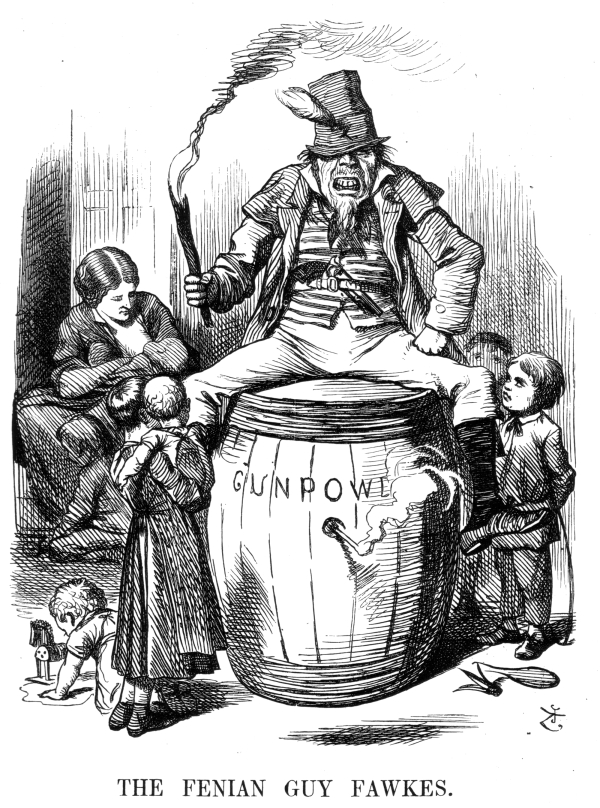
here). Often, outbreaks occur in small, tight-knit groups, due to the intensity of collective thinking. But if common thought is scaled up, hysteria can still occur. The Irish Fright of 1688 is a solemn reminder that when a prejudiced ideal is held by an entire country, fear can hypnotise the human mind into insanity. All it needs is a catalyst: political instability. [caption id="attachment_8768" align="aligncenter" width="600"] Anti-Irish propaganda continued for centuries: this cartoon is from ”Punch” magazine, published in December 1867. Credit: Wikimedia Commons[/caption]

The 17th Century Englishman’s understanding of the Irish

The trope of the ‘wild Irishman’ had been a firm narrative of the British Empire for centuries. Negative stereotypes appear as far back as 1190, with the Norman chronicler Giraldus Cambrensis justifying the Norman invasion of Ireland. He penned Topographia Hibernica, or Topography of Ireland, which played a lasting role in shaping English colonial attitudes towards the Irish. More than just poor and uncultured, the Irish were painted as unholy. In The Anglo-Irish Experience, 1680-1730: Religion, Identity and Patriotism, historian DW Hayton says: “the native Irish were called ‘a brutal race that Israel’s God ne’er knew’”. Conditioned by a racist misconception of the Irishman, the English people had a well-established fear. With political instability nibbling at their heels, they were primed for acts of mob mentality.

Political instability rocks England

When King James II took the throne after the death of the ‘Merry Monarch’ Charles II, his policies of religious tolerance were met with opposition from the political powers. Troubled by the new King’s Catholicism and his close ties with France, they were increasingly outspoken about the king’s unsuitability for the throne. Prior to the birth of James II’s son on 10th June 1688, the heir presumptive had been his 26-year-old daughter Mary, a Protestant married to William of Orange.  This change in the line of succession meant that the establishment of a Roman Catholic dynasty seemed ever more likely. In private, Tories and Whigs worked together to bring William of Orange to England to perhaps quell any danger of rising Catholic influence.

Irish soldiers come to Portsmouth

On his ascension to the throne, James had inherited an army in Ireland. It was made up of 8,238 men; majority Protestant. Over the next three years, the army would welcome some Catholic soldiers and grow to have almost 9,000 men. Due to the looming threat of an expected invasion by William of Orange, the English Army needed support from Irish troops. When 2,820 men were sent to Portsmouth in September 1688, the townspeople were suspicious. Fear began to spread. A few weeks after the Irish soldiers arrived, a newspaper reported that people were making “great complaints of the rude Irish who have caused many families to leave that place, having committed many robberies.” Rather than robberies, the true fear of the local people was that Irish or Catholic forces were in a fine position to launch an anti-Protestant uprising. In fact, just a few years earlier, the House of Lords had announced that there was a “horrid and treasonable Plot and Conspiracy, contrived and carried on by those of the Popish Religion in [Ireland], for massacring the English, and subverting the Protestant Religion, and the ancient established Government of that Kingdom.” As the Glorious Revolution to overthrow James II took hold, the Irish troops were ordered to go north to fight in the Battle of Reading on 9th December 1688. After a sorry defeat, some Irish troops were sent back to Portsmouth; some to Uxbridge, just west of London.

The Irish Fright grips England

One account from 1746 quotes Bishop Gilbert Burnet: “Country Fellows, arriving about Midnight at Westminster caused a sudden Uproar by Reporting that the Irish, in desperate Rage, were advancing to London, and putting all before them to Fire and Sword.” Other news writers passed similar comment, immediately igniting enough panic for 100,000 men to mobilise. Contemporary accounts tell us that men were discharging firearms and beating drums rapidly. Women were able to contribute more significantly to the din by beating pots and pans. False reports flew about the country. Allegedly, Uxbridge had been ransacked by the Irish. The House of Lords even had an emergency meeting at 3am in Whitehall to dissect the situation. Rather than subsiding due to lack of evidence, the Irish Fright snowballed. The following day, hysterical reports that the Irish were attacking Kent and Norfolk caused people to mobilise. People living in Kingston-upon-Thames started to cut down trees to barricade themselves against the ‘wild Irishman’. Madness swept northwards. By 15th December, Yorkshire succumbed to the Fright; believing that both the Lancastrians and the Irish were coming to burn their towns to the ground. Three days later, the Fright reached remote parts of England and Wales. On 18th December, a local mob shot and killed a supposed Irishman. As it turned out, he was an exciseman; someone they might have been happy to see the back of anyway. Significantly, the reports feeding from one town to the next talked about “8 or 9,000 Bloody Irish,” despite only 2,820 men having been stationed in Portsmouth originally. Hayton comments: “This panic was the climax to a decade of Whig propaganda, seeking to terrify the English public with the traditional nightmare of bloodthirsty Irish papists. That the programme worked so well proved the persistence in England of the popular reputation of the Irishman as a cruel savage, though it did require a political crisis to realise its full potential.”

The fallout of the Fright

Contemporary accounts tell us that at least 19 counties were swept up into the Irish Fright. All displayed a similar narrative: an onslaught of bloodthirsty Irishmen were said to have massacred the inhabitants of towns only around a day’s journey away. The panic burned brightly for a day or two before subsiding. Although the exciseman was the only casualty, innocent Catholics were targeted. A diarist noted: “[Protestant mobs] made most miserable of all the papists’ [Catholics’] houses they came near; for, under pretence of seeking for arms, they did many thousands of pounds worth of hurt, cutting down rich hangings, breaking through walls, pulling in pieces of excellent ceilings … then they secured all the papists they could get, intending to carry them all away to prison.” [caption id="attachment_8769" align="aligncenter" width="600"] Anti-Irish propaganda from ”Punch” magazine, published in May 1882. Credit: Wikimedia Commons[/caption] For all of its insanity, the Irish Fright was not a standalone, freak occurrence. Historians agree that it bore a striking resemblance to the French Great Fear of 1789, which followed the fall of the Bastille. In both uprisings, false rumours of massacres caused men and women to take up arms. Concerns about a collapsing regime, coupled with the cold realisation that no central authority could protect the people, resulted in a volatile civilian situation. With its echoes throughout history pointing towards a continuing relevance, the Irish Fright is a startling reminder of the power of a racist narrative in times of political instability.]]>
Categories
Breaking News

A St. Patrick's Day Shock – The History News of the Week

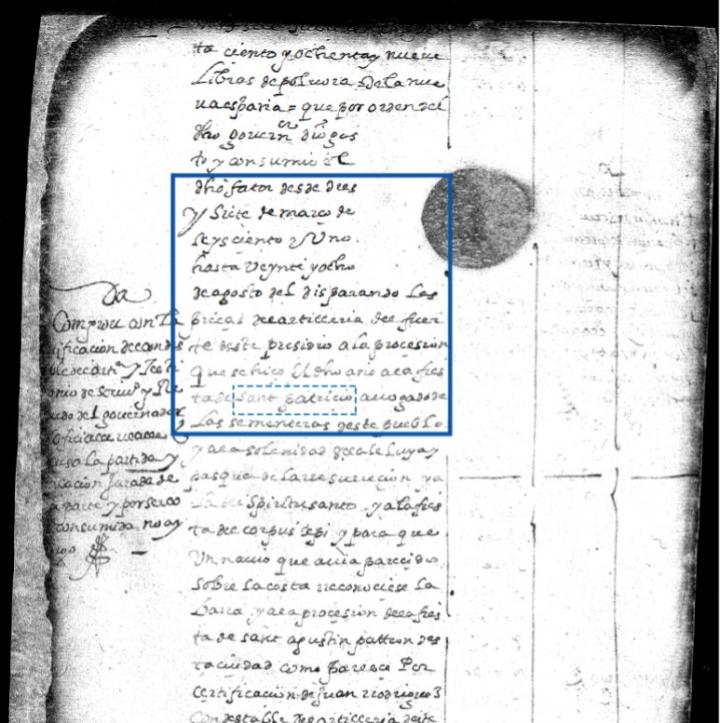
St. Patrick’s Day Celebrations had an Unlikely Origin Every 17th March cities around the globe are draped in green to celebrate St. Patrick’s Day. New research is claiming that some of the most recognisable parts of the festivities might have originated in an unexpected place. The feast of St. Patrick has been celebrated in Ireland since the ninth century. However, many of the traditions now associated with the celebration are thought to have had their beginnings with Irish immigrants to the US in the eighteenth century. Traditionally, it is thought that St. Patrick’s Day festivities such as parades and fireworks originated in north eastern US cities such as Boston and New York. However, the recently discovered evidence suggests that many of these celebrations were taking place a century before, in Florida. The basis of the new claim is gunpowder expenditures lists from St. Augustine, Florida, dated to 1600-1601. According to historians from the University of South Florida, one such list has an entry stating that in March 1600, St. Augustine’s residents gathered and processed through the streets in honour of St. Patrick, with cannon firing from a nearby wooden fort in tribute of the saint. “It was certainly a surprise,” said historian J. Michael Francis, PhD, University of South Florida-St. Petersburg, who uncovered the document. “It did not register the first time I saw the name “San Patricio,” the Spanish name for St. Patrick. After a few seconds it actually hit me that there was a St. Patrick’s Day parade/procession in St. Augustine in 1601.” The shocks didn’t end with the revelation that the residents of St. Augustine were celebrating St. Patrick’s Day with cannon and processions as early as 1600. “Even more surprising was that the document identified St. Patrick as the patron saint of the city’s maize fields,” Dr. Francis continued, in a statement from the University of South Florida. The surprising discovery was made while Dr. Francis was studying documents connected to St. Augustine’s imperial Spanish history. Neanderthals Were Compassionate Neanderthals were capable of ‘compassionate and knowledgeable health care’, according to new research from the University of York. The findings form part of a growing challenge to the image of Neanderthals as nasty, brutish and uncaring. The authors of the new study claim that in fact Neanderthals were able to deliver highly effective responses to injury and illness. [caption id="attachment_8563" align="alignnone" width="1024"]1024px-Gibraltar_Skull_(1)a Gibraltar 1 Neanderthal skull[/caption] Image credit: Jononmac46 (File:Gibraltar_Skull_(1).JPG) [CC BY-SA 3.0 (https://creativecommons.org/licenses/by-sa/3.0)], via Wikimedia Commons It has been shown before that Neanderthals provided care for their injured, but it was assumed that this was largely done out of self-interest. “Our findings suggest Neanderthals didn’t think in terms of whether others might repay their efforts, they just responded to their feelings about seeing their loved ones suffering,” said study lead author Dr. Penny Spikins, a senior lecturer from the University of York. Archaeologists have previously discovered remains of Neanderthals who’d clearly suffered serious injuries long before their deaths. The study claims that these injuries would have required monitoring, massage, fever management and hygiene care. The remains of one male Neanderthal analysed in the study had a catalogue of poor health, including a degenerative disease of the spine and shoulders. This disease would have left him weak and vulnerable in the final year of his life, the authors state. Nevertheless, his articulated remains were carefully buried, suggesting he’d remained part of the group despite being a potential burden, right up until his death. “We argue that the social significance of the broader pattern of healthcare has been overlooked and interpretations of a limited or calculated response to healthcare have been influenced by preconceptions of Neanderthals as being ‘different’ and even brutish,” Dr. Spikins explained. “However, a detailed consideration of the evidence in its social and cultural context reveals a different picture. The very similarity of Neanderthal healthcare to that of later periods has important implications. We argue that organised, knowledgeable and caring healthcare is not unique to our species but rather has a long evolutionary history.” The study has been published in the journal World Archaeology. Remains of Iron Age Feast Discovered Evidence of a huge Iron Age feast have been discovered on the Orkney Islands, off the coast of Scotland, according to The Scotsman. Archaeologists from the University of the Highlands and Islands (UHI) believe more than 10,000 animals were cooked and eaten in a massive cliff top gathering above Windwick Bay, South Ronaldsay, around 1,700 years ago. The Scotsman reports that a range of jewellery fragments and tools have been found at the site, which has been dated by radiocarbon tests on a nearby midden. “These numbers tell you about the scale of the feast and the largesse of being able to have that amount of food in circulation for what appears to be a short-lived event,” Martin Carruthers, an Iron Age expert from UHI told The Scotsman. “The feast is doing two things. It’s probably celebrating the successful conclusion of the making of a big batch of jewellery.” “The second point is the feast is pretty enormous and it is it probably the arena where pins and brooches are being handed out to individuals within the community.” Feature image: Gun expenditures log explains the procession through the streets of St. Augustine, Florida and St. Patrick as the ‘protector of the fields.’ Credit: AGI Contaduria 950 ]]>

Categories
Breaking News

Newgrange Sun Trap May Be Only 50 Years Old, Scientist Says

The Irish Times, is that Newgrange would have been a significant “Hiberno-Roman cult site” during the Iron Age. These findings are supported by “underplayed” discoveries made at the location by O’Kelly, Gibbons states. This overlooked or underplayed material includes valuable Roman coins, a gold ring, a bracelet, pendants, and torcs. Additional evidence of horses and dogs was likewise found, as well as signs of elks or stags, dating to the late seventeenth century and later. Scientists have commented on Gibbons’ new research with mixed remarks, on the one hand agreeing that O’Kelley had downplayed the evidence at the site of activity during the Iron Age; on the other finding the idea that the roof box was a modern construct hard to swallow. Dr. Richard Hensey, the author of a recently published study on Newgrange, says that several studies have indicated the extreme age of the roof box, placing it at 5,000 years old.]]>

Categories
Editorial

€185 billion – the Cost of the USSR's Occupation Of Latvia

Categories
Breaking News

Genetic Sequencing Sheds Light on Irish Origins

Categories
Book Reviews

Jonathan Swift Satirizes English Subjugation of Ireland

Related Books


The Works of Dr. Jonathan Swift book

The Works of Dr. Jonathan Swift
Accurately Revised in Twelve Volumes, Adorned With Copper-Plates, With Some Account of the Author’s Life, and Notes Historical and Explanatory Vol. 10Vol. 10
by Jonathan Swift

[gap height=”20″]]]>

Categories
Breaking News

First Eclipse Depiction Discovered in Ireland

Categories
News

Young Irelander Rebellion

Categories
News

Robert Emmet Leads the 1803 Irish Uprising

Categories
Breaking News

New Research Examines Cromwellian State-Building in Ireland

www.past.oxfordjournals.org Image courtesy of Wikimedia Commons user: Soerfm]]>