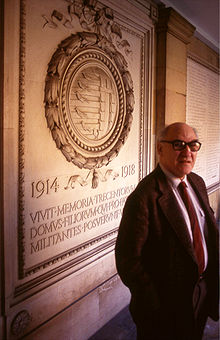
Tageblatt, and started one of the first modern advertising agencies. During the Spartacist Revolt of 1919, Mosse’s father was sent out to negotiate with Rosa Luxemburg who were among the activists who occupied the office of the family publication. Liberal, influential and rich, Mosse’s family was also, for different reasons, everything the Nazis held in contempt. Mosse, the future historian who later had to flee the Nazis, had the experience of seeing his family despised by forces from both the left and right. His objective mind, saw in the Nazi movement, especially at their rallies, elements of charisma which were attractive. Further, he realized there was nothing in the Bildung cosmopolitan liberalism of his family circle which could comprehend or resist fascism, but also the criticism of mass movements more broadly. Bildung is a German word that suggests a creative self-cultivation, rooted in philosophical meditation, which leads to maturity. It need not lead to cynicism or a tragic sense of life.
At the University of Wisconsin, after first dabbling in British history, Mosse, as teacher, began to focus on his German-Jewish identity, and pull the yarn of the alienation and repressed striving within himself. As he meditated on Nazi ideology, within its anti-modernism, he saw mass aspirations to overcome loneliness. Despite its racism, it offered a ritual faith and spectacle as it forged new community formations. Overcoming alienation, in certain respects, it left state power and capitalism untouched.
Within Nazi ideology, and the study of nationalism more generally, could be found complicated contours of sex and gender. Originally coded in Mosse’s work, they came more to the surface as he came out as a homosexual. A German Jewish exile and gay man in America, before the multi-cultural turn and gay liberation movement, he always reviled nationalism. Yet he found his way ultimately to teach at universities in Israel captivated by the ethos of new Jews who rejected humiliation and internalized anti-Jewish bigotry but were blind to the brutal occupation of the Palestinians. The ethos of the “tough Jew,” that strived to overcome self-hating middle class archetypes, later became the subject of a study by Mosse’s student Paul Breines. Mosse, like many historians, remained an ambivalent individualist. At the end of his life he was able to establish an open, secure, and loving relationship. But, in important ways, he never transcended in practice the haughty Enlightenment impulse found among progressive multi-culturalists even today. Ahead of the curve, as the American plural community was expanding through struggle, allowing for more expressions of diverse identities and personal autonomy, Mosse was part of the imperceptive fusion of cosmopolitan intent with empire.
Mosse could accept empire, as later many of his militant students would, as tragic, once he (again) had a secure place in it, as something to be ameliorated perhaps, even dialogued with, but not something to oppose. But there were other inclinations coded within his historical narratives, which official cultural history has yet to excavate and likely never will.
Of course Mosse was a historian of European intellectual and cultural history but this was the backdrop for insights which were not unique to the Occident, and were pregnant with possibility for other sectors of the world. While he pioneered cultural histories of the contours of nationalism, and gay history, this heritage is clearly embraced and is not his repressed legacy today. But something more is required to see this contemporary disciplining than being trained in the proper graduate program in history.
For those who have given up or who were never interested in challenging state power, not merely its wars, but its presidents and parliaments as the embodiment of representative government, the fight over proper cultural representation suggests a thin fight for social equality. Popular culture is a space where ordinary people’s heroism, latent understanding, and true character can be embraced – but cannot explode beyond containment. Mosse actually was trying to tell us something very different. The masses when historically tired of the compromises of liberalism and pragmatism in an environment of defeat in war, rising unemployment and poverty, are not interested in their depiction in cultural representations, unless aspiring rulers can get them to worship themselves. There are many contemporary contributions to this temple of the familiar.
Monuments and museums to past freedom struggles, festivals and parades, toys, postcards, and souvenirs, distinguished cemeteries, sports and polemical theaters, as sources of public and cultural history, it was true they were contested symbolic spaces for Mosse. More properly he wished them to be and made them so. But the dilemma was not simply in how history, culture, and memory were understood or could be better transformed. As an observer of intellectual history, Mosse observed as well the manipulations of culture by nationalist and fascist movements.
Mosse’s histories illustrate time and again that repression is when hierarchical regimes encourage societies to produce cultural representations of an animated popular self-reliance which is in fact false. Totalitarianism (and now neo-liberal and social democratic pluralism) did not so much regulate culture. It was mastering who could govern. These historical and cultural endeavors then, as Mosse’s most dynamic volumes make clear, were to keep the actual tasks and deliberations of government separate and removed from the passions and creative desires of people where direct democracy was a real aspiration and possibility.
From Napoleonic Europe to World War I, there was a repressed striving among ordinary people not denying their self-expression in culture but their desire to discard representative government. There was a radical impulse not merely toward autonomous ethnic, labor, and sexual identities that was being disciplined and might be subsequently teased out of history.
Instead elites and regimes, Mosse argued the most fascist and totalitarian in particular but also radical Jacobin regimes, continued to have an investment in not merely disciplining human bodies but harnessing their sense of glory toward worshiping themselves as the essence of modern nations that subtly but willingly carried out horrors against their fellows and themselves. This could even be done in an environment which elevated friendship, based on homo-erotic sublimation, as central to national cultures.
For Mosse, popular culture and public history produced myths which legitimized war, death, and reshaped historical memory to trivialize the conquering of people. Scholars may find this easy to understand today. There is an increasing preference for transnational cultural histories to make this point. Yet as a history teacher I find such texts have proven not to clarify for students the relations of empire but have left the intellect, especially the progressive mind, impotent before an affirmative action empire objecting to only half the ruling class. Siding with alternatively the half which proposes that ordinary people need more culture, consciousness, and development, cultural studies is often a field where hegemony is contemplated by those who supposedly know better, and then they vote for representatives of imperial governments. Expertise on the politics of symbolism does not necessarily produce people with organizational acumen and passionate desires to overturn regimes, especially beyond intermittent electoral cycles.
The Europe and United States, the spheres of George Mosse’s existence as a student and teacher who escaped the Holocaust, is now distinguished by greater ethnic and cultural pluralism. It might seem passé to underscore that racism brought to a climax tendencies inherent in the alliance between nationalism and respectability denigrating outsiders. Or that fascism’s approach to sexuality and homosexuality was not simply one of oppression, rather it demanded a strictness of form, a distinction between the normal and abnormal, which was a definite wobble, even as it bashed and executed gay people. Yet Mosse’s intellectual legacies, if not the man’s life, reveals more untimely truths.
The multicultural project is not immune from fascist intellectuals within, not simply fascist attacks external to it. All nationalism claims to provide stability in a restless world seeing itself as a civic religion with a claim toward timelessness. A more perfect union can be claimed as a civic project for a long time, even by those who would have been enslaved and conquered by its previous advocates.
It is here where Mosse foreshadows future problems of multi-cultural history but could not speak to them directly. He understood the United States could condemn Nazis’ racist policies but maintain white supremacy against Blacks, and some of its government officials could still resort to Jewish slurs. Mosse was ambivalent but aware of what he termed the eerie similarity between racist and anti-racist regimes. He avoided explicitly pointing the figure at post World War II imperial regimes in his scholarship. Mosse was aware all nation-states needed a counter-type to erect a supremacist image of itself, not just explicitly fascist regimes.
Mosse saw that the legacy of the French Revolution as well as Nazi Germany, was that both stoked a feeling of participatory democracy which was specious. It offered instead a claim on a more authentic or genuine community. Cultivating mass enthusiasm for such a meaningful community was far more important than everyday people being encouraged to be involved themselves with direct popular government, not merely keeping up with the crimes of political representatives.
The search for the authentic popular will of ordinary people can appear to discard hierarchy and privilege as it re-engineers a more democratic nationalism. Mosse understood this project could tolerate ethnic differences. His histories can be selectively mined toward a conclusion of contemporary relevance; there can be a cosmopolitan pluralistic fascism.
Mosse, it is true, in his personal life, wished to humanize nationalism, patriotism, and its racist temptations. He wanted more sexual freedom for himself as a courageous gay man coming out of the closet, as a Jewish exile in the United States, as someone sympathetic to locating freedom dreams in Israel. Still, the great scholar of the contours of nationalism could never center that liberty for him had to be crafted in two nations riddled with settler-colonialism as he ran for his life from fascism. I don’t conclude from this that Mosse, a great scholar, was hypocritical in his scholarship.
He understood that fascist culture did not diverge from mainstream European or American culture. That it rooted itself in mainstream culture and unlike most socialisms did not try chauvinistically to elevate the cultural tastes and consciousness of labor. Fascism accepted ordinary people’s preferences and went on to direct them (or appeared to do so) toward their own ends. If fascisms of the past clearly had a white supremacist masculine prototype, respectability politics has many icons today.
Mosse’s fascism, like nationalism racist and more cosmopolitan, understood that a certain type of elitism, those which professed to be guardians of values and traditions, could captivate the popular will, if it managed the aesthetics of politics in such a way that it showed reverence for the passions, instincts, and latent understandings of ordinary people.
The progressive or welfare state of mind, its basic pragmatism in the face of catastrophe, its voluntary offer to manage not smash them, and instead design new imaginaries, produces popular resentment. Religious right or fascist technocratic nationalism are no better, when they have much in common with the former besides cultural clashes.
George L Mosse’s histories revealed a common consensus by elites to terrorize while posing conflicting cultural representations of who ordinary people might be at their best, in order to train and punish them. From music videos to “reality” television, we don’t need to make popular cultural representation <i>more inclusive</i>. Rather, we need to turn over a new leaf.
There are Europhile and plural cosmopolitan images of self-reliance, which beautifies regimented and alienated work and wageless cultures that project solitary individuality and the family as respectability.
Even civilization’s discontents can reinforce this discipline as we, like voyeurs, consume them. We may not even realize that as we worship ourselves that we are still the despised and rejected, with a sense of empowerment which is a fallacy.
The lives of unemployed people of color, and even yesterday’s sexual and gender deviant, can also be rendered entertainment, self-worship, and cultural adornments for economies and nation-states which kill. This seems hardly conceivable if our frame of reference is the 1950s and early 1960s and we are permanently enamored with how far the conquered and repressed have come.
Popular culture’s vanity is at an all-time high through anti-social media, where the autonomy of plural cultural choices is expressed freely like never before, with little desire to observe governments too closely because their damned nature is widely understood or we no longer can stand the pain of paying attention too closely. The new generation’s attention, with partial insights to be sure, is distracted. So far their rebellious discontents have been nationalized.
Mosse insisted there is a latent temptation among everyday people to act unconventionally. While there is some indication, since he was a free spirit for his epoch, that he would have enjoyed benefiting from this new technology, especially iPhone apps that work like a GPS to find the proximity of individuals of one’s sexual preference, the repressed unconventional thesis that is ignored today is another fascination of Mosse’s besides sexuality. He was dynamic in how he explained the popular instinct toward direct democracy.
This was part of Mosse’s challenge to imagine a different type of morality besides bourgeois morality. This was his conclusion toward a study in which he explored what he termed a general theory of fascism. He warned time and again about what was being papered over by the cheap, thin, but attractive “nationalization of the masses.” Critics of this view might conclude Mosse was aware of direct democracy, he could distinguish between fascism and the rebellion of the sans-culottes, but to suggest he intended to embrace direct democracy goes too far. He was really warning against totalitarian impulses (but only on Tuesdays). If this is so, that would make Mosse quite a conventional historian.
If the historian’s craft may produce pent-up frustrations and insights which will always be disciplined and restricted (sooner or later), the unconventional reader will still find George Mosse to have been a historian for their place and time. He unleashed many perspectives on how direct democracy could be sublimated by counter-cultures – something crucial which must be clarified today.
Among progressive cultural historians who organize festivals of participation while still siding with the vote mob and the tragedy of American empire, in reality leaving the state and capitalism untouched, these illuminations will be lost. The hidden heritage of George Mosse may be a part of what he and his disciples once aspired to, wished to identify with, but never achieved. They could not confront their own role in history, discarding genuine resistance for creating the cultural front of an emerging affirmative action empire. This empire of liberty, with the atmosphere of a permanent festival of diversity, is distinguished by leadership with the identities of the historically oppressed, who in a benevolent spirit, remind they could never facilitate torture, degrade, repress, and conquer, having known what it is to be personally despised. At his most perceptive, George Mosse, despite being entertained and even profoundly moved by all this, would not have believed them. If he wasn’t always at his best, this too is a part of being an unconventional historian.
For Further Reading:
Paul Buhle and Nick Thorkelson. “George Mosse Finds Himself in Comics.”
The Jewish Daily Forward. December 31, 2014. Online: http://blogs.forward.com/the-arty-semite/211787/george-mosse-finds-himself-in-comics/
George L. Mosse. (2000) Confronting History: A Memoir. Madison: University of Wisconsin, 2013.
——————–. (1964) The Crisis of German Ideology. New York: Shocken, 1988.
——————–. Fallen Soldiers. New York: Oxford University, 1990.
——————–. The Fascist Revolution. New York: Howard Fertig, 1999.
——————–. Germans and Jews. New York: Howard Fertig, 1970.
——————–. The Image of Man: Creating Modern Masculinity. New York: Oxford UP, 1996.
——————–. Nationalism and Sexuality. Madison: University of Wisconsin Press, 1985.
——————–. (1975) The Nationalization of the Masses. New York: Howard Fertig, 2001.
——————–. (1966) Nazi Culture. Madison: University of Wisconsin Press, 2003.
——————–. (1978) Toward the Final Solution. New York: Howard Fertig, 1997.
——————–. (1980) Masses and Man. Detroit: Wayne State, 1987.]]>