Categories
Breaking News

Vasa-Like Warship Discovered in Sweden

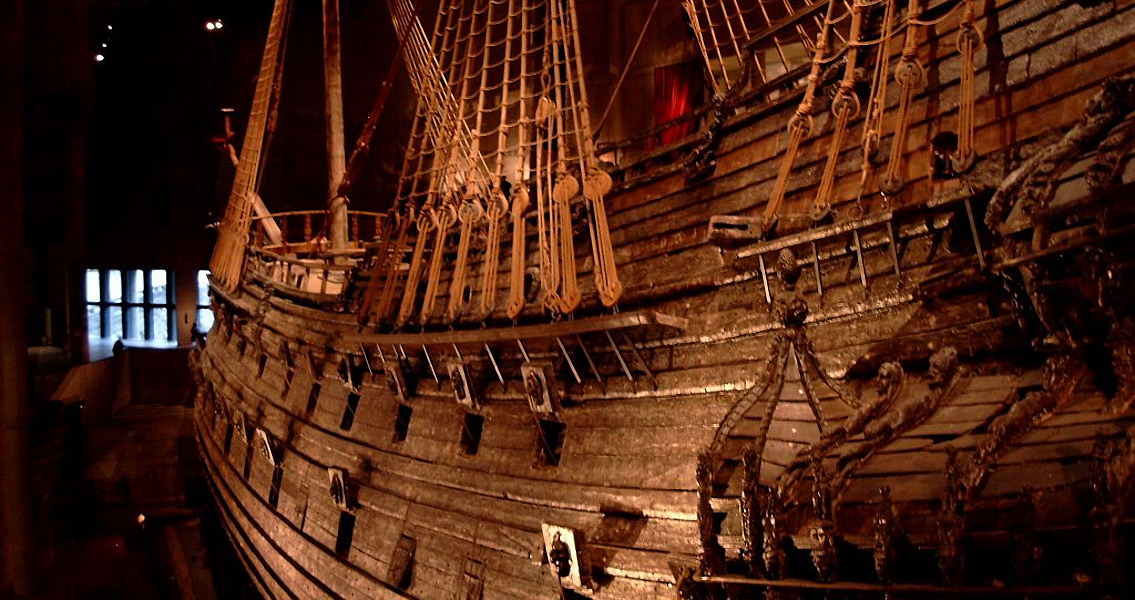
The Local, the ship is approximately 45 meters long and carried 68 or 70 cannon. Launched in 1682, it was the first ship ever built in Karlskrona, eventually ending up back where it started in 1713. A curator with the Swedish National Maritime Museums, Jim Hansson, explained in the article that the warship may have been sunk deliberately in order to utilize its cannon to defend the city during the King’s campaign against Russia, a campaign which would eventually lead to the ruin of the Swedish Empire, causing Karl XII to flee to the Ottoman Empire. The newly discovered ship is remarkably similar in size and age to the warship Vasa. The only ship from the seventeenth century to ever be salvaged practically fully intact, the 64-gun Vasa, which sank on her maiden voyage in 1628 and was salvaged in the 1960s, is on display at the world-famous Vasa Museum in Stockholm, Sweden. Opened in 1990, the Vasa Museum is reportedly Scandinavia’s most visited museum, with over 1.3 million visitors in 2016. The Vasa foundered after sailing approximately 1,300 meters into her maiden voyage. Built on the orders of Sweden’s King Gustavus Adolphus at the naval yard in Stockholm, she was armed mainly with bronze cannon which were cast specifically for the ship. Richly decorated, after completion, the Vasa was among the most powerfully armed ships in the world. However, she was also dangerously top-heavy and unstable, and yet despite her lack of stability the ship was ordered to sea. During the recovery process in 1961, thousands of objects and artifacts, along with the remains of fifteen people at a minimum, were discovered by marine archaeologists inside and around the ship’s hull, including weapons, clothing, cannon, coins, tools, cutlery and six of the ten original sails. These items, as well as the ship herself have provided researchers with invaluable information regarding naval warfare, shipbuilding and everyday life in Sweden in the early seventeenth century. The Blekinge, however, is far from being in good condition. A part of the ship seems to have been flattened when the stone pier at Karlskrona shipyard was constructed, although it’s possible the lower sections are better preserved. “Part of her is embedded in deep layers of sediment. We believe there could be a relatively in-tact level of deck under it. The ship’s not at all as well preserved as the Vasa, but the part which lies outside of the pier could be better preserved,” Hansson explained in the article. It’s likely that further research will be conducted on the shipwreck, given its historical significance as the first ship built at the Karlskrona shipyard, where a naval base is still located. The shipyard was established around 1680, at practically the same time as the city. It was a necessary facility due to heavy losses suffered by the Swedish navy in 1659. Areas of the city, consisting primarily of the Naval Port, have been declared a UNESCO World Heritage Site. ]]>
Categories
Breaking News

Two-Thousand-Year-Old Glass Workshop Discovered in Poland

Categories
Breaking News

Maya 'Superhighways' Revealed by LiDAR

Categories
Breaking News

5th Century Synagogue Discovered Under 12th Century Building

Live Science. Since 2012, three amazingly intricate and well-preserved mosaics which once decorated the floor of the older synagogue have been found at the Huqoq site during excavations led by Jodi Magness from the University of North Carolina at Chapel Hill along with Shua Kisilevitz from the Israel Antiquities Authority. The mosaics have since been removed for conservation. ]]>

Categories
Breaking News

The Lost Arthurian Kingdom of Rheged Discovered in Scotland

Categories
Breaking News

Researchers Discover Otzi the Iceman’s Last Meal

Science. ]]>

Categories
Breaking News

Termites, not a God, Created Africa’s Fairy Circles

Nature. ]]>

Categories
Breaking News

New Research Reveals Australian Megafauna Coexisted with People

Zygomaturus trilobus, discovered several decades ago may have finally provided the answer. Large and lumbering with big flared cheek bones (zygomatics), Zygomaturus was a marsupial generally the size of a large bull. Little is known about its ecology, or why it went extinct. Excavated on two different occasions during the 1980s, the animal’s upper jaw was shipped to the Australian Museum in Sydney where it was stored still surrounded by the original sediments. The lower part of the jaw is on display at Mungo National Park. Optically stimulated luminescence dating (OSL) was used to test the sediment samples, while the fossils were tested directly using uranium series (U-series) dating. The tests show the specimen died approximately 33,000 years ago. Aborigines arrived in the region about 50,000 years ago. The Zygomaturus specimen indicates megafauna and people coexisted for 17,000 years at least. In fact, the species appears to have lived until the dramatic climate change referred to as the last glacial cycle prior to the Last Glacial Maximum. This date of 33,000 years does not necessarily represent the extinction of Zygomaturus. The deteriorating climatic conditions could have made Willandra Lakes a refuge for both people and megafauna as the surrounding plains became drier, bringing species like the Zygomaturus into increased contact with people. Regardless, the fossil has caused a shift in the debate over megafauna extinction. The research has been published in the Quaternary Science Reviews journal. ]]>

Categories
Breaking News

Pendant Like the One Worn by Anne Frank Discovered at Sobibór

Telegraph. The organization is appealing to the public for anyone who has information regarding Karoline Cohn to contact IAA. They are also attempting to locate Sophie Kollman, a woman who, in 1978, submitted testimony about Karoline Cohn. ]]>

Categories
Breaking News

Military Complex in Israel Dates to the Reign of King Solomon

FoxNews article. “Only when the dates came back from the lab we were reassured that indeed these were the remains of stables and other activities from the time of David and Solomon.” The research highlights the early community’s sophisticated and refined defense system and trade links, demonstrating a connection with the distant Mediterranean region. In addition to moving food and materials back and forth from other regions, the donkeys housed at the complex would have been used as part of copper production. The fact that one of the biggest ancient copper smelting plants in the Timna Valley is located near the fortification is of particular importance. Ben-Yosef says in the article: “Until now we didn’t have evidence of military conflicts in the copper mines of Timna at this period. Moreover, they are in accord with the biblical accounts depicting wars between David and the Edomites who inhabited this region.” The archaeologist went on to add that given the hotly debated accounts between biblical historians, finding actual evidence is significant. Aviv University notes in a recently released statement that the fabled King Solomon mines are believed by some experts to be located somewhere among the Timna Valley ancient smelting camps. There is no clear description of “King Solomon’s mines” within the Old Testament, but there are references to military clashes between the Edomites (the descendants of Esau, Isaac’s firstborn son and Jacob’s twin brother) and Israel. Discovered in 1934, the copper smelting site in Timna Valley was first believed to be a slave camp dating to the Iron Age. This theory was debunked by Ben-Yosef along with his colleagues in 2014, when they analyzed organic clothing and material finds which indicated a sophisticated, hierarchical society. The research team intends to continue their exploration of the ancient societies in the Timna copper mine area. The research has been published in The Journal of Archaeological Science. ]]>