Categories
Breaking News

Stone Age Fences Discovered in Denmark Surround Mystery

Science Nordic. “The openings don’t seem to sit next to each of the post rows, and we’re slightly amazed by that. But maybe it functioned as a sort of labyrinth–at least that’s how we imagine it. That way you weren’t able to look inside the common space, which may have been an advantage.” Generally, a palisade type of construction is built for defense, however, the rows of poles at Stevns would have stood approximately two meters tall and were placed in a way that would have allowed a person to squeeze through, suggesting a gathering area. Numerous palisade enclosures have been discovered in Denmark and Sweden in recent years, with some of the most intriguing sites found on Bornholm, a Danish island in the Baltic Sea. In 1988 a large timber palisade (one of two on the island) enclosing a sun temple was excavated by archeologists at Vasagårds Field on the south side of the island. The Stevns site may have also had a ritualistic purpose. One difference between the Stevns site and the Bornholm palisades is that the poles at Bornholm are located much more tightly together. It’s also probable the Bornholm fences were built prior to the ones at Stevns. Dating analysis of the Stevns site is not yet complete, however, several of the pottery fragments found there indicate it may date to the latter half of the Middle Neolithic Funnel Beaker Culture between 2900 BCE and 2800 BCE. The Funnel Beaker culture draws its name from its characteristic beakers, ceramics and amphorae which were formed with funnel-shaped tops and found in dolmen burials. A dolmen is a type of megalithic tomb with a single chamber, which typically consisted of a flat horizontal capstone supported by at least two vertical megaliths. “We’ve unfortunately not found any circular shaped constructions like they have on Bornholm, but the similarities between the enclosures makes me think about rituals in our finds too,” Sloth says in the article. Image courtesy of Danish Geodata Agency / Pernille Rohde Sloth ]]>

Categories
Breaking News

Scientists Making Progress in Creation of Woolly Mammoth Hybrid Embryo

The Guardian. “Actually, it would be more like an elephant with a number of mammoth traits. We’re not there yet, but it could happen in a couple of years.” Already dubbed a “mammophant”, the animal would have numerous mammoth traits such as small ears, shaggy hair and blood that allows the animal to tolerate freezing temperatures. The existence of an actual mammophant however, is still years beyond the creation of an embryo. Future plans, which could take more than a decade to realize, are to grow the embryo in an artificial womb in a lab. The scientists believe their modifications can help the endangered Asian elephant, and help battle global warming by reducing the rate at which Arctic permafrost is thawing. As the permafrost thaws, the process of microbes consuming the organic material beneath it releases huge amounts of the greenhouse gas methane into the atmosphere. When herds of mammoths wandered the Arctic, they suppressed forest growth which in turn prevented the melting of permafrost. “They keep the tundra from thawing by punching through snow and allowing cold air to come in,” Church explained in the article, “In the summer they knock down trees and help the grass grow.” There are critics of the team’s work who consider the revival of extinct creatures to be filled with unpredictable consequences, such as the impact such an introduction would have on elephants and other animals. Regardless of the ethical considerations the team of scientists continues their work. They successfully grew a mouse embryo inside an artificial womb for 10 days, half of its 20-day gestation period. An elephant calf‘s gestation period is 660 days, making growing one a much more difficult feat. Professor Church recently spoke about his team’s progress trying to recreate the long-extinct mammoth’s genetic blueprint over the past two years at the annual meeting of the American Association for the Advancement of Science (AAAS) in Boston. ]]>

Categories
Breaking News

The First Gate Ever Found at a Jewish Town Named for Gates

Times of Israel. The town’s affluence could have served as a reason for the heightened security. Beit She’arim was the home to many prominent and wealthy Jews, so the community might have been named from the fortifications built to keep them safe. Another possibility is that it was the site of an important Roman fortress. Erlich and her team have plans to return and continue excavations at both Beit Zaid and Beit She’arim next season. ]]>

Categories
Breaking News

Volcano May Explain Mysterious 100-Year Maya Dark Age

Geology. ]]>

Categories
Breaking News

Veteran Archaeologist Discovers Temples in Northern Sudan

Categories
Breaking News

New Research Finds Map of Shogun’s Castle to be Among Oldest

Categories
Breaking News

Chinese Princess Bride and General Discovered Buried Together

Wenwu in 2015. This same article has now been translated into English and published in the journal Chinese Cultural Relics. In the journal article, the archaeologists also discuss the other tombs they found in the cemetery, noting that they excavated 69 tombs in total. The research team included members from the Shanxi Provincial Institute of Archaeology, the Shanxi University’s School of History and Culture, the Agency of Cultural Relics and Tourism of Jinyuan District, Taiyuan city, and the Taiyuan Municipal Institute of Cultural Relics and Archaeology. ]]>

Categories
Breaking News

Ovatiovermis cribratus – A New “Stand-Up” Species

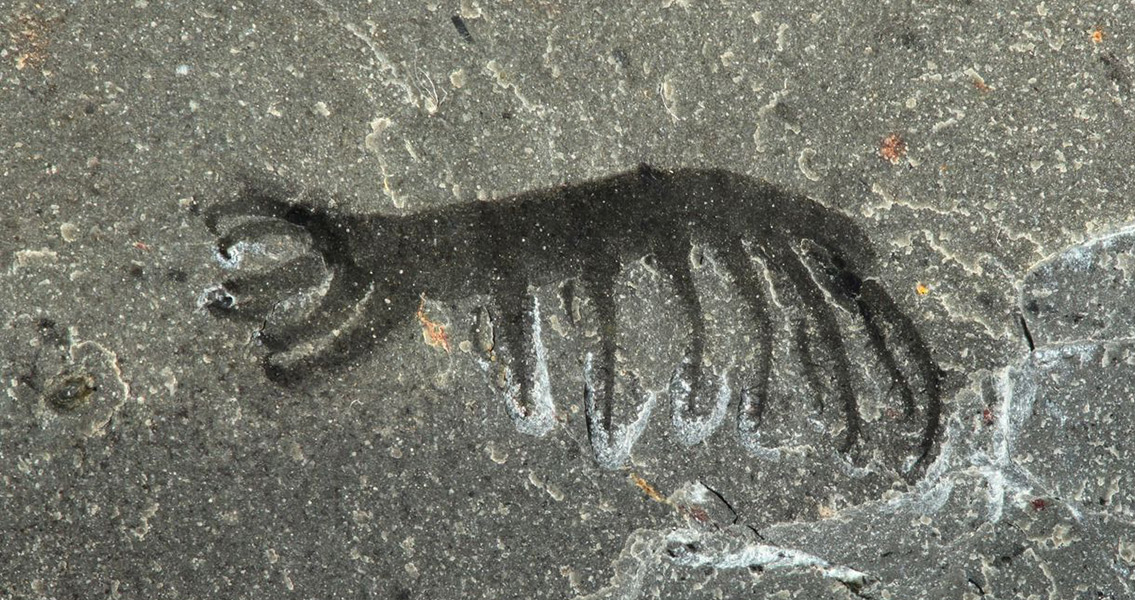
Ovatiovermis cribratus, a 500-million-year-old worm no bigger than a thumb and with leg-like appendages, has recently been identified as a new species. The fossil specimen resembles a flattened shrimp, but the tiny creature, a distant relative of arthropods and tardigrades, hung around in North America’s shallow seas eons before shrimp existed. Evolutionary biologists based their approximation of the worm-like creature on two fossils, the first discovered decades ago and a second which was found by a tourist in 2011 visiting the Burgess Shale. The Burgess Shale Formation, where both specimens were found, is a UNESCO World Heritage site known for its extraordinary deposit of marine fossils. The Formation, a former seafloor, is found in the Canadian Rockies of British Columbia and boasts more than just exoskeletons and bones. It’s also known for the exceptional preservation of the soft tissues of the fossils there. At 508 million years old, Burgess is one of the earliest fossil beds known to contain soft-part imprints. The rock formation is black shale and is visible at several locations near the city of Field, B.C., in Yoho National Park and Kicking Horse Pass – a high mountain pass on the border of Alberta and British Columbia. Another outcrop is located 42 km south, in Kootenay National Park. The Burgess Shale was discovered in 1909 by Charles Walcott, a paleontologist. He returned with his family in 1910 and established a quarry at Fossil Ridge. The importance of soft-bodied preservation, and the wide range of organisms Walcott recognized as being new to science, caused him to return to the site numerous times until 1924. By 1924, at age 74, Walcott had collected more than 65,000 specimens. The name, Ovatiovermis cribratus, stems from how researchers believe the creature fed. Ovatiovermis because it’s thought the creature stood up on the seafloor, in an ongoing standing ovation of sorts, and cribratus in reference to the way it may have sieved passing water in order to collect food. Lobopodians (meaning “blunt feet” in Greek) are worm-like organisms with stubby legs. “Lobopodians have mostly been seen so far as an eclectic group. We think that suspension feeding was common among them and turned out to be important in the initial ‘burst’ of that colossal group that gave rise to water bears, velvet worms and arthropods,” Cédric Aria, a co-author of the recently published study, said in a statement. Other animals, the skeleton shrimp for example, have comparable eating patterns. The Burgess Shale Formation and its fossil-carrying deposits correlate to the Stephen formation, a collection of dark mudstones approximately 508 million years old. The beds holding the fossils were deposited at the bottom of a cliff that was around 160 meters tall, deep enough to be below the agitation caused by waves during a storm. Originally it was believed the Burgess Shale was set down in anoxic conditions, ongoing research, however, suggests oxygen was present on a continual basis. Ovatiovermis cribratus was identified in an article recently published in BMC Evolutionary Biology. Photo courtesy of Jean-Bernard Caron—Royal Ontario Museum ]]>

Categories
Breaking News

Tomb of an Egyptian Scribe Accidentally Discovered in Luxor

Categories
Breaking News

Uprooted Trees Reveal Historical Artifacts in Savannah