Categories
Breaking News

Homo Habilis Were First Out of Africa

Homo erectus as long believed, but a smaller species, Homo habilis, also called Handy Man, Discovery News writes. The senior author of the study told the website that the Homo habilis species was characterised by more ape-like features than previously thought, such as climbing besides walking on two legs, but also had some features characteristic of modern humans; such as a large brain, and tool-making skills. It was, however, shorter than Homo erectus: a more muscular species more closely resembling modern man. Using the huge dataset, Mark Collard, who is professor at the Human Evolutionary Studies Program of Simon Fraser University, and his team compared a number of alternative evolutionary trees and looked into how well each tree fit in with the dataset. There were three possible outcomes: either the tree was inconsistent with the dataset and was hence rejected, it was partially consistent, or it was fully consistent with the dataset. Based on what they found from the comparisons, the researchers suggest that Handy Man went into Asia and Europe from Africa and somewhere in Asia it gave rise to Homo erectus. Collard explains that the ‘Upright Man’ then went into Africa, a bold suggestion in the face of current consensus but backed by evolutionary data, apparently. The little Handy Man was also the ancestor of another species, this time even smaller: the Homo floresiensis, the ‘Hobbit Humans’ who were thought to have been nothing more than physically deformed humans. In fact, according to the theory of Collard and his team, H.floresienis were a separate species that inhabited the island of Flores in Indonesia. As to where the first modern human originated, Collard says this most likely happened in South Africa. He told Discovery News that “The fact that Australopithecus sediba [a two-million-year-old fossil] groups with Homo is consistent with the idea that the earliest known representative of the genus Homo originated in South Africa.” Another interesting conclusion of the team was that the Neanderthals were almost certainly a species exclusive to Eurasia; there was no evidence that its representatives had ever been in Africa. At the same time the researchers were unable to establish the immediate ancestor of this species, as scientist before them had been unable to trace back the origins of other hominin species from the Middle Pleistocene. Collard said he hoped his team’s findings would encourage further research by other scientists in South Africa, China, and Southeast Asia, where some of the oldest known human fossils have been unearthed. Asked by Discovery News to comment on the study, the director of New York University’s Center for the Study of Human Origins, Terry Harrison, said it would definitely fuel a debate among palaeoanthropologists, hardly a surprise given the way it challenges long-held beliefs in the area. Another commenter, human origins professor Bernard Wood from George Washington University, said the team who did the study had made an important step in furthering our understanding about evolution, which he called “superficial” at present. Image courtesy of Wikimedia Commons user: Royroydeb ]]>

Categories
Breaking News

Tiger Hunting Strategy As Old As Tigers Themselves

Leptobos brevicornis, a large, now extinct bovine weighing up to 300 kilos, with pointed horns. On the fossil there are three traces of sharp teeth, one even piercing the almost 8-cm bone clean through. At first, Li said, speaking to the South China Morning Post, he thought the hole in the bone came from a missing tooth of the bovine but closer inspection showed that it had the full set of teeth on its lower jaw. The researcher was also able to establish that the traces were not caused by anything else but a predator’s teeth. Using teeth samples from large cats that are known to have lived in the area around the time tigers emerged as a species, including a sample from a tiger ancestor, the Panthera palaeosiensis, Li determined that the hole in the mandible must have come from such an animal. According to Li’s mentor, Deng Tao, researcher at the Laboratory of Vertebrate Evolution and Human Origins, this could be the only fossil of a tiger bite. Based on the location of the bite marks, Li came to the conclusion that tigers’ hunting strategy has been the same for the last two million years. “This is like playing the Hunger Games for more than two million years without bothering to change the strategy,” he told the South China Morning Post. Such a consistency is truly remarkable and perhaps proof of the strategy’s efficiency. Modern tigers are the largest member of the feline family but they tend to hunt prey that is larger than themselves. In order to be able to quickly subdue its victim, a tiger targets the head and neck, a strategy well documented by feline researchers. However, it has only been documented for modern representatives of the tiger family, and fossil records tend to be scarce, notes Deng, as they are so far only available for hyenas and bears. As to whether the bite of that ancient tiger was instantly lethal, Li and Deng cannot say with certainty. It is possible that the bovine lived for a while after the attack but not long, as the bite marks showed no signs of healing. Now the fossil will be subjected to further examination aiming to determine, among other things, the force of the bite. This could be inferred from the cracks inside the bone, but has so far proven impossible to do using CT scanning because of the sheer size of the fossil. Image courtesy of Wikimedia Commons user: Dick Mudde]]>

Categories
Breaking News

Did Tectonic Plate Movement Drive Evolution?

“Cycles of nutrient trace elements in the Phanerozoic ocean” Image courtesy of Wikimedia Commons user: US Geological Survey]]>

Categories
Breaking News

Rare Roman Mural Found in Arles

Categories
Breaking News

Sponge Discovery Questions Cambrian Explosion

Eocyathispongia qiania. The information provided through these methods was sufficient for the team to determine that the fossil had a number of characteristics in common with sponges from the Cambrian, characteristics that were until now thought to have only emerged during the explosion period. Bottjer told Phys.org that the sponge had already developed “fundamental sponge traits” 60 million years before the beginning of the Cambrian explosion, which meant that the majority of “developmental genes” for sponges were already present at the time. The obvious implication is that evolution was more gradual than believed, causing a rethink of the dating of early animal evolution. What’s perhaps even more fascinating is that the genes in the sponge fossil are present to this day in a variety of animals up to and including us humans. Bottjer added that in the future, the relatively new discipline of palaeogenomics will come to play an increasingly prominent role in research thanks to modern technology. Palaeogenomics focuses on the evolution of genes, determining when this or that gene first appeared in an organism. Until now, the fossil record came from bigger animals, but with SEM and synchrotron microscopy, it is likely that a host of previously unknown stages in evolution will be revealed. For more information: “Sponge grade body fossil with cellular resolution dating 60 Myr before the Cambrian” ]]>

Categories
Breaking News

Bronze Age Gold Threads Unearthed in Denmark

Categories
Breaking News

Medieval Skeleton Speaks of Towton Bloodshed

Categories
Breaking News

Fire Made Scavenging Safer for Early Humans

chimpanzees have also been found to have a preference for cooked meat. For more information: “The significance of cooking for early hominin scavenging” Image courtesy of Wikimedia Commons user: Alina Zienowicz Ala z ]]>

Categories
Breaking News

13th Century Mummy Found in Siberia

Categories
Breaking News

Fossil Confirms Tropical Climate in North America

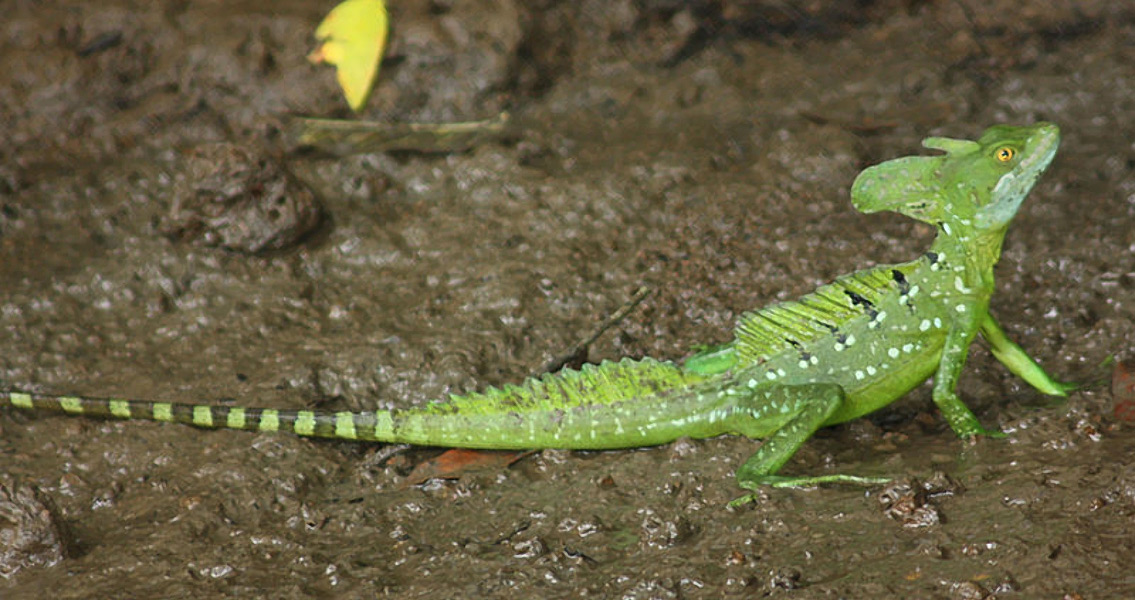
Babibasiliscus alxi and suggested it may have been the first representative of the Jesus lizard family. He said in a press release the lizard was probably active during the day and lived mostly in trees. A bone ridge on the top of its head provided shade from the sun and at the same time probably made it look constantly angry. It had small teeth that ended in three points, suggesting its usual diet included anything from snakes and other lizards to fish, insects, and even plants. However, it also had wide cheekbones, so it is possible that it ate larger animals as well. The basilisk family, which also includes chameleons and iguanas, is among the least studied representatives of the reptile world because there are not many fossils that scientists can study. Today these lizards live across North America, in Central America and as far down south as Ecuador. They are collectively called casquehead lizards, or helmeted lizards, because of the ridge they have on their heads – in some species on just the males, and in others on both females and males. In naming this ancient ancestor of today’s Jesus lizards, Conrad said he had honored an indigenous people from Wyoming, the Shoshone, in whose language “babi” means cousin; pointing to the kind of genetic relationship the ancient species has to modern-day Jesus lizards. These reptiles are called that because of their ability to run across the surface of water over short distances. Based on the fossil record it has previously been suggested that at some point, around 50 million years ago, mid and even high latitudes were characterised by tropical climate but as the weather started cooling down, these heat and humidity loving species moved south. According to Conrad, any evidence of these developments can be useful for the future as it may, he says, “give us an idea of what to expect from our dynamic Earth”, especially at this point in time, when the planet is undergoing another period of global warming. For more information: “A New Eocene Casquehead Lizard (Reptilia, Corytophanidae) from North America. Image courtesy of Wikimedia Commons user: Charlesjsharp]]>