

Homo species has just got more complex, with two scientists suggesting fire use contributed to our rise and the Neanderthals’ fall. Anna Goldfield, an archaeologist from Boston University, and Ross Booton, a mathematical biologist from Sheffield University, looked into this particular aspect of Neanderthals’ lives and discovered that even though fire was not completely unfamiliar to them, they definitely did not use it as consistently as modern humans. Although signs of fire use have been found at Neanderthal sites across Europe, they are scarce, suggesting fire was more of an occasional blessing than a fact of life. How did this impact the survival chances of the Neanderthals? By depriving them of a more wholesome calorie intake and safer food. Cooking is one of the best ways to rid food of harmful bacteria, parasites, and viruses, making it considerably safer to eat than when raw. Another major advantage of cooking is that it increases the amount of “processable” protein, and protein is indispensable for survival. So, according to Goldfield and Booton, who used mathematical models to try and detect a link between frequency of fire use and survival rates among both Neanderthals and modern humans, the former lived for hundreds of thousands of years in Europe without resorting to the use of fire on a regular basis. Modern humans, however, had mastered the element and made good use of it for warmth and cooking. The models revealed that this had a significant impact on survival chances. A mathematical model stipulating that modern humans used fire consistently while Neanderthals did not, yielded a gradual rise in the modern human population and a decline in Neanderthal numbers. A model which stipulated that the two species used fire with a similar frequency yielded no significant difference in their survival chances. Since we already know for a fact that the Neanderthals went extinct relatively soon after modern humans came on the European scene, the first model seems to be a more accurate reflection of reality. Further support for the “fire mastery hypothesis” comes in the different nutritional needs of Neanderthals and modern humans. Neanderthals were bulkier than us and needed a higher calorie intake to survive. Modern humans could survive with less. So, by mastering fire and cooking, the human populations expanded and, according to the mathematical models, consumed a larger share of the reindeer population (a crucial source of calories for both humans and Neanderthals, 40,000 years ago). Neanderthals were therefore left with scarcer access to a food source that they needed in larger quantities than humans. This latest research is further support of a more general theory that it was shrinking resources that spelled doom for the Neanderthals. This shrinking was not just due to the appearance of modern humans, however. Earlier studies have suggested that climatic factors reduced the amount of available sustenance. These, coupled with the mastery of fire characteristic of modern humans, may well have contributed to the demise of the Neanderthals, by restricting their access to the resources they needed to survive. Image courtesy of Wikimedia Commons user: Dirk Beyer]]>


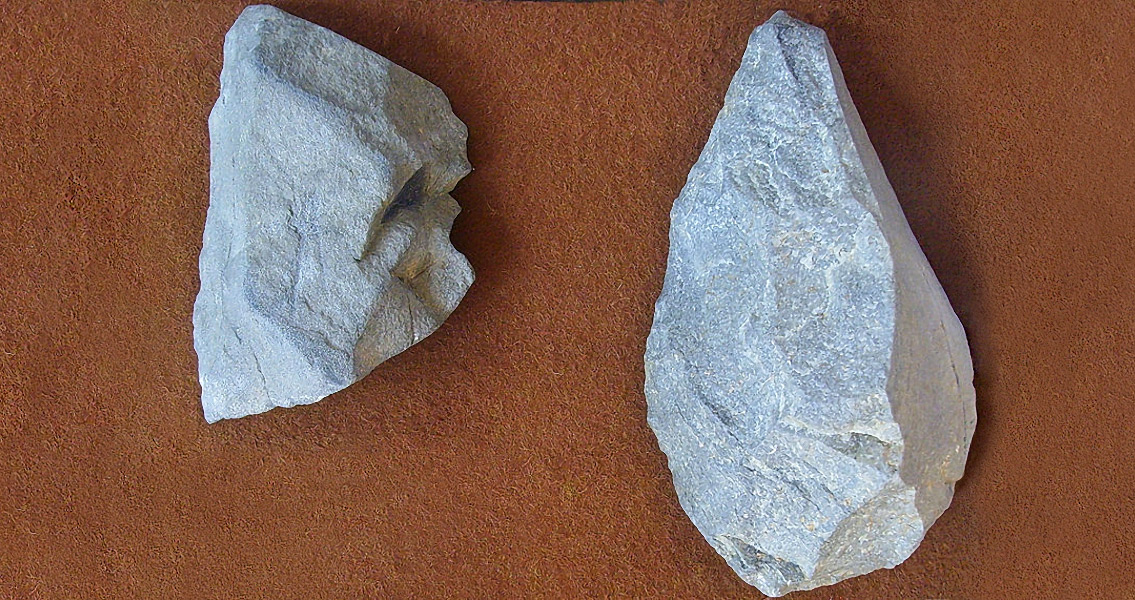


Homo genus was not the first species to discover how to do this. Lead researcher Sonia Harmand, an archaeologist at Stony Brook University, said the team found the site, near lake Turkana in northern Kenya, by accident four years ago after taking a wrong turn. They noticed several stone tools on the surface of the earth, and got digging. Their work yielded 20 more artefacts that were underground, and as many as 130 on the surface. These included cores – chunks of rock from which pieces are chipped to make tools, anvils and flakes (small pieces of stone used as tools). According to Harmand, the pieces bore marks of deliberate manipulation, so they could not have been the result of accidental fracture. The artefacts were well preserved in the sediment, so the researchers were able to date them quite accurately. One of the pieces was so well preserved that it could be fitted back to the core from which it had been chipped with the help of an anvil. As for the genus which made and used these tools, Harmand said she believed it had been either the Kenyathropus or the Australopithecus. The former was a species discovered in the same area, near lake Turkana, in 1999. The fossil was dated to between 3.2 and 3.5 million years ago, and is considered to be evidence of the diversity of pre-Homo species. The Australopithecus’ most famous representative is Lucy, the incomplete female skeleton discovered in the 1970s in Ethiopia, which supplied science with a lot of information about our early ancestors. One other interesting implication of this discovery is related to an earlier study, from 2010, when archaeologists working in Ethiopia unearthed a 3.4-million-year-old hominin child fossil, along with animal bones bearing what the authors of the study claimed were deliberate markings. The study was received sceptically, given the gap in time between what was until then considered the oldest known human tools, but now, thanks to Harmand’s team, its credibility could rise. According to the authors of the earlier study, the Australopitheci used stone tools to deflesh their prey and break the bones to get to the marrow. Both finds are evidence that technology played a major role in hominin evolution even at these early stages and, says anthropologist Alison Brooks from George Washington University, was a driver for the emergence of the Homo genus. Harmand’s team has now proposed a special term for these tools: Lomekwian technology, after the name of the excavations site, Lomekwi 3. Image courtesy of Wikimedia Commons user: John Atherton]]>