Categories
Breaking News

Unique Mosaics Found in Synagogue in Galilee

Livescience in July 2012 that the synagogue had likely been the only place of worship in the small village of Huqoq. She explained that the lavish designs of the synagogue would have been unusual for such a small village, suggesting Huqoq could have been a particularly affluent place. Magness and the other scholars working at the site are currently trying to work out why the synagogue featured the prominent, non-secular mosaic. Further excavations at the site are scheduled for summer 2016. For more information: www.uncnews.unc.edu Image Courtesy of Wikimedia Commons user: Jim Haberman ]]>

Categories
Breaking News

Excavation of Crashed WWII-Era Fighter Plane Begins

Categories
Breaking News

Study Models Effects of Climate Change on Population in LGM

Proceedings of the National Academy of Sciences of North America (PNAS) last week, the study by Miikka Tallavaara, Miska Luoto, Natalia Korhonen, Heikki Järvinen and Heikki Seppä deployed ethnographic and climate data to model population sizes during the LGM. An understanding of past human population sizes and densities is hugely important in studying prehistoric cultural and genetic development, the impacts of climate change, and the effects humans have had on ecosystems, and other species. As the study authors explain, large groups of interacting humans experience different cultural and genetic evolution compared to smaller, seperated groups. “Large pools of interacting individuals can create and maintain adaptive skills, as well as phonological variation, more effectively than small populations, and they are also capable of faster cumulative cultural evolution. A decrease in population size may even result in a loss of complex cultural traits.” Despite the significance of prehistoric population history however, it has hitherto remained difficult to reconstruct. Previous attempts to model population size have used archaeological and genetic data, methods the study authors argue make it “extremely difficult to meaningfully compare DNA-based population reconstructions with the records of cultural or environmental changes.” The authors of the study used recent developments in climate envelope modelling, which allow estimates to be made about the suitability of the climate to maintain a species population, to simulate the development of hunter-gatherer populations during the climate change of the LGM. According to their simulation, the population size shrunk from 330,000 people 30,000 years ago to a minimum of 130,000 people 23,000 years ago, as the LGM reached its coldest, most uninhabitable point. The human population in Europe then began to increase, and by 13,000 years ago had reached 410,000 people. Although the general trends in population size from the simulation match those offered by archaeological evidence, the authors point out that their work suggests the population of Europe was substantially higher during the LGM than is typically thought. One explanation offered by the team for this anomally is that the archaeological evidence provides an incomplete representation of population dynamics. The size of the archaeological record varies between different places and time, and can be affected by different rates of erosion and decay. The study concludes that even during the harshest period of the LGM, 36% of the continent remained inhabitable for humans. The conclusions the study makes about population dynamics could be hugely beneficial for future studies of human’s genetic and cultural evolution. For more information: www.pnas.org Image courtesy of Wikimedia Commons user: Christine Zenino]]>

Categories
Breaking News

Rare Roman Mural Found in Arles

Categories
Breaking News

Sponge Discovery Questions Cambrian Explosion

Eocyathispongia qiania. The information provided through these methods was sufficient for the team to determine that the fossil had a number of characteristics in common with sponges from the Cambrian, characteristics that were until now thought to have only emerged during the explosion period. Bottjer told Phys.org that the sponge had already developed “fundamental sponge traits” 60 million years before the beginning of the Cambrian explosion, which meant that the majority of “developmental genes” for sponges were already present at the time. The obvious implication is that evolution was more gradual than believed, causing a rethink of the dating of early animal evolution. What’s perhaps even more fascinating is that the genes in the sponge fossil are present to this day in a variety of animals up to and including us humans. Bottjer added that in the future, the relatively new discipline of palaeogenomics will come to play an increasingly prominent role in research thanks to modern technology. Palaeogenomics focuses on the evolution of genes, determining when this or that gene first appeared in an organism. Until now, the fossil record came from bigger animals, but with SEM and synchrotron microscopy, it is likely that a host of previously unknown stages in evolution will be revealed. For more information: “Sponge grade body fossil with cellular resolution dating 60 Myr before the Cambrian” ]]>

Categories
Breaking News

Polish Researchers Discover Ancient Egyptian Burial

Categories
Breaking News

Bronze Age Gold Threads Unearthed in Denmark

Categories
Breaking News

Scientists Examine Sunken Radioactive Aircraft Carrier

Categories
Breaking News

Medieval Skeleton Speaks of Towton Bloodshed

Categories
Breaking News

Computer Imaging Reveals Secrets of Ancient Skull

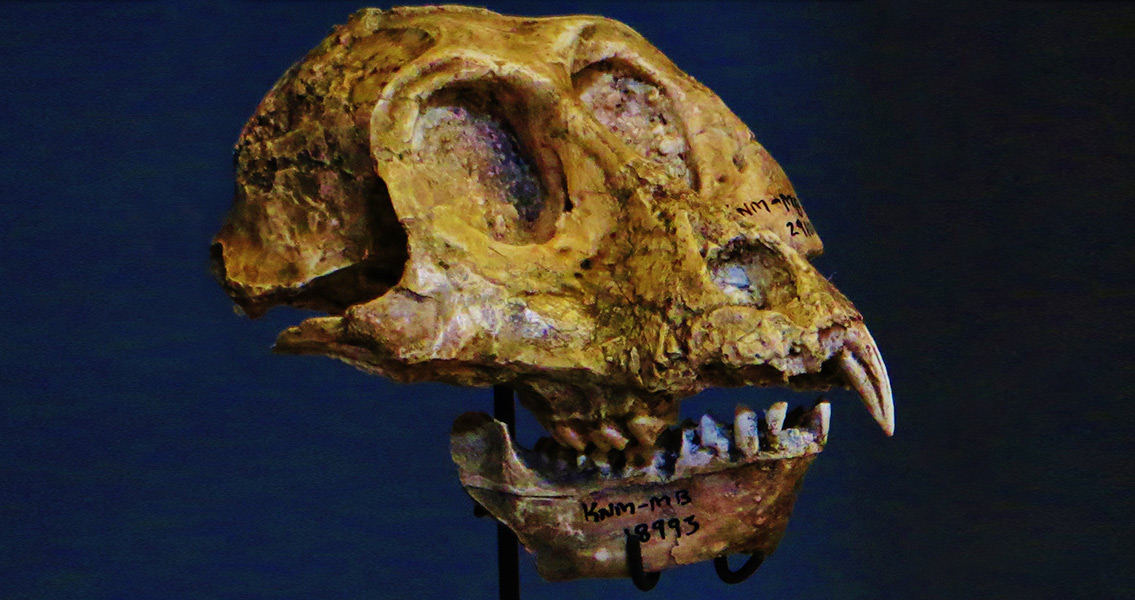
Victoriapithecus, an ancient monkey species that has evolutionary links to macaques, baboons, and other smaller primates in the family, once roamed Africa at a time when humanity was still spreading across the globe in tribes of hunter-gatherers. The skull of this particular monkey was discovered in Kenya on an island in the middle of Lake Victoria in 1997. So far, the skull is the only evidence that the monkey species ever existed, as there have been no other Victoriapithecus remains found since. An extremely rare find, the Victoriapithecus skull is one of the few remains of early primates that have survived to the modern day. The skull represents an unprecedented opportunity for scientists to delve into the secrets of early primate brain development – and by extension the brain development of early humans, which share an evolutionary link not just to Victoriapithecus but to all primates thanks to our shared ancestry. An international research team from the Max Planck Institute for Evolutionary Anthropology in Germany and Duke University in the United States used high-resolution X-rays to construct a 3D model of the brain of Victoriapithecus. The scientists discovered that the long-extinct monkey’s brain was around half the size of a modern monkey’s living today – only around 36 cubic centimeters – but despite the difference in size the level of complexity of the Victoriapithecus brain was quite high, as the folds and wrinkles in the monkey’s brain were tightly grouped. In a press release accompanying the publication of the team’s findings in the journal Nature Communications, study co-author Lauren Gonzales said that accepted academic thought had been that the size of primate brains grew before adding additional folds and complexities. However, the imaging of the Victoriapithecus brain has revealed the reverse, providing some of the clearest proof that in this case the complexity came before the size of the primate brain evolved to become bigger. The research may also be able to aid in backing up the claims that Homo floresiensis, a humanoid primate species dating from at least 18,000 years in the past, was able to use stone tools and make fire despite having relatively small brains for their body size. Additional discoveries made by the research team include that the monkey species had an olfactory bulb, the region of the brain that controls smell, that was around three times larger than it was expected to have been. This led the team to suggest that Victoriapithecus had a highly developed sense of smell – one that might have been better than its modern living cousins have today. For more information: www.nature.com Image courtesy of Wikimedia Commons user: Ghedoghedo]]>