Categories
Krakatoa Eruption Starts

Natural History and one of Rome’s most learned men when it came to nature, continued relaxing in his home close to Pompeii despite noticing a massive plume of smoke billowing out of the mountain. Pliny the Younger had noticed the earth tremors in the preceding weeks, but casually noted in his account that they “…were not particularly alarming because they are frequent in Campania.” Lasting for twenty four hours, the few who realised the danger of the eruption had the chance to escape the danger zone. For several hours a rain of ash and pumice fell on the area surrounding the mountain, causing many, including the elder Pliny, to take shelter in their residences. Just after midnight on the 25th a pyroclastic flow from the volcano engulfed Herculaneum, annihilating the town and causing any survivors to flee towards Pompeii. Several hours later, on the morning of the 25th, Pompeii itself was also destroyed as a cloud of volcanic gas and debris rolled down the slope of the mountain and smothered the city. Buildings were smashed by pyroclastic waves, while people fleeing the eruption or sheltering under roofs were killed instantly. Exact casualty figures for the eruption are impossible to tell, as the corpses that archaeologists study today represent only a small sample of the total. Towns, villages and countryside from the south of Vesuvius all the way to the Sorrentine Peninsular, some 20 km away, were devastated by the eruption. The Romans wouldn’t rebuild or repopulate the area destroyed by the eruption. The site of Pompeii was left to be sacked by looters, who tunneled holes into the city’s buildings to steal any valuables that had survived. The eruption affected the Bay of Naples as a whole, although Naples itself and other settlements on the northern bank of the bay were either hardly impacted upon, or recovered quickly, it led to a decline for Naples as a vacation location for the wealthiest of Roman society. Image courtesy of Wikimedia Commons user: Glmike523 ]]>

reinterment earlier this year. Accounts from the time claim that Richard was slain in the battle before his naked body was taken to Leicester to be buried. Since the discovery, detailed examination of Richard’s body has allowed forensic archaeologists to gain a better understanding of the events leading to his death. It has also helped form a better image of the man himself, dispelling some myths which originated in the aftermath of the battle and were probably a consequence of the victors trying to discredit their former enemy, and challenging the portrayal given in Shakespeare’s play, Richard III. The Wars of the Roses had started thirty years before, at a battle in St. Albans. Richard of York led a force of some 3,000 men against King Henry VI on 22nd May, 1455. A number of factors had contributed to the outbreak of the war: Henry’s descent into insanity, the perceived dangerous influence of his wife Margaret of Anjou, and a growing class of powerful magnates in the countryside who increasingly ignored the authority of the king. A sporadic war waged between the Houses of York and Lancaster which ultimately ended with a Yorkist victory, and Richard of York winning the right to inherit the throne on Henry’s death at the expense of his son Edward. Continued conflict over the rights to the throne meant that the York victory over Henry in 1460 was not decisive, and the Wars of the Roses would continue until the Battle of Bosworth Field. Richard III took the throne amid much controversy in July 1483. He had been named Lord Protector of the realm for his twelve year old nephew Edward V earlier in the year, following the death of this brother Edward IV. Before Edward V could be crowned, the marriage of his parents was declared invalid, making their child ineligible for the throne. As a result, Richard assumed the English crown with backing from the House of Lords, and rumours began to circulate that Edward V and his brother Richard of Shrewsbury had been killed on Richard III’s orders. Henry Tudor spent the weeks before August 22nd creating an army to attack Richard III. The first months of Richard’s reign had seen him alienate both Lancastrians and his fellow Yorkists, leading to a growing clamour for the Lancastrians to depose Richard. Knowing his forces would be heavily outnumbered by the king’s armies, Henry turned to the King of France, Charles VIII, and the powerful South Wales landowner, Rhys ap Thomas, to provide soldiers to bolster his forces. In addition, Henry contacted his stepfather Lord Stanley, who secretly donated finances to fund Henry’s cause. Henry’s forces landed at Milford Haven on August 1st, and began their march towards England, collecting the soldiers offered by Rhys ap Thomas along the way. Richard III underestimated the amount of support he had in Wales, and realising that the Welsh would not attack Henry’s army, set forth with his troops to intercept them. Meeting near Leicester on 22nd August, Henry had an army of only around 5,000, compared to Richard’s force of some 12000 men. Few first hand accounts of the battle remain, but it seems that the course of the fighting was swayed when Lord Stanley sent his troops into the battle in aid of Henry. Richard had not called on the powerful Stanley family to join in the battle and their substantial armies, although close to the fighting, had initially remained uninvolved. What caused Lord Stanley to send his troops in, aiding his stepson and betraying the king, is unclear. It proved decisive however, Richard’s armies were caught be surprise, and the king killed in the ambush. Henry was crowned Henry VII in the aftermath, and his marriage to Elizabeth of York the following year united the Lancastrian and Yorkist claims to the throne – ending the Wars of the Roses and signaling the start of one of England’s most famous dynasties. ]]>


Proceedings of the National Academy of Science, Christian Meyer, Christian Lohr, Detlef Gronenborn and Kurt W. Alt argue that the mass grave is adding to the continued reappraisal of the extent of warfare and violence in Central Europe during the early Neolithic. An extensive study of the mass grave in Schöneck-Kilianstädten has shown that twenty six individuals buried there were killed by either blunt force or arrow injuries. The bodies were then thrown into a commingled mass grave. Significantly, according to the authors, the grave demonstrates “a pattern of intentional mutilation of violence victims.” There is clear evidence among the remains of the mass grave of an intentional, sytematic breaking of the victims’ lower limbs. Half of the skeletons had perimortem fractures, according to the study authors, suggesting the victims were either tortured shortly before death or mutilated afterwards. Such a pattern of violence has not been observed before at Neolithic sites. The fact that the remains were scattered around, seemingly randomly, is also unusual. In other Linear Pottery burials each person was given their own grave within a graveyard. Bodies were often carefully buried alongside grave goods such as possessions or pottery. The researchers take this as evidence that Schöneck-Kilianstädten must have been the site of a massacre where normal burial rites and customs were abandoned. Taken alongside other Neolithic massacre sites in central Europe at Talheim, Germany, and Asparn/Schletz, Austria, the team believe the mass grave at Schöneck-Kilianstädten adds to the mounting evidence of moments of extreme mass violence towards the end of the Linear Pottery Culture. “The new evidence presented here for unequivocal lethal violence on a large scale is put into perspective for the Early Neolithic of Central Europe and, in conjunction with previous results, indicates that massacres of entire communities were not isolated occurrences but rather were frequent features of the last phases of the LBK (Linear Pottery Culture).” Sometimes referred to as the New Stone Age, the Neolithic was a period defined by the development of new stone technology. It also saw farmers migrate west from Anatolia (what is now Turkey) into Europe, displacing the nomadic people and fishermen who had inhabited the continent previously. Settlements and communities sprung up across the continent as people built houses, cultivated land and started to decorate pottery. The extent to which these early settlements were blighted by conflict and violence however, has remained unclear. The end of nomadic lifestyles could have created increasing competition between different communities for access to the best land, rivalries which may have been intensified through climate conditions such as drought. The excavation of the Schöneck-Kilianstädten site has added crucial evidence to the study of large scale violence in the Linear Pottery Culture. The discovery, along with the other sites in Germany and Austria, has allowed researchers to start piecing together the nature, extent, and causes of warfare in the Central European Neolithic. For more information: www.pnas.org Image courtesy of Wikimedia Commons user: Joostik ]]>

www.pnas.org]]>

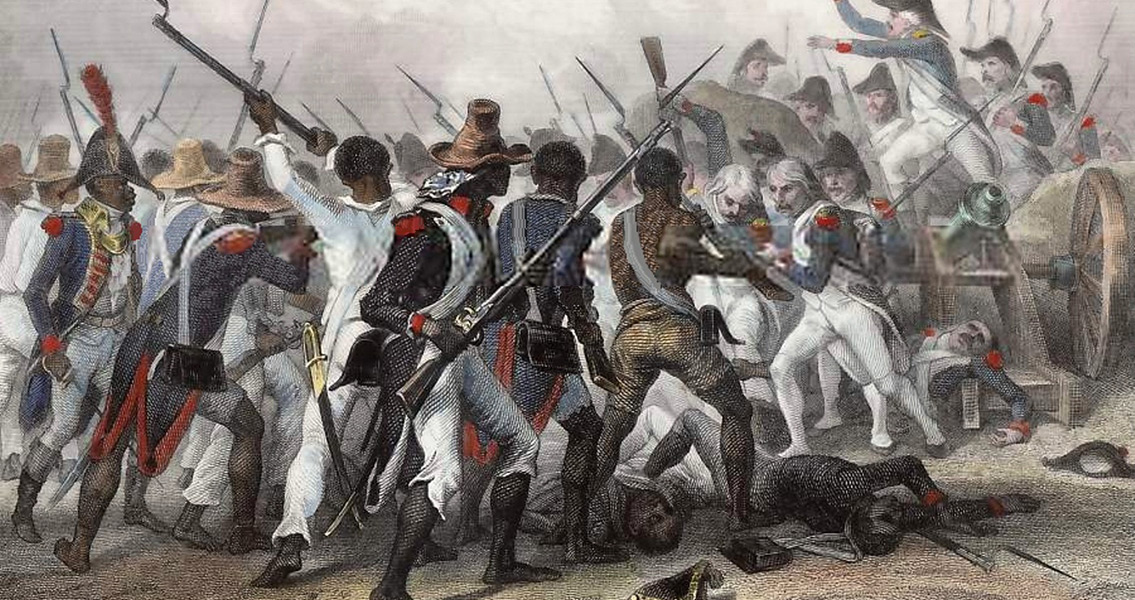
petit blancs, something akin to a white middle class comprised of artisans, teachers and shop keepers there to provide services for the rich white landowners. Among Saint Domingue’s black diaspora, slaves undoubtedly made up the majority. However, there were also a substantial amount of freed slaves, who often had wealth at a similar level to that of the petit blancs. Alongside them were an unusually large amount of escaped slaves who had successfully fled into the forests and mountains, highlighting that Saint-Domingue had a long history of defiance among its slave population. Bands of runaway slaves had long carried out a campaign of guerrilla warfare against the plantation owners, seeking vengence for their mistreatment and stealing supplies of weapons and vital provisions. One of the most infamous rebellions, led by the supposed voodoo sorcerer François Macandal, lasted for six years from 1751 to 1757 and left around 6,000 people dead. Changing ideas of liberty and the rights of man which had formed in the wake of the French Revolution started to influence opinion in Saint-Domingue, with the white population seeking to maximise their profits with freedom from France, and the black population inspired to win equality and freedom from slavery. Of particular concern were debates in France to abolish slavery at home and abroad, something the white planters were inevitably against. In this complicated mix of differing interests that Saint-Domingue had become, it was the massive slave population that was the first to act. At a gathering of 200 slave leaders at the Bois Caiman ceremony on 14th August, 1791, Boukman, an influential voodoo leader, declared that it was time for the slaves to rebel and seize their freedom. Eight days later the uprising, led by Toussaint l’Overture, started. A coordinated action in the north of Saint Domingue saw hundreds of slaves rebel against their owners and march through the island capturing and liberating other plantations. By 1792 the slave rebellion had gained control of a third of Saint Domingue. The white plantation owners were isolated, and even reinforcements sent from France were unable bring the rebellion under control. By 1798 the rebellion had survived both French attempts to quell it and a British attempt to colonise the island. Two years later the Haitian Revolution expanded into the neighboring colony of Santo Dominigo (what is today the Dominican Republic). Toussaint declared himself governor of all of Hispaniola, and abolished slavery across the island. Following a failed attempt by Napoleon’s armies to retake the former colony, Haiti was declared an independent republic in 1803. ]]>