

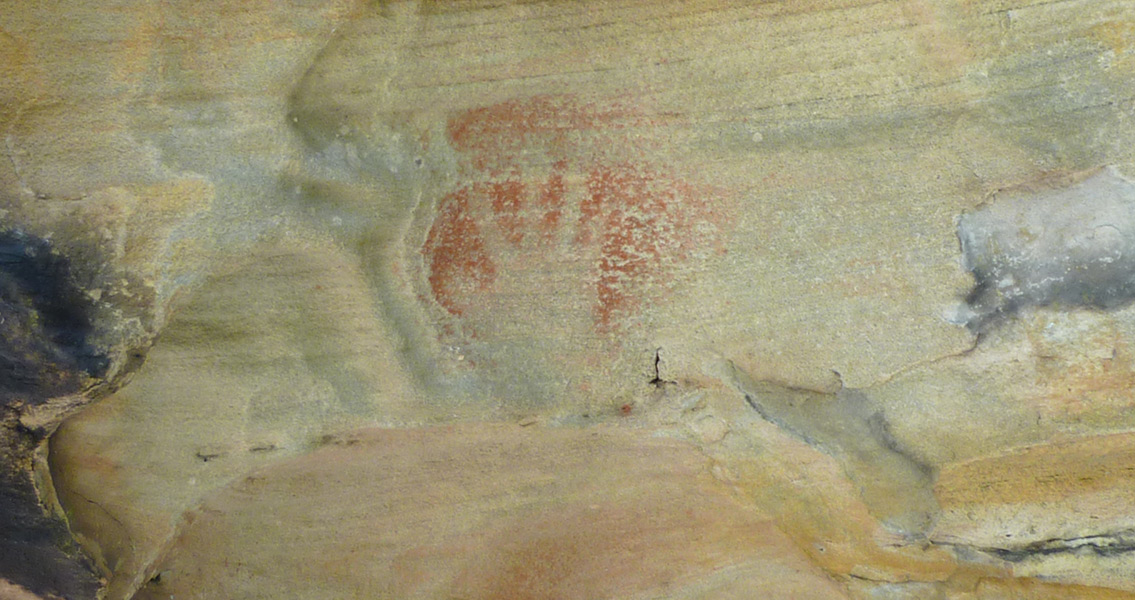
Phys ORG: “Archaeologists are interested in hand stencils because they provide a direct, physical connection with an artist living more than 35,000 years ago. Now, using a new experimental application, results from our study indicate it is possible to determine with more than 90% accuracy the sex of someone who lived tens of thousands of years ago from the shape and size of their hand outline. We have even applied the method to hand stencils where digits are missing – common in Paleolithic art – something prior studies have not been able to do.” The hand stencils were created by blowing pigment over a hand as it was held against a stone surface, when the hand was removed it left behind an outline of its shape. Hand stencils discovered in Sulawesi, Indonesia have been dated to 40,000 years ago, and the ones found in Europe are an estimated 37,000 years old, a time period referred to as the Upper Paleolithic. Prior to this research, experts studied the size of the hand and the length of the fingers to determine the gender of its owner, which often led to conflicting outcomes. For this project, researchers used geometric morphometrics to determine sex-based differences in the shape and form of the hand. By digitizing hand stencils from a known gender, along with a number of 2D landmarks, the true shape and the relative size of each sample could be statistically evaluated. Geometric morphometrics is the statistical analysis of a specific type of geometric data associated with an organism, data about the location of the parts of an organism in relation to each other. This technique combines morphometrics (the geometry of organisms) with engineering and computer science to focus on information at location points inside of, or on, organisms. Forensic anthropologist Dr. Patrick Randolph-Quinney told Phys ORG: “The problem with focusing on hand size and finger length is that two different shaped hands can have identical linear dimensions and ratios. To capture shape, we applied geometric morphometrics, a technique used in forensic studies that had never been tested on hand stencils before. This geometric approach is very powerful as it allows us to look at the palm and fingers independently. It revealed that the shape of the palm is actually most indicative of the sex of the individual, rather than the finger size or length.” The project was a collaborative effort between archaeologists, biologists, and anthropologists from the University of Central Lancashire (UCLan) and the University of Liverpool in the UK, and the University of the Witwatersrand (Wits) in South Africa. The research has been published in the Journal of Archaeological Science. ]]>

Proceedings of the National Academy of Sciences. All of the authors are from Washington State University, and all of them have taken advantage of computational modelling in their archaeological and anthropological studies. A pioneer in the field of model based archaeology, Kohler developed computer based simulations known as agent-based models, of the interactions between peoples in the American Southwest and their environment. He used these to simulate how virtual Pueblo Indian families, living on computer-generated and geographically accurate landscapes, probably would have responded to changes in specific variables like precipitation, population size and resource depletion. Comparing the results of such agent-based models with real archaeological evidence allows anthropologists to identify the conditions and situations that challenged our ancestors, and how successfully they responded to those challenges. Agent-based modelling can also be used to assess the impacts humans had on their environment during periods of climate change. One study mentioned in the PNAS article described how drought, hunting and competition for habitats led to the extinction of many large mammals in Egypt in 3,000 BCE. Meanwhile, d’Alpoim Guedes and Bocinsky are studying the effects of settlement patterns in Tibet on erosion. “Agent-based modeling is like a video game in the sense that you program certain parameters and rules into your simulation and then let your virtual agents play things out to the logical conclusion,” said Crabtree, who completed her Ph.D earlier this year. “It enables us to not only predict the effectiveness of growing different crops and other adaptations but also how human societies can evolve and impact their environment.” Crop niche modelling is perhaps the most significant application of the fusion of computer simulations with traditional archaeological methods, allowing researchers to predict which plants managed to grow in defiance of drought in the past. Bocinsky and d’Alpoim Guedes are using the technique to find forgotten crops from history which could be useful in areas where the food supply is currently affected by disease or drought. They’ve already discovered a strain of drought-tolerant corn the Hopi Indians of Arizona adapted over the centuries to prosper in poor soil. “Our models showed Hopi corn could grow well in the Ethiopian highlands where one of their staple foods, the Ethiopian banana, has been afflicted by emerging pests, disease and blasts of intense heat,” Bocinsky said. “Cultivating Hopi corn and other traditional, drought-resistant crops could become crucial for human survival in other places impacted by climate change.” The WSU researchers have also identified a crop which could be used as an alternative food source on the Tibetan Plateau – a region blighted by rising temperatures which make it difficult for inhabitants to grow their traditional cold weather crops, and breed yaks. In a 2015 paper, Bocinsky and d’Alpoim Guedes found that foxtail and proso millet, which stopped being cultivated on the Plateau 4,000 years ago as the climate cooled, could once again become viable food sources. “These millets are on the verge of becoming forgotten crops,” d’Alpoim Guedes said. “But due to their heat tolerance and high nutritional value, and very low rainfall requirements, they may once again be useful resources for a warmer future.” With so much anthropological data from around the world yet to be digitised, scientists are only just scratching the surface of the insights that could be gleaned from our ancestors, using archaeology based modelling. “The (archaeology) field is in the midst of a renaissance toward more computational approaches,” Kohler said. “Our hope is that combining traditional archaeology fieldwork with data-driven modeling techniques will help us more knowledgeably manage our numbers, our ecosystem interactions and avoid past errors regarding climate change.” ]]>

The Irish Times, is that Newgrange would have been a significant “Hiberno-Roman cult site” during the Iron Age. These findings are supported by “underplayed” discoveries made at the location by O’Kelly, Gibbons states. This overlooked or underplayed material includes valuable Roman coins, a gold ring, a bracelet, pendants, and torcs. Additional evidence of horses and dogs was likewise found, as well as signs of elks or stags, dating to the late seventeenth century and later. Scientists have commented on Gibbons’ new research with mixed remarks, on the one hand agreeing that O’Kelley had downplayed the evidence at the site of activity during the Iron Age; on the other finding the idea that the roof box was a modern construct hard to swallow. Dr. Richard Hensey, the author of a recently published study on Newgrange, says that several studies have indicated the extreme age of the roof box, placing it at 5,000 years old.]]>
Nature Plants, can be found here]]>

Live Science: “Each one contains lengthy colophons [notes] written by the scribes, telling historical and social, and religious events of their times — a fact that makes them precious sources.” Mar Behnam monastery was the home of numerous ancient texts, pieces of artwork and carved inscriptions that dated back centuries. It was occupied by ISIS beginning in June, 2014, until it was recaptured by the Iraqi government in November, 2016. Photographs and a news report published shortly after the monastery’s recapture show that ISIS militants had destroyed several of the monastery’s buildings, burnt any texts they found, defaced and destroyed artwork and inscriptions, and left graffiti on all of the remaining structures. The Monastery of the Martyrs Mar Behnam and Marth Sarah is a Syriac Catholic monastery in northern Iraq. It was built in the twelfth century by Senchareb, an Assyrian king, as penance for the murder of his son Behnam and daughter Sarah following their conversion to Christianity. Sculptures of the church indicate that renovations were completed in 1164 and again between 1250-1261. The monks abandoned the monastery, for unknown reasons, in 1819. It’s been under the care of the Syriac Catholic Church since 1839, although at some point in its history it was part of the Church of the East for ten centuries or more, as shown by the rare Turkic inscriptions left behind by Mongol pilgrims during the thirteenth century. The monastery was renovated again in 1986, and was visited by thousands of Muslims and Christians every year until ISIS took control of the region. A young priest hid the texts at Mar Behnam just 40 days before ISIS arrived. They were put in large metal cans and placed in a storage room enclosed behind the newly constructed wall. The priest, who was forced out of the monastery, kept the undertaking a secret until he felt the region was secure. The texts remained behind the wall for more than two years. It’s been reported that ISIS used the same building as a base for its morality police. What happens to the texts now is unclear and Harrak wonders if they should be taken out of Iraq, at least in the short term, for safekeeping. “What is the future of these manuscripts? Iraq is a restless country,” Harrak told Live Science. “Should they take them to Europe, for example, or the Vatican Library or somewhere more secure?” ]]>

here Image courtesy of University of Oklahoma]]>

The Diary of A Young Girl has since been translated into over sixty different languages. The latest revelation that the family were not betrayed is likely to be a controversial one. For many years the story of the Frank family has been considered a symbol of Dutch bravery and defiance in the Second World War, but also of collaboration. Many studies have previously tried to solve the mystery of who actually reported the family. Carried out by the Anne Frank House, the new study published last Friday sought to find out what led the authorities to the hiding place of the Frank family. “The question has always been: Who betrayed Anne Frank and the others in hiding? This explicit focus on betrayal, however, limits the perspective on the arrest,” reads the five page summary of the study. As well as examining details of the arrest itself, the new study is the first to also look at Anne Frank’s Diary as a source to gain an insight into what drew the authorities to the address at Prinsengracht 263. The researchers found that there was a lot happening at the house that could have attracted the attention of Nazi authorities. “This new study reveals that there was more going on at 263 Prinsengracht than just people being hidden in the Secret Annexe. Illegal work and fraud with ration coupons was also taking place.” they write in the summary. “…it is possible that the SD searched the building because of this illegal work and fraud with ration coupons, and that the SD investigators discovered Anne Frank and the seven others in hiding simply by chance.” Two men in the building dealt illegal ration cards, and had been arrested earlier in 1944, a fact actually mentioned in Anne’s Diary. The study explains: “During their day-to-day activities, investigators from this department often came across Jews in hiding by chance.” As the authors of the study admit, their findings don’t completely refute the idea that the eight Jews hiding in the Annexe were betrayed. The study does however, show that the details of their capture are yet to be fully explained, that the popular telling of the story might be too simple. More information about the study can be found here ]]>