Categories
Editorial

Melanesian cargo cults and the unquenchable thirst of consumerism

Credit: https://godshotspot.wordpress.com/2016/05/02/the-cargo-cult-belief/[/caption]

Outsiders come to the islands

During the Second World War, the US Army’s ‘island hopping’ strategy saw its troops occupy small, relatively unguarded but well-located islands in the South Pacific. From there, they could embark upon their path to invade Japan. In avoiding major islands and focusing on island hopping, American soldiers came into contact with people who had, until then, had little or no contact with the outside world. The G.I.s came with aeroplanes, manufactured goods, modern medicine, canned food and guns: all of which were new concepts to the islanders.

Perceiving new technologies

Having been colonised by the British Empire, the people of Tanna, a small island in what is now Vanuatu, had already encountered Westerners. Mass-produced goods, however, were new to them. Sci Fi writer Arthur C. Clarke’s assertion that ‘any sufficiently advanced technology is indistinguishable from magic’ was proven true: it wasn’t long before cults worshipping the American goods appeared in islands around the Pacific. Most notably, they cropped up in the islands of Vanuatu, Fiji and New Guinea.

The John Frum cargo cult

These foreigners and their apparently miraculous supplies caused the people of Tanna to mix their existing beliefs (which included an anti-colonialist cult as well as Keraperamun, a volcano god) with their new experiences. The result came to be known as the John Frum cargo cult. To this day, the members of the cult worship a god named John Frum, who is usually depicted as an American solider in full uniform. A neighbouring cult from the same island also worships a god called Tom Navy. These were not considered to be ‘new’ gods, but instead extensions of their existing deities.

Absence leads to fetishism

As the war came to an end, the Americans went back home. The islanders, however, continued to worship their newly evolved deities in an effort to convince the gods to return and bring with them an abundance of cargo. To the people of Tanna, John Frum, Tom Navy and the other deities became messianic figures who would one day return in ships and aeroplanes laden with fascinating goods. A kind of fetishism emerged, as members of the John Frum cargo cult started to build symbolic runways out of bamboo. Adding to this, they erected wooden air control towers and designed life-size replicas of aeroplanes out of the wood and straw from the island. [caption id="attachment_8823" align="aligncenter" width="500"] Members of the John Frum cult with a replica of an aeroplane. Credit: http://purgingtalon.com/diabologue/wp-content/uploads/2009/01/cargocult1.jpg[/caption] In 1957, this fetishism progressed further as the newly formed ‘Tanna Army’ emerged. It is a non-violent organisation that emulates the public parades and military mannerisms of the American army. Its ‘soldiers’ dress in red, white and blue; and to this day, a parade occurs on the 15th of February every year.

So what are the Melanesian cargo cults?

The definition of ‘cargo cults’ has thrown up a multitude of problems. In 1948, anthropologist Lucy Mair wrote ‘the motive force of cargo cult is a feeling of hopeless envy of the European with his immensely higher material standards’. This is by no means an accepted analysis of the movements; but it presents an interesting juxtaposition of the cults with modern consumerism. Loosely, we can now say that they are organised social movements of people in pursuit of ‘cargo’ by means of ritual action. Whether the cults were nativistic, and thus concerned with reviving waning traditions, or iconoclastic, and thus focused on replacing local culture with Western substitutes, continues to be subject to debate. We can say with absolute certainty, though, that over the past 7 decades, these movements have played a pivotal role in developing the communities and cultures currently in play on the islands of Vanuatu. Where there are leaders and prophets of these cults, they are concerned with social harmony and order. They insist that in order for new cargo to arrive on the islands, certain social rules have to be followed. Moral renewal and collectivism over individualism are common themes: to love one another, to perform different kinds of sexual relationships, and the rejection of stealing, lying and cheating. No order, no cargo. A prominent writer and researcher on the cargo cults, Peter Worsley, has argued that cargo cults ‘weld previously hostile and separate groups together into a new unity’ and that ‘by projecting his message on to the supernatural plane’, a cargo cult luminary establishes that his leadership ‘transcends the narrow province of local gods and spirits associated with particular clans, tribes or villages’.

Cargo cults: a comforting reflection of the human condition

Despite having largely faded away, stories of cargo cults are constantly doing the rounds. A quick internet search of the term will throw up seemingly endless analyses and hypotheses; and if you are so inclined, you can purchase a bottle of John Frum alcohol to sip at your leisure. Many documentaries have been made about the faction that specifically worships Prince Philip, Duke of Edinburgh. So why the obsession? Simply put, they epitomise modern, consumerist desire. It is a desire that cannot be satiated. We have endless opportunities to shop for our own cargo, and yet the acquisition of goods never seems to satisfy us. When we get our cargo, it doesn’t quash the desire. It intensifies it. Unending desire and the constant strive to be better, have more, and achieve dominance is human nature – whether it’s on the shores of Tanna or in the heart of Manhattan. To Westerners, cargo cults seem to be as futile as they are relatable. It’s the modern condition, reflected in a place that feels like another world.]]>

Categories
Breaking News

Anne Frank Possibly Not Betrayed but Captured by Chance

The Diary of A Young Girl has since been translated into over sixty different languages. The latest revelation that the family were not betrayed is likely to be a controversial one. For many years the story of the Frank family has been considered a symbol of Dutch bravery and defiance in the Second World War, but also of collaboration. Many studies have previously tried to solve the mystery of who actually reported the family. Carried out by the Anne Frank House, the new study published last Friday sought to find out what led the authorities to the hiding place of the Frank family. “The question has always been: Who betrayed Anne Frank and the others in hiding? This explicit focus on betrayal, however, limits the perspective on the arrest,” reads the five page summary of the study. As well as examining details of the arrest itself, the new study is the first to also look at Anne Frank’s Diary as a source to gain an insight into what drew the authorities to the address at Prinsengracht 263. The researchers found that there was a lot happening at the house that could have attracted the attention of Nazi authorities. “This new study reveals that there was more going on at 263 Prinsengracht than just people being hidden in the Secret Annexe. Illegal work and fraud with ration coupons was also taking place.” they write in the summary. “…it is possible that the SD searched the building because of this illegal work and fraud with ration coupons, and that the SD investigators discovered Anne Frank and the seven others in hiding simply by chance.” Two men in the building dealt illegal ration cards, and had been arrested earlier in 1944, a fact actually mentioned in Anne’s Diary. The study explains: “During their day-to-day activities, investigators from this department often came across Jews in hiding by chance.” As the authors of the study admit, their findings don’t completely refute the idea that the eight Jews hiding in the Annexe were betrayed. The study does however, show that the details of their capture are yet to be fully explained, that the popular telling of the story might be too simple. More information about the study can be found here ]]>

Categories
News

Pearl Harbor: 75 Years Since the Day that Lives in Infamy

Categories
Breaking News

Nazi Networks in Post War Germany Under Investigation

Adolf Eichmann, were eventually captured, while others managed to evade justice for the rest of their lives. While many who’d worked in the higher echelons of the Nazi regime were either killed in the Second World War or prosecuted at the Nuremberg Trials, lower level party members or soldiers were often allowed to continue unpunished, forging careers in Germany’s post war society. ]]>

Categories
Editorial

The Ghost Army that Helped Bring Down Hitler

Categories
News

1943 Race Riot Ignites in Beaumont, Texas

Categories
News

'Angel Of Death' Josef Mengele Arrives At Auschwitz

Categories
News

Hitler Sends Bombers to Aid Rashid Ali al-Gailani's Iraq

Categories
News

Ezra Pound, The Poet Who Supported Mussolini, is Released

The Cantos. Combining memories, feelings and impressions from the poet’s life alongside fragments of other literature, the poem was also remarkable for revealing his growing interest in history and politics. Perhaps responding to the massive upheavals that had befallen Europe in the First World War and the decades leading to the Second, Pound became increasingly obsessed with economic history. In particular, he came to believe that misunderstanding of the financial system by governments and the general population was allowing international bankers to take advantage. This, he believed, was the main cause of war in the world. Pound’s world view ultimately led him to support Italian dictator Benito Mussolini. In 1939 he returned home to the USA, hoping he could prevent his home country going to war against the Axis powers. He soon realised he wouldn’t be able to achieve his goal, and set off for Rome. He recorded hundreds of radio broadcasts for Rome Radio, praising Mussolini, criticising the USA, and claiming that the war was the result of a Jewish conspiracy. A belief that a fascist state was the most fertile for the creation of art was another key idea behind Pound’s support for Il Duce. In 1943 Italy was invaded by the Allies, and Pound was handed over to the US forces in 1945, who soon flew him back home to stand trial for treason. He was declared insane however, and sent to St. Elizabeth’s Hospital. His incarceration lasted for close to thirteen years, but it failed to stem his creativity. He continued work on The Cantos, publishing two more volumes of what had become his life’s work, and translated works of Chinese poetry. Pound stayed visible to the public throughout his time at St. Elizabeth’s, controversially winning the Bollingen Prize while also receiving visitors and maintaining correspondence with the outside world. On 18th April 1958, Pound was declared unfit to stand trial, and all charges against him were dropped. Then, as now however, Pound’s mental state was a cause of significant controversy, with many questioning whether he was really insane. In the 1980s, a decade after Pound’s death, a series of articles were published by psychiatrists with access to newly released records, claiming that Pound had in fact been sane all along. “The Pound case is one of the earliest and most flagrant examples of the ongoing abuse of psychiatry in the American criminal-justice system. For it seems clear that one man, Dr. Overholser, decided that Pound should not stand trial for treason and then singlehandedly engineered the testimony that led to his hospital confinement.” wrote Dr. Fuller Torrey in a Psychiatry Today article in 1981, suggesting that almost every doctor who examined Pound considered him sane. After his release, Pound returned to Italy where he lived until his death in 1972. While back in Europe, he publicly declared the whole of the USA to be an ‘insane asylum’, and performed a fascist salute in public several times. Pound was a pioneer of modern literature who vocally supported the most abhorrent political idea of the twentieth century, a renowned critic who inspired debates on the very nature of sanity. Before he died he never finished The Cantos, leaving behind a sprawling, unpredictable and uncategorisable work which seems an accurate testimony to his remarkable life. This article was updated on 18th April 2016. The original wrongly suggested that Italy was invaded by the Allies in 1945, rather than 1943.]]>

Categories
Breaking News

Shipwrecks Seen by Landsat Satellites

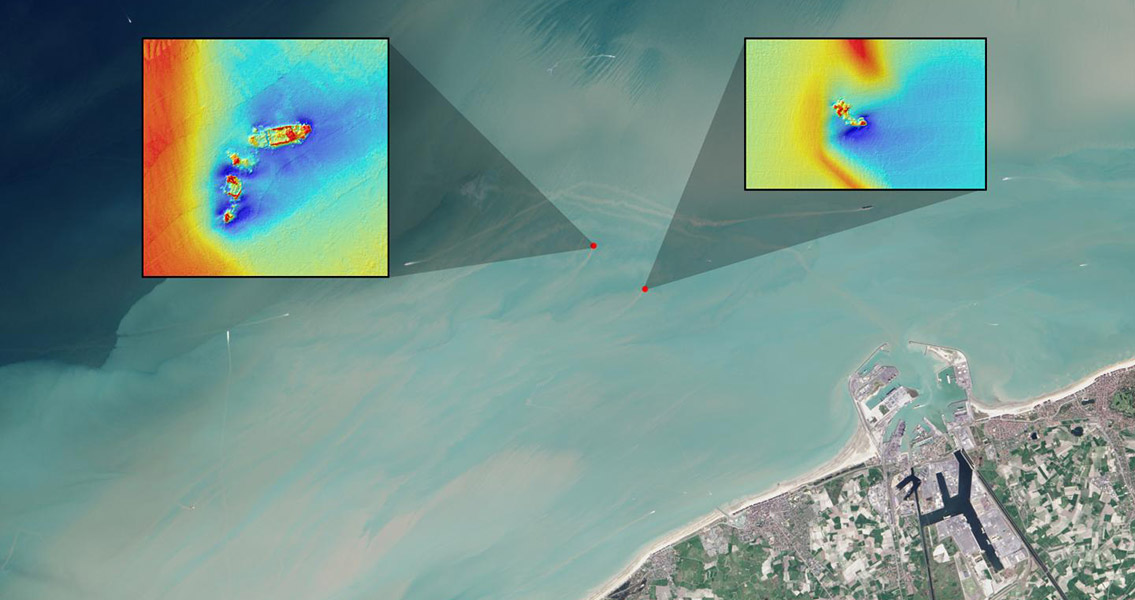
Journal of Archaeological Science. The team of researchers found that shipwrecks close to the coast can leave sediment plumes which are visible on the surface of the sea, revealing their location. Using free data from the Landsat 8 satellite, the team have detected plumes extending as far as 4 km downstream from the site of a shipwreck. It is the first study of its kind to show that Landsat 8 and similar satellites can be used to find shipwrecks in sediment heavy coastal waters. Around three million ships are scattered throughout the planet’s oceans, with the vast majority close to shore due to the abundance of navigational hazards in coastal areas. 25% of all the world’s shipwrecks are estimated to be in the North Atlantic. In particular, the narrow 100 mile stretch of the North Sea which separates England from the Netherlands and Belgium is saturated with Second World War wrecks, a consequence of mines, submarines and warships being deployed during the conflict to disrupt shipping between the Allies and Dutch and Belgian ports. So substantial is the potential environmental threat from these wrecks, the Council of Europe’s Parliamentary Assembly recommended they be mapped and monitored. This was the region that formed the focus of the researchers’ study. Taking the known locations of four shipwrecks from the Second World War: the SS Sansip, the SS Samvurn, the SS Nippon and the SS Neutron, as a starting point, the team mapped sediment plumes extending from the wrecks’ locations using Landsat 8 images and tidal models. They found that two of the wrecks which were mostly unburied created sediment plumes which could be measured during ebb and flow tides. The team suggest that the exposed parts of these ships create pits which fill with sediments during slack tides (when currents are reasonably still). During ebb and flow tides, the sediments are re-suspended in the water, creating the plumes which point to a shipwreck’s location. By mapping sediment plumes during different stages of the tides, the team postulate that it is possible to trace their origins and find as yet unearthed shipwrecks. As long as the waters in which a ship sank are shallow enough for the plumes to reach the surface, it is possible to detect them with optical satellites such as Landsat, according to the authors of the study. As coastal waters, where most shipwreck’s take place, are normally shallow and rich in sediment, the team’s findings could add a valuable new shipwreck detection method to the tool kit of marine archaeologists. Image courtesy of NASA/USGS Landsat image/Jesse Allen, NASA Earth Observatory]]>